Bu ırk rehberi şu an İngilizce sunuluyor. Bu dil için tam çeviri henüz hazır değil.
Tanıyan kuruluşlar
Bu ırkı listelerinde tutan bağımsız kayıt kuruluşları. Ayrıntı için rozete dokunun.
Bu statüler kuruluşların kayıt ve yarışma sistemlerindeki konumu gösterir; sağlık, kalite veya üstünlük puanı değildir.
Irk Özellikleri
Çok enerjik
Yüksek uyum
Düşük bakım ihtiyacı
Çok kolay eğitilir
Apartmanda iyi uyum
Çok kısa yalnızlık (birkaç saat)
Rehberlikle yönetilebilir
Genellikle diğer evcil hayvanlarla iyi anlaşır
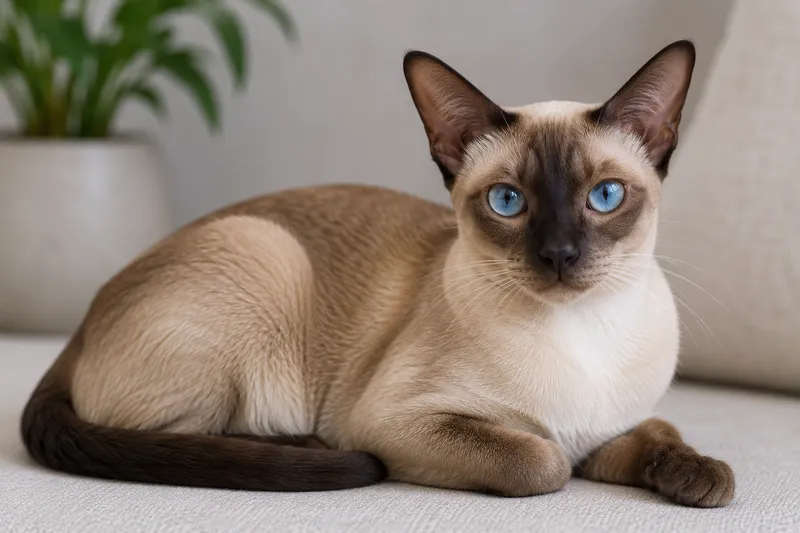
The Thai is a medium-sized, muscular and moderately elongated cat with balanced proportions, medium bone, a broad rounded upper head, and a distinctly tapering muzzle. Its ears are moderately large rather than extreme, and its oval blue eyes contribute to an alert, expressive appearance.
The short, fine coat displays the colorpoint pattern, with a pale central body and darker coloring on the face, ears, legs, feet, and tail. All Thai cats have blue eyes, while accepted point colors and patterns vary between registries. The coat is adapted to a warm climate and lies relatively close to the body without a heavy undercoat.
The breed is intended to preserve the moderate appearance of the indigenous pointed cats of Thailand and the Siamese cats seen in the West during the late nineteenth and early twentieth centuries. It is also known as the Wichienmaat or Old-Style Siamese. The informal term applehead is not an official breed name and does not automatically identify a pedigree Thai.
Are Thai cats good family pets?
Thai cats are often affectionate, playful, and highly involved family companions. They commonly live well with respectful children who understand gentle handling and enjoy regular interactive play.
Do Thai cats get along with other pets?
Well-socialized Thai cats generally have a good potential to live successfully with compatible cats and cat-friendly dogs. Introductions should still be gradual because individual temperament, age, and previous experience affect every relationship.
Can a Thai cat live in an apartment?
A Thai can live successfully in an apartment when provided with climbing space, energetic daily play, puzzle activities, scratching areas, and frequent companionship. Prospective owners should also be comfortable with an active and communicative cat.
Can Thai cats be left alone during the day?
Most adults can manage ordinary short absences, but the breed is poorly suited to frequent prolonged isolation. A predictable routine, extensive enrichment, and a compatible human or animal companion can help meet its strong social needs.
How much grooming does a Thai cat need?
The short coat normally needs only light weekly grooming. Dental hygiene, nail trimming, ear checks, and body-condition monitoring generally require more attention than coat maintenance.
What is the difference between a Thai and a modern Siamese?
The Thai preserves a more moderate body, medium bone, broader rounded upper head, and less extreme proportions. The modern Siamese is generally longer, finer boned, more tubular, and has a much longer wedge-shaped head with very large ears.
Is every applehead Siamese a Thai cat?
No. Applehead is an informal descriptive term rather than an official breed name. A round-headed colorpoint cat is not automatically a Thai, because pedigree, ancestry, complete physical type, and registry requirements also matter.
What health testing should a Thai breeder discuss?
There is no single universal Thai-specific testing panel. A responsible breeder should discuss family health and genetic diversity and explain whether PRA rdAc or any other line-specific testing is relevant to the pedigree.
- Tür
- Cat
Thai hakkında daha fazla
Pet profilleri ve genel hesaplar yakında açılacak. Şimdilik doğrulanmış ırk rehberlerini atlas’ta keşfedebilirsin.