

Thai
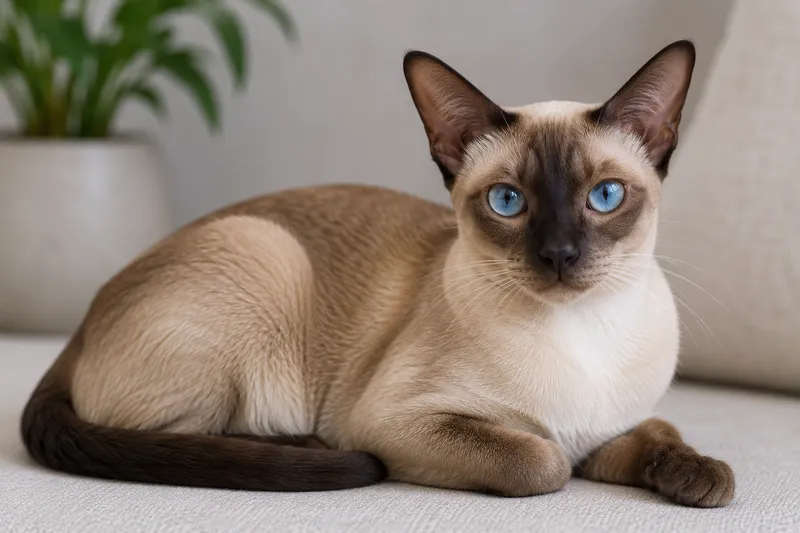
The Thai is a medium-sized, muscular and moderately elongated cat with balanced proportions, medium bone, a broad rounded upper head, and a distinctly tapering muzzle. Its ears are moderately large rather than extreme,…
Recognized by: FIFe · TICA
Size
Medium
Weight
3.2–5.4 kg
Life span
15–20 years
Breed Traits
Energy Level
Very energetic
Energy Level: 5 of 5
Low energyHigh energyChild / Family Compatibility
High compatibility
Child / Family Compatibility: 4 of 5
Low compatibilityHigh compatibilityGrooming Need
Low grooming need
Grooming Need: 1 of 5
Low maintenanceHigh maintenanceTrainability
Very easy to train
Trainability: 5 of 5
Hard to trainEasy to trainApartment / Home Suitability
Fits apartments well
Apartment / Home Suitability: 4 of 5
Needs space / yardExcellent for apartmentsAlone-Time Tolerance
Very short alone time (a few hours)
Alone-Time Tolerance: 1 of 5
Needs frequent companyHandles long alone timeFirst-Time Owner Suitability
Manageable with guidance
First-Time Owner Suitability: 3 of 5
Needs experienced ownerGreat for first-time ownersCompatibility with Other Pets
Generally gets along well with other pets
Compatibility with Other Pets: 4 of 5
Single-pet homes are a better fitHighly compatible with other animals
The Thai is a medium-sized, muscular and moderately elongated cat with balanced proportions, medium bone, a broad rounded upper head, and a distinctly tapering muzzle. Its ears are moderately large rather than extreme, and its oval blue eyes contribute to an alert, expressive appearance.
The short, fine coat displays the colorpoint pattern, with a pale central body and darker coloring on the face, ears, legs, feet, and tail. All Thai cats have blue eyes, while accepted point colors and patterns vary between registries. The coat is adapted to a warm climate and lies relatively close to the body without a heavy undercoat.
The breed is intended to preserve the moderate appearance of the indigenous pointed cats of Thailand and the Siamese cats seen in the West during the late nineteenth and early twentieth centuries. It is also known as the Wichienmaat or Old-Style Siamese. The informal term applehead is not an official breed name and does not automatically identify a pedigree Thai.
Thai cats are generally affectionate, confident, curious, intelligent, and intensely interested in their household. Many greet familiar people at the door, follow them between rooms, seek lap or shoulder contact, and attempt to participate in almost every daily activity.
They are highly communicative and often use chirps, conversational meows, body language, and gentle paw touches to request attention. Although individual voices vary, prospective owners should expect a cat that regularly expresses its needs and responds when spoken to.
Thais remain active and playful throughout much of adulthood and commonly enjoy retrieving, climbing, puzzle feeders, clicker training, and interactive games. Their strong social attachment makes them poorly suited to frequent prolonged isolation, and they often live successfully with respectful children and compatible companion animals.
The short, fine coat is very easy to maintain and normally needs only gentle weekly brushing or wiping with a soft grooming cloth. Frequent bathing is unnecessary unless the coat becomes contaminated or an individual cat has a specific medical or hygiene need.
Daily life should include energetic interactive play, secure climbing furniture, scratching surfaces, puzzle activities, and frequent social engagement. Thai cats can adapt well to apartment living, but a small home must still provide enough exercise, vertical space, mental stimulation, and companionship.
Routine care should include dental hygiene, nail trimming, ear checks, body-condition monitoring, and regular veterinary examinations. Their athletic build should remain firm and muscular, so food portions should be adjusted according to the individual cat's age, activity, and body condition.
The Thai is generally regarded as a healthy natural and preservation breed, and current evidence does not establish a single common inherited disorder that defines the entire population. Maintaining genetic diversity, avoiding unnecessarily close matings, and recording family health remain important because a small pedigree population can still develop line-specific problems.
Progressive retinal atrophy rdAc, associated with a recessive CEP290 variant, occurs in several modern Siamese-related populations. However, one published survey found no copies of this variant in its limited samples of recently imported Thai cats or rounder-headed traditional Siamese. The small sample size cannot prove that the variant is absent from every Thai line, so testing may still be discussed when pedigrees contain modern Siamese-related ancestry or when a breeder's programme identifies a specific reason.
There is currently no universal DNA panel capable of guaranteeing the health of every Thai cat. Prospective owners should ask about family longevity, eye health, mobility, dental disease, heart and kidney health, known illnesses, causes of death, genetic diversity, and veterinary screening practices. This information is for general educational purposes and is not a substitute for diagnosis or treatment by a veterinarian.
Recognizing organizations
Independent registries that list this breed. Tap a badge to learn more.
These statuses reflect each registry’s recording and show systems. They are not a health, quality, or superiority score.
Frequently asked questions
Are Thai cats good family pets?
Thai cats are often affectionate, playful, and highly involved family companions. They commonly live well with respectful children who understand gentle handling and enjoy regular interactive play.
Do Thai cats get along with other pets?
Well-socialized Thai cats generally have a good potential to live successfully with compatible cats and cat-friendly dogs. Introductions should still be gradual because individual temperament, age, and previous experience affect every relationship.
Can a Thai cat live in an apartment?
A Thai can live successfully in an apartment when provided with climbing space, energetic daily play, puzzle activities, scratching areas, and frequent companionship. Prospective owners should also be comfortable with an active and communicative cat.
Can Thai cats be left alone during the day?
Most adults can manage ordinary short absences, but the breed is poorly suited to frequent prolonged isolation. A predictable routine, extensive enrichment, and a compatible human or animal companion can help meet its strong social needs.
How much grooming does a Thai cat need?
The short coat normally needs only light weekly grooming. Dental hygiene, nail trimming, ear checks, and body-condition monitoring generally require more attention than coat maintenance.
What is the difference between a Thai and a modern Siamese?
The Thai preserves a more moderate body, medium bone, broader rounded upper head, and less extreme proportions. The modern Siamese is generally longer, finer boned, more tubular, and has a much longer wedge-shaped head with very large ears.
Is every applehead Siamese a Thai cat?
No. Applehead is an informal descriptive term rather than an official breed name. A round-headed colorpoint cat is not automatically a Thai, because pedigree, ancestry, complete physical type, and registry requirements also matter.
What health testing should a Thai breeder discuss?
There is no single universal Thai-specific testing panel. A responsible breeder should discuss family health and genetic diversity and explain whether PRA rdAc or any other line-specific testing is relevant to the pedigree.
More about Thai
Pet profiles are coming soon. For now, keep exploring trusted breed knowledge in the Breed Guide.
Back to Breed Guide