Bu ırk rehberi şu an İngilizce sunuluyor. Bu dil için tam çeviri henüz hazır değil.
Tanıyan kuruluşlar
Bu ırkı listelerinde tutan bağımsız kayıt kuruluşları. Ayrıntı için rozete dokunun.
Bu statüler kuruluşların kayıt ve yarışma sistemlerindeki konumu gösterir; sağlık, kalite veya üstünlük puanı değildir.
Irk Özellikleri
Çok enerjik
Orta uyum
Düşük bakım ihtiyacı
Çok kolay eğitilir
Küçük alanda zorlanır
Yarım gün zorlanır
Yeni başlayanlar için zorlayıcı
Doğru sosyalleştirmeyle uyum sağlayabilir
The Savannah is a hybrid-derived pedigree cat developed from crosses between the African serval and domestic cats. The first documented Savannah kitten was born in the United States in 1986, and an organized breeding programme later established a domestic population with a written standard. TICA accepted the breed for registration in 2001 and granted Championship status in 2012.
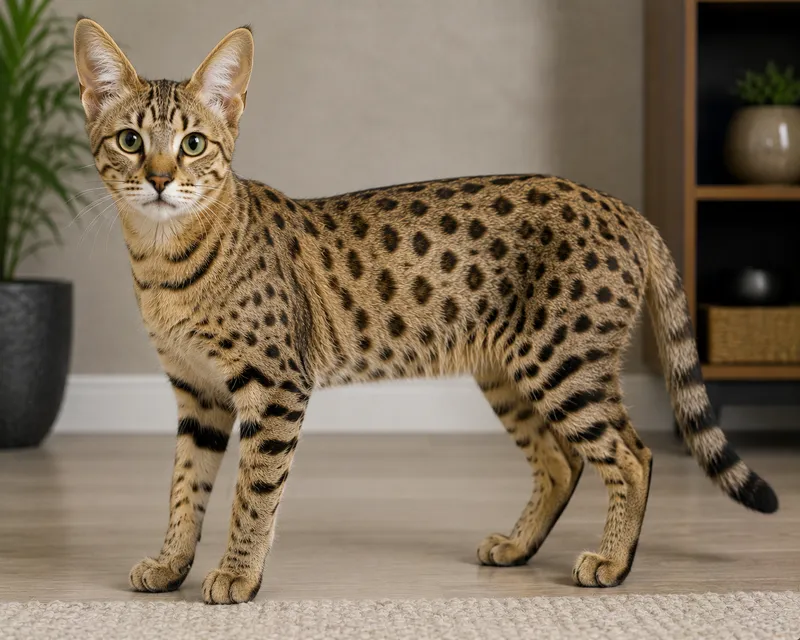
A typical Savannah is tall, lean, and athletic, with exceptionally long legs, a long neck, a relatively small head, large upright ears, hooded eyes, and a medium-length tail. Its height and proportions can make it appear heavier than it is. Adult size varies considerably with sex, domestic ancestry, and distance from the serval foundation cross.
Recognised TICA colours are brown black spotted tabby, silver spotted tabby, black, and black smoke. The spotted forms should have distinct dark markings that reinforce the serval-like outline without making the Savannah a miniature serval. Filial labels such as F1, F2, and later generations describe distance from a serval ancestor, while SBT is a pedigree registration classification associated with established Savannah-to-Savannah breeding.
Are Savannah cats good family pets?
A well-socialized later-generation Savannah can be an involved and affectionate companion in a prepared household. The breed's intensity, strength, activity level, and generation-dependent behaviour mean it is better suited to families willing to provide structured play, training, secure spaces, and consistent boundaries.
Are Savannah cats good with children?
Some Savannahs live successfully with confident, respectful older children who understand feline body language. Young children should always be supervised because rough handling, chasing, or highly physical play can frighten the cat or lead to accidental injury.
Do Savannah cats get along with other pets?
Many later-generation Savannahs can live with compatible cats or active cat-friendly dogs after careful introductions. Their strong chase and hunting behaviour may make birds, rodents, reptiles, aquarium animals, and other small pets unsafe housemates.
Can a Savannah cat live in an apartment?
Apartment living is possible but demanding because the Savannah needs substantial vertical territory, vigorous daily exercise, training, and secure enrichment. A small or minimally furnished home that cannot accommodate climbing, jumping, and frequent interactive activity is unlikely to be suitable.
Can Savannah cats be left alone during the day?
Many adults can tolerate ordinary short absences, but repeated prolonged isolation is a poor match for this active and socially involved breed. Puzzle activities and compatible animal companionship may help, but they do not replace dependable daily interaction and exercise.
How much grooming does a Savannah need?
The short coat generally needs only light weekly brushing and occasional additional grooming during shedding. Dental hygiene, nail care, ear observation, parasite prevention, and body-condition monitoring usually require more attention than coat maintenance.
What is the difference between F1, F2, and SBT Savannah cats?
F1 cats have a serval parent, while F2 and later filial labels indicate progressively greater generational distance from a serval ancestor. SBT is a TICA pedigree classification associated with established Savannah breeding, and SBT cats are generally more predictable as domestic companions than early-generation hybrids, although individuals still vary.
What health and legal checks are important before obtaining a Savannah?
Ask for the cat's generation, pedigree, veterinary records, PKLR testing, ancestry-appropriate PRA results, cardiac screening information, and family health history. Confirm local ownership, import, housing, and insurance rules before paying a deposit because restrictions may depend on jurisdiction or generation.
- Tür
- Cat
Savannah hakkında daha fazla
Pet profilleri ve genel hesaplar yakında açılacak. Şimdilik doğrulanmış ırk rehberlerini atlas’ta keşfedebilirsin.