

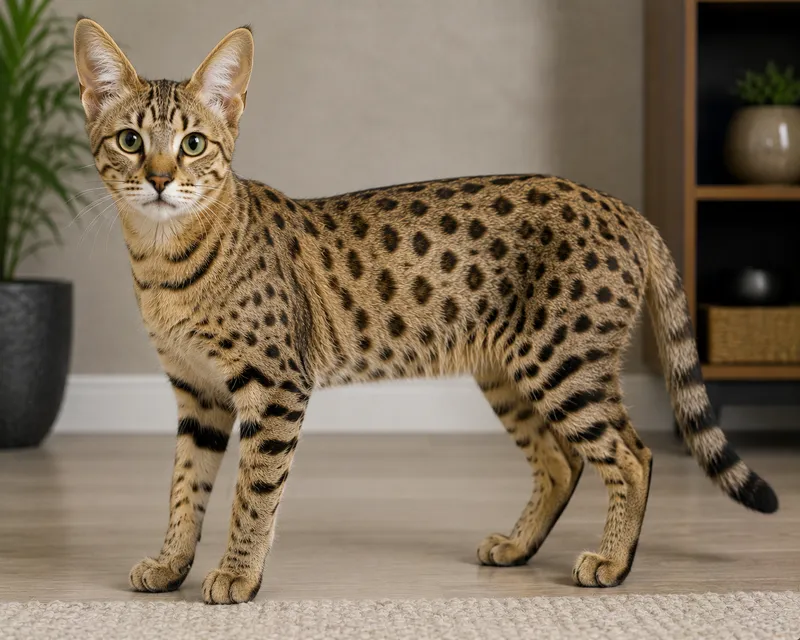
Savannah
The Savannah is a hybrid-derived pedigree cat developed from crosses between the African serval and domestic cats. The first documented Savannah kitten was born in the United States in 1986, and an organized breeding…
Recognized by: TICA
Size
Large
Weight
3.6–9.1 kg
Life span
12–15 years
Breed Traits
Energy Level
Very energetic
Energy Level: 5 of 5
Low energyHigh energyChild / Family Compatibility
Moderate compatibility
Child / Family Compatibility: 3 of 5
Low compatibilityHigh compatibilityGrooming Need
Low grooming need
Grooming Need: 1 of 5
Low maintenanceHigh maintenanceTrainability
Very easy to train
Trainability: 5 of 5
Hard to trainEasy to trainApartment / Home Suitability
Struggles in small spaces
Apartment / Home Suitability: 2 of 5
Needs space / yardExcellent for apartmentsAlone-Time Tolerance
Half-day is hard
Alone-Time Tolerance: 2 of 5
Needs frequent companyHandles long alone timeFirst-Time Owner Suitability
Challenging for beginners
First-Time Owner Suitability: 2 of 5
Needs experienced ownerGreat for first-time ownersCompatibility with Other Pets
Can adapt with proper socialization
Compatibility with Other Pets: 3 of 5
Single-pet homes are a better fitHighly compatible with other animals
The Savannah is a hybrid-derived pedigree cat developed from crosses between the African serval and domestic cats. The first documented Savannah kitten was born in the United States in 1986, and an organized breeding programme later established a domestic population with a written standard. TICA accepted the breed for registration in 2001 and granted Championship status in 2012.
A typical Savannah is tall, lean, and athletic, with exceptionally long legs, a long neck, a relatively small head, large upright ears, hooded eyes, and a medium-length tail. Its height and proportions can make it appear heavier than it is. Adult size varies considerably with sex, domestic ancestry, and distance from the serval foundation cross.
Recognised TICA colours are brown black spotted tabby, silver spotted tabby, black, and black smoke. The spotted forms should have distinct dark markings that reinforce the serval-like outline without making the Savannah a miniature serval. Filial labels such as F1, F2, and later generations describe distance from a serval ancestor, while SBT is a pedigree registration classification associated with established Savannah-to-Savannah breeding.
Savannahs are generally highly active, intelligent, assertive, and intensely curious. Many form strong bonds with familiar people, follow household activity, learn routines quickly, and investigate doors, cupboards, taps, and objects that less persistent cats might ignore. Affection is often expressed through proximity, play, greetings, or head rubs rather than prolonged lap sitting.
They commonly enjoy retrieving toys, food puzzles, harness training, climbing, running, and jumping to unusually high resting places. Some individuals investigate or play with water, but this is not guaranteed. Daily structured activity is essential because an under-stimulated Savannah may create its own entertainment through climbing, opening, chewing, or knocking objects down.
Temperament and management needs can differ between early-generation hybrids and later-generation pedigreed Savannahs. Well-socialized later-generation cats may live successfully in prepared family homes, but this is not generally a low-demand breed. Prospective owners should assess the individual cat's generation, upbringing, confidence, handling history, and previous experience rather than relying only on a broad breed description.
The short coat has little heavy undercoat and usually needs only light weekly brushing. Routine care should also include nail trimming, visible ear checks, dental hygiene, clean litter facilities, body-condition monitoring, and regular veterinary examinations. A complete life-stage-appropriate domestic cat diet is suitable; serval ancestry does not by itself create a requirement for raw meat or an exotic diet.
Savannahs require extensive daily enrichment. Tall, stable climbing structures, large scratching surfaces, interactive toys, puzzle feeders, training sessions, and vigorous play help provide appropriate outlets. Breakable objects, toxic plants, electrical cords, doors, cupboards, windows, and balconies should be secured for a powerful cat capable of high jumps and persistent exploration.
Outdoor access should be limited to secure enclosures or properly conditioned harness activity where lawful and safe. Free roaming creates risks to the cat and local wildlife and may violate regulations in some locations. Before acquiring a Savannah, owners should confirm local rules, housing restrictions, insurance conditions, and veterinary access because legal treatment can differ by jurisdiction and generation.
Large, long-term studies defining disease prevalence across Savannah generations remain limited. A PKLR variant causing autosomal recessive erythrocyte pyruvate kinase deficiency has been detected in sampled Savannahs, and published research recommends testing the breed. The available Savannah sample was small, so the finding supports screening but does not establish that the disorder is common throughout the breed.
TICA also recommends progressive retinal atrophy screening and reports a history of hypertrophic cardiomyopathy in some Savannah lines. No Savannah-specific HCM DNA test is established, so cardiac evaluation should be guided by veterinary examination, family history, and breeder screening practices. PRA testing should be selected according to the domestic breeds and variants present in the cat's ancestry rather than treated as a universal guarantee.
Male infertility is expected in F1 and other early backcross generations because of genetic incompatibility between the serval and domestic cat genomes; fertility generally returns in later generations but can vary. Prospective owners should request the cat's generation and pedigree, PKLR and relevant PRA results, cardiac screening information, family longevity, and records of known disease while remembering that a DNA result does not guarantee overall health. This information is for general educational purposes and is not a substitute for diagnosis or treatment by a veterinarian.
Recognizing organizations
Independent registries that list this breed. Tap a badge to learn more.
These statuses reflect each registry’s recording and show systems. They are not a health, quality, or superiority score.
Frequently asked questions
Are Savannah cats good family pets?
A well-socialized later-generation Savannah can be an involved and affectionate companion in a prepared household. The breed's intensity, strength, activity level, and generation-dependent behaviour mean it is better suited to families willing to provide structured play, training, secure spaces, and consistent boundaries.
Are Savannah cats good with children?
Some Savannahs live successfully with confident, respectful older children who understand feline body language. Young children should always be supervised because rough handling, chasing, or highly physical play can frighten the cat or lead to accidental injury.
Do Savannah cats get along with other pets?
Many later-generation Savannahs can live with compatible cats or active cat-friendly dogs after careful introductions. Their strong chase and hunting behaviour may make birds, rodents, reptiles, aquarium animals, and other small pets unsafe housemates.
Can a Savannah cat live in an apartment?
Apartment living is possible but demanding because the Savannah needs substantial vertical territory, vigorous daily exercise, training, and secure enrichment. A small or minimally furnished home that cannot accommodate climbing, jumping, and frequent interactive activity is unlikely to be suitable.
Can Savannah cats be left alone during the day?
Many adults can tolerate ordinary short absences, but repeated prolonged isolation is a poor match for this active and socially involved breed. Puzzle activities and compatible animal companionship may help, but they do not replace dependable daily interaction and exercise.
How much grooming does a Savannah need?
The short coat generally needs only light weekly brushing and occasional additional grooming during shedding. Dental hygiene, nail care, ear observation, parasite prevention, and body-condition monitoring usually require more attention than coat maintenance.
What is the difference between F1, F2, and SBT Savannah cats?
F1 cats have a serval parent, while F2 and later filial labels indicate progressively greater generational distance from a serval ancestor. SBT is a TICA pedigree classification associated with established Savannah breeding, and SBT cats are generally more predictable as domestic companions than early-generation hybrids, although individuals still vary.
What health and legal checks are important before obtaining a Savannah?
Ask for the cat's generation, pedigree, veterinary records, PKLR testing, ancestry-appropriate PRA results, cardiac screening information, and family health history. Confirm local ownership, import, housing, and insurance rules before paying a deposit because restrictions may depend on jurisdiction or generation.
More about Savannah
Pet profiles are coming soon. For now, keep exploring trusted breed knowledge in the Breed Guide.
Back to Breed Guide