Bu ırk rehberi şu an İngilizce sunuluyor. Bu dil için tam çeviri henüz hazır değil.
Tanıyan kuruluşlar
Bu ırkı listelerinde tutan bağımsız kayıt kuruluşları. Ayrıntı için rozete dokunun.
Bu statüler kuruluşların kayıt ve yarışma sistemlerindeki konumu gösterir; sağlık, kalite veya üstünlük puanı değildir.
Irk Özellikleri
Düşük enerji
Yüksek uyum
Yoğun bakım ihtiyacı
Orta eğitilebilirlik
Apartmana çok uygun
Tipik iş günü idare eder
Yeni başlayanlar için zorlayıcı
Genellikle diğer evcil hayvanlarla iyi anlaşır
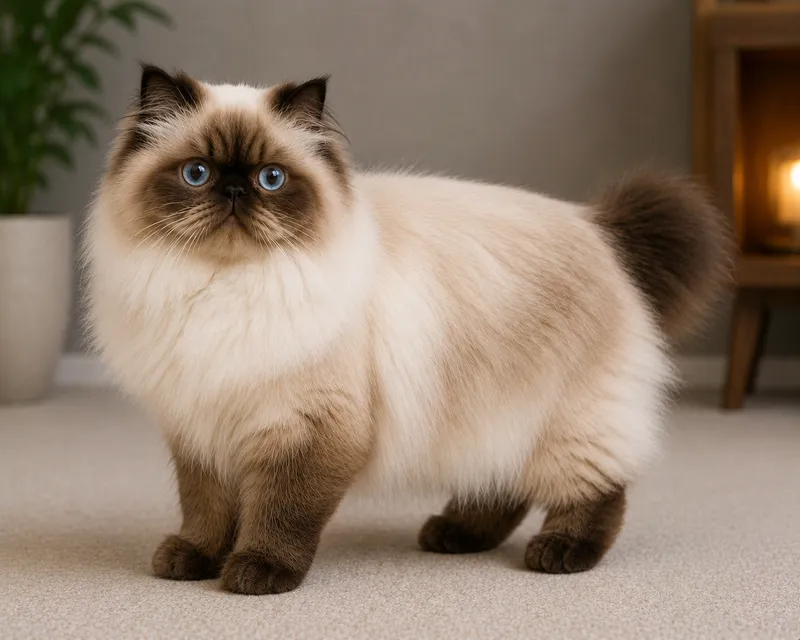
The Himalayan is a longhaired colorpoint cat developed by combining Persian type with the temperature-sensitive pointed pattern historically associated with Siamese cats. Experimental breeding work was documented in the United States during the 1930s, followed by additional programs in Britain and North America during the 1950s. Registry classification now varies: some organizations treat the Himalayan as a distinct member of the Persian breed group, while others classify it as the pointed division or colour variety of the Persian.
A typical Himalayan is medium to large, heavily boned, and cobby, with a broad chest, short strong legs, a short well-furnished tail, and a large rounded head. The eyes are large, round, widely spaced, and deep blue. The nose is short and broad, although the degree of facial shortening differs between breeding lines and has important welfare implications.
The coat is long, dense, fine, and flowing, with a full ruff and substantial undercoat. The body is lighter than the cooler points of the face, ears, legs, feet, and tail. Accepted point colours and patterns vary by registry and may include seal, blue, chocolate, lilac, red, cream, tortie, and tabby or lynx point combinations.
Are Himalayan cats good family pets?
Himalayans can be affectionate and calm family companions in homes that provide gentle handling, daily grooming, and regular health monitoring. They usually prefer predictable routines and quiet interaction over constant noise or boisterous activity.
Are Himalayan cats good with children?
Many well-socialized Himalayans live successfully with respectful children. Children should avoid rough play, support the cat's body when lifting, and allow the cat to retreat when it wants rest.
Do Himalayan cats get along with other pets?
Himalayans often adapt to compatible cats and calm cat-friendly dogs after gradual introductions. A very energetic or intrusive companion may overwhelm a quiet individual, so each animal needs separate resources and resting space.
Can a Himalayan cat live in an apartment?
The breed is generally well suited to apartment living because of its moderate activity level. The home should still provide daily play, scratching areas, stable low climbing options, temperature control, and secure windows or balconies.
Can Himalayan cats be left alone during the day?
Many adults can manage ordinary workday absences when their routine is predictable and their needs are met before and after. Frequent prolonged isolation is not ideal, and coat, eye, breathing, eating, and litter-box problems may go unnoticed without daily observation.
How much grooming does a Himalayan need?
A Himalayan usually needs thorough daily combing because the long dense coat and undercoat can mat quickly. The eye area may also require daily gentle cleaning, and some cats need professional grooming support when coat care cannot be maintained comfortably at home.
Is the Himalayan a separate breed or a type of Persian?
The answer depends on the registry. TICA lists the Himalayan within the Persian Breed Group, while CFA places Himalayans in a Persian division; FIFe and GCCF recognise the same general phenotype as pointed or Colourpoint Persian varieties. BondPals maintains Himalayan as a separate registry entry and Atlas page.
What health screening should a Himalayan breeder provide?
Documented PKD1 testing is especially important because the variant is established in Persian and Persian-derived cats. Depending on ancestry and the breeding program, Persian PRA testing, veterinary eye assessment, evaluation of breathing and nostril openness, dental alignment, and family health history may also be relevant.
- Tür
- Cat
Himalayan hakkında daha fazla
Pet profilleri ve genel hesaplar yakında açılacak. Şimdilik doğrulanmış ırk rehberlerini atlas’ta keşfedebilirsin.