

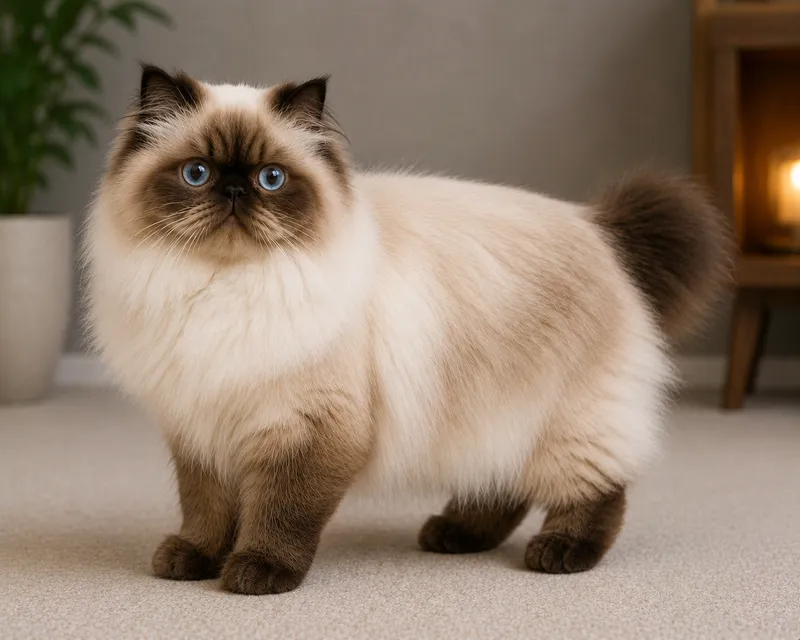
Himalayan
The Himalayan is a longhaired colorpoint cat developed by combining Persian type with the temperature-sensitive pointed pattern historically associated with Siamese cats. Experimental breeding work was documented in the…
Recognized by: CFA · FIFe · +2
Size
Medium
Weight
2.7–5.5 kg
Life span
8–16 years
Breed Traits
Energy Level
Low energy
Energy Level: 2 of 5
Low energyHigh energyChild / Family Compatibility
High compatibility
Child / Family Compatibility: 4 of 5
Low compatibilityHigh compatibilityGrooming Need
Intensive grooming need
Grooming Need: 5 of 5
Low maintenanceHigh maintenanceTrainability
Moderately trainable
Trainability: 3 of 5
Hard to trainEasy to trainApartment / Home Suitability
Excellent apartment fit
Apartment / Home Suitability: 5 of 5
Needs space / yardExcellent for apartmentsAlone-Time Tolerance
Handles a typical workday
Alone-Time Tolerance: 3 of 5
Needs frequent companyHandles long alone timeFirst-Time Owner Suitability
Challenging for beginners
First-Time Owner Suitability: 2 of 5
Needs experienced ownerGreat for first-time ownersCompatibility with Other Pets
Generally gets along well with other pets
Compatibility with Other Pets: 4 of 5
Single-pet homes are a better fitHighly compatible with other animals
The Himalayan is a longhaired colorpoint cat developed by combining Persian type with the temperature-sensitive pointed pattern historically associated with Siamese cats. Experimental breeding work was documented in the United States during the 1930s, followed by additional programs in Britain and North America during the 1950s. Registry classification now varies: some organizations treat the Himalayan as a distinct member of the Persian breed group, while others classify it as the pointed division or colour variety of the Persian.
A typical Himalayan is medium to large, heavily boned, and cobby, with a broad chest, short strong legs, a short well-furnished tail, and a large rounded head. The eyes are large, round, widely spaced, and deep blue. The nose is short and broad, although the degree of facial shortening differs between breeding lines and has important welfare implications.
The coat is long, dense, fine, and flowing, with a full ruff and substantial undercoat. The body is lighter than the cooler points of the face, ears, legs, feet, and tail. Accepted point colours and patterns vary by registry and may include seal, blue, chocolate, lilac, red, cream, tortie, and tabby or lynx point combinations.
Himalayans are generally described as gentle, affectionate, quiet, and most comfortable in a calm, predictable household. Many enjoy sitting beside or on familiar people, communicating with a soft voice, and observing family activity without demanding constant movement or attention.
They usually prefer short sessions of interactive play to prolonged high-intensity exercise. Wand toys, rolling balls, food puzzles, and low stable climbing furniture can encourage activity while respecting the cat's build, coat, and individual breathing capacity.
Well-socialized Himalayans may live successfully with respectful children, compatible cats, and calm cat-friendly dogs. They can be sensitive to rough handling, noise, or highly energetic companions, so introductions should be gradual and the cat should always have quiet resting areas.
The dense long coat requires daily combing to prevent tangles and mats, with particular attention to the chest, belly, armpits, hindquarters, and areas behind the ears. Some cats also benefit from periodic bathing and careful drying, but grooming routines should be introduced gradually and never cause distress or overheating.
Large eyes and shortened facial anatomy can contribute to tear overflow and facial staining. Wipe the eye area gently with a separate clean, damp pad for each eye, keep facial folds and surrounding hair dry, and seek veterinary assessment for squinting, redness, cloudiness, discharge, pain, or a sudden change in tear production.
Provide measured portions of a complete life-stage-appropriate diet, daily gentle play, dental hygiene, nail care, and clean litter facilities. Monitor body condition because excess weight can worsen mobility and breathing. A cool indoor environment, open access to fresh water, and avoidance of strenuous activity during heat are especially important for cats with more extreme facial shortening.
Polycystic kidney disease caused by a dominant PKD1 variant is well documented in Persian and Persian-derived cats, and the Himalayan is considered appropriate for testing. Responsible breeding programs should use documented PKD1 results and relevant veterinary evaluation; current prevalence can differ between populations, and a negative result applies only to the tested variant rather than every possible kidney disorder.
Brachycephalic facial conformation may affect breathing, tear drainage, corneal protection, and dental alignment. Research in Persian-type cats shows that more extreme skull shortening is associated with greater eye exposure, reduced dimensions at parts of the nasal airway, and increased dental displacement. Noisy or laboured breathing, exercise or heat intolerance, persistent eye irritation, corneal injury, or difficulty eating should not be dismissed as normal for the breed.
An early-onset recessive form of progressive retinal atrophy has also been identified in Persian lines, and ancestry-appropriate PRA testing may be relevant for Himalayan breeding cats. Prospective owners should request family health history, veterinary records, and available PKD1 and PRA results, while remembering that a DNA result does not guarantee overall health. This information is for general educational purposes and is not a substitute for diagnosis or treatment by a veterinarian.
Recognizing organizations
Independent registries that list this breed. Tap a badge to learn more.
These statuses reflect each registry’s recording and show systems. They are not a health, quality, or superiority score.
CFAChampionshiphttps://cfa.org/breed/persian/ FIFeFully recognisedPointed Persian — Fully recognisedhttps://fifeweb.org/cats/breeds/persian/ GCCFChampionship statusColourpoint Persian — Championship statushttps://www.gccfcats.org/getting-a-cat/choosing/cat-breeds/persian/ TICAChampionshiphttps://tica.org/breed/himalayan/
Frequently asked questions
Are Himalayan cats good family pets?
Himalayans can be affectionate and calm family companions in homes that provide gentle handling, daily grooming, and regular health monitoring. They usually prefer predictable routines and quiet interaction over constant noise or boisterous activity.
Are Himalayan cats good with children?
Many well-socialized Himalayans live successfully with respectful children. Children should avoid rough play, support the cat's body when lifting, and allow the cat to retreat when it wants rest.
Do Himalayan cats get along with other pets?
Himalayans often adapt to compatible cats and calm cat-friendly dogs after gradual introductions. A very energetic or intrusive companion may overwhelm a quiet individual, so each animal needs separate resources and resting space.
Can a Himalayan cat live in an apartment?
The breed is generally well suited to apartment living because of its moderate activity level. The home should still provide daily play, scratching areas, stable low climbing options, temperature control, and secure windows or balconies.
Can Himalayan cats be left alone during the day?
Many adults can manage ordinary workday absences when their routine is predictable and their needs are met before and after. Frequent prolonged isolation is not ideal, and coat, eye, breathing, eating, and litter-box problems may go unnoticed without daily observation.
How much grooming does a Himalayan need?
A Himalayan usually needs thorough daily combing because the long dense coat and undercoat can mat quickly. The eye area may also require daily gentle cleaning, and some cats need professional grooming support when coat care cannot be maintained comfortably at home.
Is the Himalayan a separate breed or a type of Persian?
The answer depends on the registry. TICA lists the Himalayan within the Persian Breed Group, while CFA places Himalayans in a Persian division; FIFe and GCCF recognise the same general phenotype as pointed or Colourpoint Persian varieties. BondPals maintains Himalayan as a separate registry entry and Atlas page.
What health screening should a Himalayan breeder provide?
Documented PKD1 testing is especially important because the variant is established in Persian and Persian-derived cats. Depending on ancestry and the breeding program, Persian PRA testing, veterinary eye assessment, evaluation of breathing and nostril openness, dental alignment, and family health history may also be relevant.
More about Himalayan
Pet profiles are coming soon. For now, keep exploring trusted breed knowledge in the Breed Guide.
Back to Breed Guide