

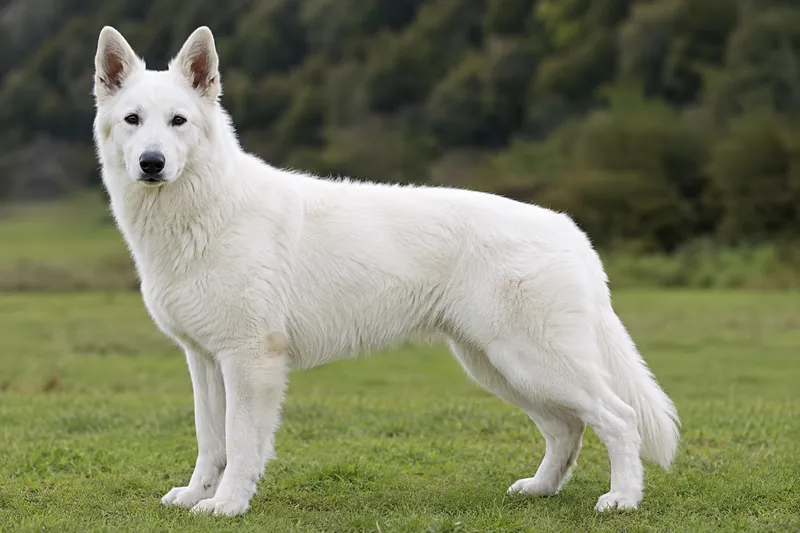
White Swiss Shepherd Dog
The White Swiss Shepherd Dog, also known by the French name Berger Blanc Suisse, is a large, athletic shepherd with erect natural ears, a moderately long body, and a bushy sabre-shaped tail. Its weather-resistant double…
Recognized by: ANKC · FCI · +1
Size
Large
Weight
25–40 kg
Life span
10–14 years
Breed Traits
Energy Level
Very energetic
Energy Level: 5 of 5
Low energyHigh energyChild / Family Compatibility
High compatibility
Child / Family Compatibility: 4 of 5
Low compatibilityHigh compatibilityGrooming Need
High grooming need
Grooming Need: 4 of 5
Low maintenanceHigh maintenanceTrainability
Very easy to train
Trainability: 5 of 5
Hard to trainEasy to trainApartment / Home Suitability
Struggles in small spaces
Apartment / Home Suitability: 2 of 5
Needs space / yardExcellent for apartmentsAlone-Time Tolerance
Half-day is hard
Alone-Time Tolerance: 2 of 5
Needs frequent companyHandles long alone timeFirst-Time Owner Suitability
Manageable with guidance
First-Time Owner Suitability: 3 of 5
Needs experienced ownerGreat for first-time ownersCompatibility with Other Pets
Generally gets along well with other pets
Compatibility with Other Pets: 4 of 5
Single-pet homes are a better fitHighly compatible with other animals
The White Swiss Shepherd Dog, also known by the French name Berger Blanc Suisse, is a large, athletic shepherd with erect natural ears, a moderately long body, and a bushy sabre-shaped tail. Its weather-resistant double coat may be medium-length or long and is white, while dark pigmentation of the skin, nose, lips, eye rims, and pads is desirable; the breed is not defined by albinism.
The breed developed in Switzerland from white shepherd dogs imported from the United States and Canada during the 1970s. These dogs were entered in the Swiss stud book as a new breed from 1991, and the FCI later recognized the White Swiss Shepherd Dog definitively under Switzerland rather than treating it only as a German Shepherd color variety.
Although the two breeds share historical ancestry and remain visibly related, the White Swiss Shepherd Dog has its own international standard and breeding population. Functional structure, a level and firm back, balanced movement, stable temperament, and freedom from exaggeration should take priority over coat length or a dramatic show-ring appearance.
White Swiss Shepherd Dogs are commonly lively, attentive, intelligent, and deeply devoted to their households. They often enjoy learning and working with people, but their alertness and physical energy require purposeful outlets rather than passive companionship alone.
The standard describes a friendly, adaptable dog that may be discreet or slightly reserved with unfamiliar people without being fearful or needlessly aggressive. Early positive socialization is important because insufficient exposure, harsh treatment, or prolonged isolation can contribute to anxiety or over-reactive behavior in a sensitive individual.
Reward-based training generally suits the breed's responsiveness and willingness to cooperate. Calm practice in settling, loose-leash walking, recall, handling, and polite greetings should begin early, while household compatibility with children and other animals must still be assessed for each individual dog.
A White Swiss Shepherd Dog needs substantial daily physical activity together with mental work. Brisk walks, hiking after physical maturity, scent games, obedience, herding-style activities, and structured play can meet these needs, while young puppies should avoid repetitive high-impact exercise as their joints develop.
Both coat varieties have a dense undercoat and shed throughout the year, with heavier seasonal coat changes. Brush several times each week and more often during heavy shedding, while maintaining the nails, teeth, and erect ears and checking the skin beneath the pale coat.
This social working breed benefits from regular involvement in family life and is not well suited to long periods of isolation or confinement without meaningful activity. Secure fencing, consistent training, a lean body condition, and a complete diet appropriate for large-breed growth help support safe daily management.
Health concerns reported in White Swiss Shepherd Dogs include hip and elbow dysplasia, degenerative myelopathy, and the MDR1 drug-sensitivity variant. Eye, thyroid, and cardiac findings may also occur, and no screening program can predict every condition that an individual dog may develop.
Responsible breeding assessment should include recognized hip and elbow evaluations. More comprehensive breed-club guidance also recommends cardiac and ophthalmologist examinations, thyroid evaluation, and DNA results for degenerative myelopathy and MDR1; a DM result indicates genetic risk information rather than certainty that a dog will or will not develop the disease.
Owners should ensure that the veterinarian knows a dog's MDR1 status before medications are selected, without changing or withholding treatment independently. Persistent lameness, reduced coordination, exercise intolerance, fainting, vision changes, or unusual adverse reactions warrants prompt veterinary assessment, and prospective buyers should request independently verifiable results for both parents.
This information is for general educational purposes and is not a substitute for diagnosis or treatment by a veterinarian.
Recognizing organizations
Independent registries that list this breed. Tap a badge to learn more.
These statuses reflect each registry’s recording and show systems. They are not a health, quality, or superiority score.
Frequently asked questions
Is the White Swiss Shepherd Dog the same as a white German Shepherd?
The breeds share historical ancestry, but the White Swiss Shepherd Dog is recognized by the FCI as a distinct Swiss breed with its own standard and breeding population. A white-coated German Shepherd should therefore not automatically be relabeled as a White Swiss Shepherd Dog.
Is a White Swiss Shepherd Dog suitable for apartment living?
Apartment living is possible only when the dog receives substantial daily exercise, training, enrichment, and regular access to suitable outdoor areas. Its size, activity level, alertness, and heavy shedding make a roomier home easier for many households.
How much exercise does a White Swiss Shepherd Dog need?
Healthy adults generally need extensive daily activity divided among walks, play, training, and mentally challenging work. Exercise should match the dog's age and health, while puppies require controlled movement that does not overload developing joints.
Are White Swiss Shepherd Dogs good with children?
Many well-socialized individuals are affectionate and gentle with considerate children. Adults should supervise interactions because the dog's size and enthusiasm can cause accidental knocks, and both dog and child need clear, respectful boundaries.
Can White Swiss Shepherd Dogs live with other pets?
Many can live successfully with compatible dogs and cats after gradual, positive introductions. Herding behavior, excitement, prey interest, and resource guarding vary among individuals, so supervision and household management remain important.
Are White Swiss Shepherd Dogs easy to train?
They are intelligent, responsive, and often highly motivated to work with their handler. Gentle reward-based methods, early socialization, short varied sessions, and practice around distractions are more effective than harsh correction.
How much grooming does a White Swiss Shepherd Dog need?
The medium or long double coat should be brushed several times each week and more frequently during seasonal shedding. Routine care also includes nail trimming, dental hygiene, ear checks, and inspection of the skin beneath the dense coat.
What health screening should a White Swiss Shepherd Dog breeder provide?
Ask for independently verifiable hip and elbow results and discuss cardiac, eye, thyroid, degenerative myelopathy, and MDR1 testing for both parents. Review the actual findings and relevant family history because completed screening does not guarantee that a puppy will remain free of disease.
More about White Swiss Shepherd Dog
Pet profiles are coming soon. For now, keep exploring trusted breed knowledge in the Breed Guide.
Back to Breed Guide