

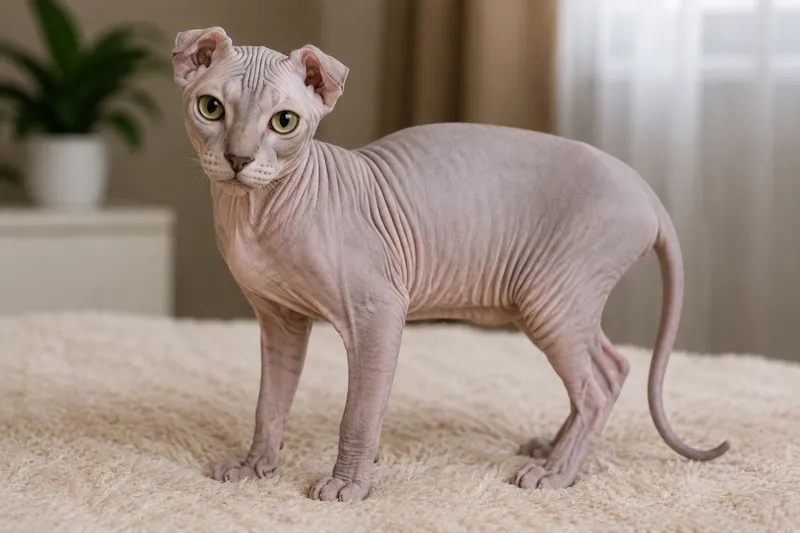
Ukrainian Levkoy
The Ukrainian Levkoy is a modern hairless cat developed in Ukraine by combining hairless domestic-cat lines, particularly Don Sphynx ancestry, with the folded-ear characteristic associated with Scottish Fold cats. The…
Recognized by: TICA
Size
Medium
Weight
3.5–6 kg
Life span
12–15 years
Breed Traits
Energy Level
High energy
Energy Level: 4 of 5
Low energyHigh energyChild / Family Compatibility
High compatibility
Child / Family Compatibility: 4 of 5
Low compatibilityHigh compatibilityGrooming Need
High grooming need
Grooming Need: 4 of 5
Low maintenanceHigh maintenanceTrainability
Easy to train
Trainability: 4 of 5
Hard to trainEasy to trainApartment / Home Suitability
Excellent apartment fit
Apartment / Home Suitability: 5 of 5
Needs space / yardExcellent for apartmentsAlone-Time Tolerance
Half-day is hard
Alone-Time Tolerance: 2 of 5
Needs frequent companyHandles long alone timeFirst-Time Owner Suitability
Challenging for beginners
First-Time Owner Suitability: 2 of 5
Needs experienced ownerGreat for first-time ownersCompatibility with Other Pets
Generally gets along well with other pets
Compatibility with Other Pets: 4 of 5
Single-pet homes are a better fitHighly compatible with other animals
The Ukrainian Levkoy is a modern hairless cat developed in Ukraine by combining hairless domestic-cat lines, particularly Don Sphynx ancestry, with the folded-ear characteristic associated with Scottish Fold cats. The organized breeding programme began around the start of the 2000s, and the first registered cats appeared during the early development of the breed.
The name Levkoy refers to a flower whose folded petals were considered reminiscent of the breed's unusual ears. The Ukrainian Levkoy was deliberately created to have a distinctive appearance rather than simply reproducing the type of an existing hairless breed. Its official RUI standard describes a medium-sized, rather long, muscular but slender rectangular body, an angular modified-wedge head, prominent cheekbones, a stepped profile, large almond-shaped eyes, and large ears whose upper portion folds forward and downward.
The skin is soft, elastic, excessive, and wrinkled, particularly around the head, neck, legs, belly, and groin. Completely hairless cats are preferred under the historical standard, although velour-like residual hair and brush-coated cats have also occurred within the breeding programme. All colours can occur because pigmentation remains visible in the skin even when conventional coat is absent.
Straight-eared cats can also occur within breeding lines and have historically been important because responsible folded-ear breeding should not rely on mating two cats carrying the fold-associated trait. Registry acceptance varies substantially, and the Ukrainian Levkoy is not currently recognized by the major international registries represented in the BondPals recognition allowlist.
Ukrainian Levkoys are generally described in their breed standard as friendly and active. Many are social, curious, interactive cats that enjoy participating in household routines and maintaining frequent contact with familiar people.
Their relatively athletic body and long legs support ordinary feline play, climbing, running, and exploration. Interactive wand toys, food puzzles, climbing furniture, scratching opportunities, and short reward-based training sessions can provide useful physical and mental stimulation.
Well-socialized individuals may live successfully with respectful children, compatible cats, and cat-friendly dogs. Because the breed remains rare and temperament data are limited, individual socialization, breeding history, handling experience, and personality should carry more weight than broad breed stereotypes.
Hairlessness does not make the Ukrainian Levkoy maintenance-free. Without a conventional coat to absorb and distribute skin oils, some individuals may develop visible oil or debris on the skin and around skin folds. Cleaning should be based on the individual cat's condition, using gentle cat-appropriate products and avoiding excessive washing that could irritate the skin.
The exposed skin offers less protection from cold, strong sunlight, rough surfaces, and scratches. Provide warm indoor resting places without overheating, limit prolonged intense sun exposure, and discuss persistent redness, scaling, sores, excessive oiliness, or other skin changes with a veterinarian rather than assuming they are normal consequences of hairlessness.
Folded ears should be handled gently and never deliberately pressed, flattened, or manipulated to increase the fold. Owners should also watch the cat's gait, jumping ability, tail flexibility, paw shape, and willingness to move. Stiffness, limping, reluctance to jump, a thick or inflexible tail, painful joints, or progressive mobility changes warrant veterinary assessment.
Routine care should also include dental hygiene, nail trimming, clean litter facilities, daily interactive play, body-condition monitoring, and measured portions of a complete life-stage-appropriate diet.
Published health research focused specifically on the Ukrainian Levkoy is very limited, so breed-wide disease prevalence cannot currently be estimated with confidence. However, the folded-ear component of the breed's ancestry deserves particular attention because the Scottish Fold phenotype is associated with the dominant TRPV4 c.1024G>T variant that alters cartilage and bone development.
In cats carrying the established Scottish Fold variant, even one copy can be associated with cartilage and skeletal abnormalities, including malformed digits, thickened or inflexible tails, and progressive osteoarthritis; cats carrying two copies can develop more severe disease. Direct population studies establishing how frequently this specific variant occurs in modern Ukrainian Levkoy breeding lines are lacking, so owners and breeders should not assume that every folded-ear Levkoy has identical genetic status. Where folded-ear ancestry is present, veterinary genetic advice and targeted assessment of the relevant fold-associated variant are appropriate considerations.
The genetic basis of the Donskoy-type hairlessness used in the breed is not fully resolved and should not be confused with the established KRT71-associated Sphynx hairlessness mutation. A commercial result for the Sphynx hairless variant therefore should not be presented as complete Ukrainian Levkoy coat or health clearance.
Prospective owners should request veterinary and family records covering mobility, joint and tail abnormalities, chronic pain, skin disease, dental health, reproductive outcomes, longevity, and causes of death. Breeders should prioritize functional movement, healthy skin, genetic diversity, and avoidance of matings that could increase fold-associated skeletal risk. This information is for general educational purposes and is not a substitute for diagnosis or treatment by a veterinarian.
Recognizing organizations
Independent registries that list this breed. Tap a badge to learn more.
These statuses reflect each registry’s recording and show systems. They are not a health, quality, or superiority score.
Frequently asked questions
What is a Ukrainian Levkoy?
The Ukrainian Levkoy is a rare modern cat developed in Ukraine to combine hairlessness with folded ears and a distinctive angular head and slender muscular body. Its foundation includes Don Sphynx and Scottish Fold-related ancestry.
Is the Ukrainian Levkoy recognized by major cat registries?
The breed has a formal provisional standard within the Ukrainian-based RUI system, but it does not currently have positive recognition from CFA, TICA, FIFe, or GCCF that can be recorded under the BondPals recognition system. Registry status should therefore not be confused with the existence of an established breeding programme.
Are all Ukrainian Levkoys completely hairless?
No. Completely bare skin is the best-known presentation, but residual velour-like hair and brush-coated individuals have also occurred in the breeding programme. Coat coverage can vary between cats.
Do all Ukrainian Levkoys have folded ears?
No. Straight-eared cats can occur within the breeding population and have historically been useful breeding partners. The folded-ear characteristic comes from the breed's Scottish Fold-related ancestry and should be treated as a structural genetic trait rather than merely a cosmetic feature.
Are Ukrainian Levkoys good family cats?
They are generally described as friendly, active, and social, and well-socialized individuals may become affectionate family companions. Because the breed is rare, individual temperament and early socialization are more reliable guides than assuming every Ukrainian Levkoy will behave the same way.
Can a Ukrainian Levkoy live in an apartment?
Yes. Indoor apartment living can suit the breed well when the cat receives daily interactive play, climbing and scratching opportunities, social contact, and warm comfortable resting areas. Secure indoor living also helps protect exposed skin from temperature extremes and excessive sun.
Does the Ukrainian Levkoy need special skin care?
Yes, many hairless individuals need regular skin observation and occasional gentle cleaning because skin oils are not absorbed by a conventional coat. The exact schedule should depend on the individual cat, and persistent redness, sores, scaling, or excessive oiliness should be assessed by a veterinarian.
What health screening is especially important for a Ukrainian Levkoy?
Because folded-ear ancestry can involve the TRPV4 variant responsible for Scottish Fold osteochondrodysplasia, breeders should pay particular attention to genetic status, joint and tail structure, gait, and lifelong mobility. Skin health, dental health, family longevity, reproductive history, and any recurrent problems in the breeding line should also be documented; no single DNA panel guarantees complete health.
More about Ukrainian Levkoy
Pet profiles are coming soon. For now, keep exploring trusted breed knowledge in the Breed Guide.
Back to Breed Guide