

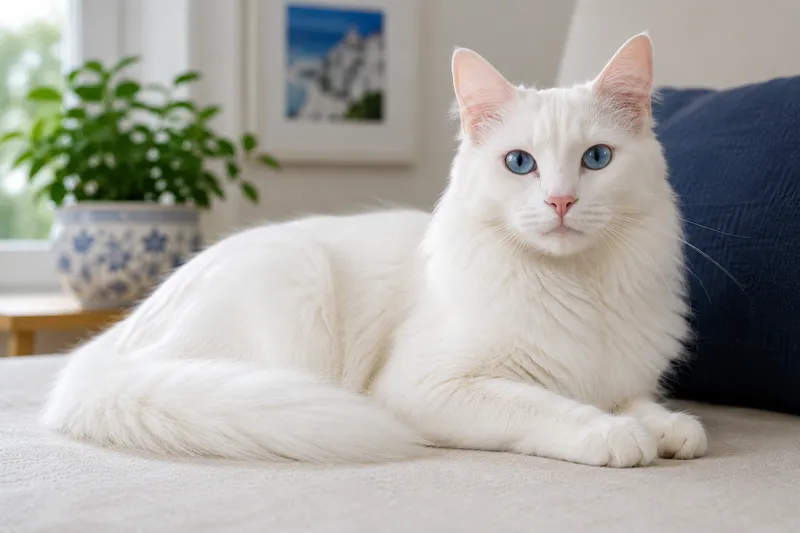
Turkish Angora
The Turkish Angora is a medium-sized, elegant cat with a long, finely boned but muscular body, slender legs, a tapering wedge-shaped head, large upright ears, and a full plumed tail. Its semi-long single coat is fine…
Recognized by: CFA · FIFe · +2
Size
Medium
Weight
2.3–4.5 kg
Life span
12–18 years
Breed Traits
Energy Level
Very energetic
Energy Level: 5 of 5
Low energyHigh energyChild / Family Compatibility
High compatibility
Child / Family Compatibility: 4 of 5
Low compatibilityHigh compatibilityGrooming Need
Light grooming need
Grooming Need: 2 of 5
Low maintenanceHigh maintenanceTrainability
Very easy to train
Trainability: 5 of 5
Hard to trainEasy to trainApartment / Home Suitability
Fits apartments well
Apartment / Home Suitability: 4 of 5
Needs space / yardExcellent for apartmentsAlone-Time Tolerance
Handles a typical workday
Alone-Time Tolerance: 3 of 5
Needs frequent companyHandles long alone timeFirst-Time Owner Suitability
Manageable with guidance
First-Time Owner Suitability: 3 of 5
Needs experienced ownerGreat for first-time ownersCompatibility with Other Pets
Generally gets along well with other pets
Compatibility with Other Pets: 4 of 5
Single-pet homes are a better fitHighly compatible with other animals
The Turkish Angora is a medium-sized, elegant cat with a long, finely boned but muscular body, slender legs, a tapering wedge-shaped head, large upright ears, and a full plumed tail. Its semi-long single coat is fine and silky, with relatively little undercoat, and occurs in many traditional colors and patterns rather than white alone.
The breed is associated with Ankara and the surrounding region of central Anatolia in modern Turkey. Longhaired cats from the region were documented in Europe centuries ago, although the exact relationship between those historical cats and every modern pedigree line cannot be established with certainty.
Preservation programs in Turkey, including work associated with Ankara Zoo, helped protect the native type when the breed had declined internationally. Modern Turkish Angoras retain a graceful appearance while remaining athletic, strong, inquisitive, and highly capable climbers.
Turkish Angoras are generally intelligent, active, curious, and strongly involved in household life. Many form a particularly close bond with one person while remaining affectionate and interactive with other familiar members of the home.
They commonly enjoy retrieving toys, climbing to high observation points, opening accessible cupboards, exploring puzzle feeders, and learning routines through positive reinforcement. Their confidence and determination can make them entertaining companions, but insufficient stimulation may lead to persistent attention-seeking or unwanted exploration.
Well-socialized Turkish Angoras often live successfully with respectful children, compatible cats, and cat-friendly dogs. They can be independent for ordinary periods during the day, but they still benefit from dependable companionship, play, and social interaction.
The fine single coat is less prone to matting than many dense longhaired coats and usually benefits from gentle weekly combing. Grooming may need to increase during seasonal coat changes, especially around the tail, chest, and hindquarters where loose hair can collect.
Daily life should include tall and stable climbing furniture, scratching surfaces, energetic interactive play, puzzle activities, and opportunities to observe the household from secure elevated places. Windows, balconies, fragile shelves, and accessible cupboards should be secured because this breed is agile, curious, and persistent.
Routine care should include dental hygiene, nail trimming, ear checks, body-condition monitoring, and regular veterinary examinations. White cats with lightly pigmented ears should also be protected from prolonged intense sun exposure.
Congenital hearing loss can occur in some white cats and is more strongly associated with white coats combined with one or two blue eyes. Not every white or blue-eyed Turkish Angora is deaf, and colored cats are not affected by this pigment-associated risk in the same way. A brainstem auditory evoked response, or BAER, test can objectively assess hearing in each ear.
Hypertrophic cardiomyopathy has also been reported in Turkish Angoras and should be discussed through family cardiac history and appropriate veterinary screening. There is currently no Turkish Angora-specific DNA test capable of excluding every form of HCM, so a general commercial genetic panel should not be presented as a lifelong heart-health guarantee.
Prospective owners should ask about BAER results for relevant white cats, family heart health, longevity, known illnesses, causes of death in related cats, and documented veterinary records. This information is for general educational purposes and is not a substitute for diagnosis or treatment by a veterinarian.
Recognizing organizations
Independent registries that list this breed. Tap a badge to learn more.
These statuses reflect each registry’s recording and show systems. They are not a health, quality, or superiority score.
Frequently asked questions
Are Turkish Angoras good family cats?
Turkish Angoras are often affectionate, playful, and highly involved family companions. They commonly live well with respectful children, although their active and strong-willed nature may not suit a household seeking a very quiet cat.
Do Turkish Angoras get along with other pets?
Well-socialized Turkish Angoras often live successfully with compatible cats and cat-friendly dogs. Introductions should still be gradual because some individuals are confident and may attempt to control access to preferred people, toys, or high resting places.
Can a Turkish Angora live in an apartment?
The breed can adapt well to apartment living when provided with tall climbing areas, energetic daily play, scratching surfaces, and mental challenges. Windows and balconies must be secured because Turkish Angoras are agile and strongly attracted to elevated spaces.
Can Turkish Angoras be left alone during the day?
Many adults can manage ordinary working-day absences when they have enrichment and a predictable routine. They remain socially engaged cats and should receive dependable companionship, play, and interaction every day.
How much grooming does a Turkish Angora need?
The fine single coat usually needs gentle combing about once a week and is less prone to matting than many dense long coats. Additional grooming may be useful during seasonal shedding or when loose hair collects around the tail and hindquarters.
Are all Turkish Angoras white?
No. White is historically famous and remains common, but pedigree Turkish Angoras are accepted in many traditional colors and patterns. Color rules vary between registries, so recognition of a particular variety should be checked with the relevant organization.
Are all white Turkish Angoras deaf?
No. White cats, particularly those with one or two blue eyes, have a higher risk of congenital deafness, but many have normal hearing. A BAER test is the objective method used to assess hearing separately in both ears.
What health information should a Turkish Angora breeder provide?
A responsible breeder should discuss BAER hearing results where relevant, family heart health, cardiac screening practices, longevity, known illnesses, and veterinary records. Buyers should be cautious of claims that appearance, pedigree, or one commercial DNA panel guarantees lifelong health.
More about Turkish Angora
Pet profiles are coming soon. For now, keep exploring trusted breed knowledge in the Breed Guide.
Back to Breed Guide