

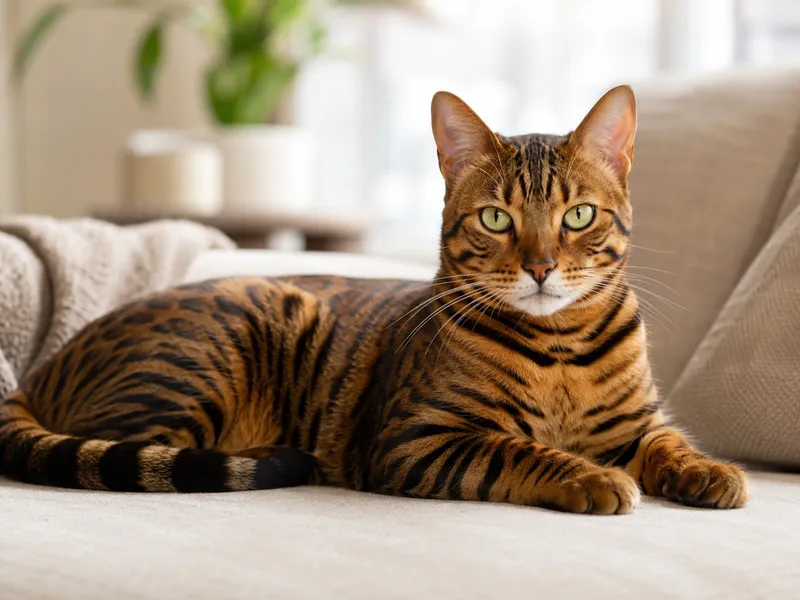
Toyger
The Toyger is a medium-to-large, long-bodied and muscular cat with substantial bone, high shoulders, a deep chest, and a thick tail carried low. Its head is long, broad, and deep, with small rounded ears, a wide muzzle,…
Recognized by: GCCF · TICA
Size
Large
Weight
3.2–6.8 kg
Life span
12–15 years
Breed Traits
Energy Level
High energy
Energy Level: 4 of 5
Low energyHigh energyChild / Family Compatibility
Very high compatibility
Child / Family Compatibility: 5 of 5
Low compatibilityHigh compatibilityGrooming Need
Low grooming need
Grooming Need: 1 of 5
Low maintenanceHigh maintenanceTrainability
Very easy to train
Trainability: 5 of 5
Hard to trainEasy to trainApartment / Home Suitability
Fits apartments well
Apartment / Home Suitability: 4 of 5
Needs space / yardExcellent for apartmentsAlone-Time Tolerance
Half-day is hard
Alone-Time Tolerance: 2 of 5
Needs frequent companyHandles long alone timeFirst-Time Owner Suitability
Suitable for many first-timers
First-Time Owner Suitability: 4 of 5
Needs experienced ownerGreat for first-time ownersCompatibility with Other Pets
Shows very high compatibility
Compatibility with Other Pets: 5 of 5
Single-pet homes are a better fitHighly compatible with other animals
The Toyger is a medium-to-large, long-bodied and muscular cat with substantial bone, high shoulders, a deep chest, and a thick tail carried low. Its head is long, broad, and deep, with small rounded ears, a wide muzzle, and facial markings intended to create a circular pattern reminiscent of a tiger.
The short, dense coat is best known for bold, branching vertical markings over a bright warm background. The pattern should look more irregular and braided than an ordinary domestic mackerel tabby, while a glittered surface can give the coat a golden shine. Championship Toygers are principally shown as brown or black mackerel tabbies, with exact terminology depending on the registry.
The breed was developed in the United States from the late 1980s by Judy Sugden. Foundation cats included domestic shorthairs and a Bengal, followed by carefully selected cats that contributed unusual head and body markings. The Toyger was designed to resemble a miniature tiger, but it has no tiger or other big-cat ancestry.
Toygers are generally friendly, confident, intelligent, and strongly interested in people. Many follow household members between rooms, greet visitors, and enjoy participating in family activities while retaining a calmer and more manageable temperament than their dramatic appearance might suggest.
They are athletic and usually respond well to positive-reinforcement training. Retrieving games, food puzzles, exercise wheels, harness walking, agility activities, and interactive play can provide useful outlets for their intelligence and physical ability.
Well-socialized Toygers commonly live successfully with respectful children, compatible cats, and cat-friendly dogs. They appreciate dependable interaction and enrichment, but many adults can also settle quietly when their exercise and companionship needs have been met.
The short coat is easy to maintain and normally needs only gentle weekly brushing or wiping with a soft grooming cloth. This removes loose hair and helps preserve the natural shine of the glittered coat. Routine bathing is generally unnecessary.
Daily life should include stable climbing furniture, scratching surfaces, interactive play, puzzle activities, and safe opportunities to explore. Toygers can adapt well to apartment living when the home provides enough vertical space, exercise, mental stimulation, and regular human contact.
Routine care should include dental hygiene, nail trimming, ear checks, body-condition monitoring, and regular veterinary examinations. Their heavy bone and muscular build should not be confused with excess weight, so feeding should be adjusted according to the individual cat's body condition and activity level.
Erythrocyte pyruvate kinase deficiency is an autosomal recessive inherited condition for which Toygers are considered an appropriate testing population. It can cause intermittent haemolytic anaemia, with possible signs including weakness, lethargy, weight loss, jaundice, or abdominal enlargement. A DNA test can identify clear, carrier, and genetically affected cats.
Progressive retinal atrophy PRA-b is another autosomal recessive condition relevant to Toygers through Bengal-related ancestry. Affected cats develop progressive degeneration of the retina and may experience severe vision loss or blindness. A DNA test is available to identify clear, carrier, and affected genotypes.
Heart murmurs and possible hypertrophic cardiomyopathy have been reported in the breed, but no Toyger-specific DNA test can exclude every form of HCM. Cow-hocked hind-leg posture has also occurred and should be evaluated in the context of the individual cat's movement and orthopedic health. Prospective owners should request documented PK deficiency and PRA-b results and ask about family heart health, mobility, longevity, known illnesses, and veterinary screening practices. This information is for general educational purposes and is not a substitute for diagnosis or treatment by a veterinarian.
Recognizing organizations
Independent registries that list this breed. Tap a badge to learn more.
These statuses reflect each registry’s recording and show systems. They are not a health, quality, or superiority score.
Frequently asked questions
Are Toygers good family cats?
Toygers are often friendly, playful, and involved family companions. They commonly live well with respectful children who understand gentle handling and enjoy structured interactive play.
Do Toygers get along with other pets?
Well-socialized Toygers generally have a high potential to live successfully with compatible cats and cat-friendly dogs. Introductions should still be gradual because age, confidence, and previous experience affect every relationship.
Can a Toyger live in an apartment?
A Toyger can adapt well to apartment living when provided with stable climbing furniture, daily interactive play, scratching areas, puzzle activities, and regular companionship. The home must still accommodate the breed's muscular size and activity.
Can Toygers be left alone during the day?
Many adult Toygers can manage ordinary short absences when they have a predictable routine and an enriched environment. Frequent prolonged isolation is not ideal for this people-oriented breed.
How much grooming does a Toyger need?
The short coat normally needs only gentle weekly brushing or wiping with a soft cloth. Dental hygiene, nail trimming, ear checks, and body-condition monitoring usually require more attention than coat maintenance.
Does the Toyger have tiger ancestry?
No. Toygers were selectively developed from domestic cats to create a tiger-like appearance and were never crossed with tigers or other big cats. One important foundation breed was the Bengal, so the Toyger should not be described as having no wild-cat ancestry at any point in its broader pedigree.
What is the difference between a Toyger, Bengal, and Ocicat?
The Toyger is selected for bold branching vertical stripes and a low, powerful tiger-like outline. Bengals are known mainly for spotted or marbled patterns and descend from early Asian leopard cat crosses, while Ocicats were created from established domestic breeds to produce a spotted appearance.
What health testing should a Toyger breeder discuss?
A responsible breeder should provide documented pyruvate kinase deficiency and PRA-b results and discuss family heart health, mobility, longevity, known illnesses, veterinary screening practices, and causes of death in related cats.
More about Toyger
Pet profiles are coming soon. For now, keep exploring trusted breed knowledge in the Breed Guide.
Back to Breed Guide