

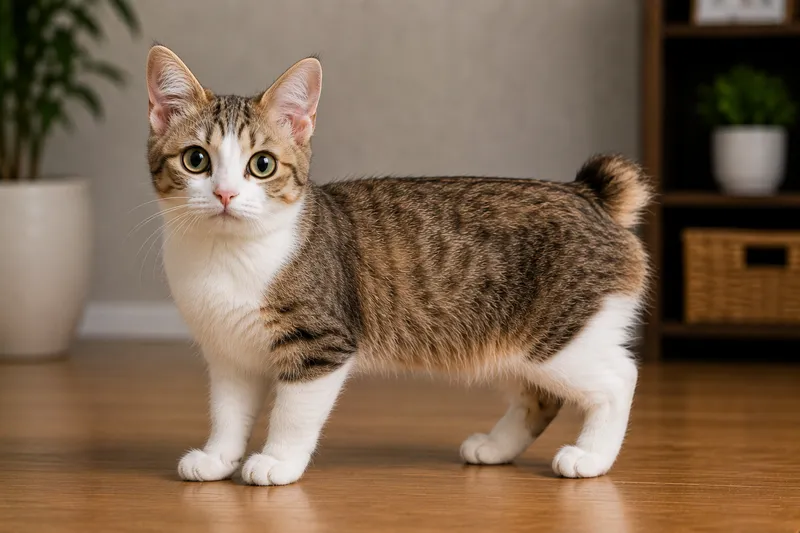
Toybob
The Toybob is a naturally small bobtailed breed developed primarily in Russia. Its modern history is traced to two stray cats with unusual short tails acquired by Elena Krasnichenko in 1983. A fully grown male from…
Recognized by: CFA · TICA
Size
Small
Weight
1.8–3.2 kg
Life span
12–15 years
Breed Traits
Energy Level
High energy
Energy Level: 4 of 5
Low energyHigh energyChild / Family Compatibility
High compatibility
Child / Family Compatibility: 4 of 5
Low compatibilityHigh compatibilityGrooming Need
Moderate grooming need
Grooming Need: 3 of 5
Low maintenanceHigh maintenanceTrainability
Easy to train
Trainability: 4 of 5
Hard to trainEasy to trainApartment / Home Suitability
Excellent apartment fit
Apartment / Home Suitability: 5 of 5
Needs space / yardExcellent for apartmentsAlone-Time Tolerance
Half-day is hard
Alone-Time Tolerance: 2 of 5
Needs frequent companyHandles long alone timeFirst-Time Owner Suitability
Manageable with guidance
First-Time Owner Suitability: 3 of 5
Needs experienced ownerGreat for first-time ownersCompatibility with Other Pets
Generally gets along well with other pets
Compatibility with Other Pets: 4 of 5
Single-pet homes are a better fitHighly compatible with other animals
The Toybob is a naturally small bobtailed breed developed primarily in Russia. Its modern history is traced to two stray cats with unusual short tails acquired by Elena Krasnichenko in 1983. A fully grown male from their descendants, Kutciy, was mistaken for a kitten at a 1989 cat show and helped inspire the breed's name.
Adults retain a kitten-like appearance but should be compact, muscular, well-boned, and proportionally balanced rather than frail or dwarfed. The head has rounded contours, large open eyes, a short muzzle, and medium ears. The legs remain proportionate to the body; disproportionately shortened legs are not part of the Toybob standard.
The defining tail contains at least two vertebrae and may combine kinks, curves, or a nearly straight section, with a maximum bone length reaching the hock. Toybobs occur in shorthaired and longhaired forms and in all genetically possible colors and patterns. The longhaired form has a plush semi-long to long coat, furnishings, and a plumed tail, while the shorthaired form has a resilient plush coat.
Toybobs are generally described as gentle, affectionate, playful, and agile. Many remain interested in games well into adulthood and enjoy retrieving, puzzle feeders, interactive toys, climbing, and learning predictable household routines.
They often form close relationships with familiar people and may prefer being involved in daily activity rather than observing from a distance. Their small size should not be mistaken for low energy or physical fragility, although rough handling can overwhelm any compact cat.
Well-socialized individuals may live successfully with respectful children, compatible cats, and calm cat-friendly dogs. Their confidence and sociability vary by individual, so introductions should be gradual and the cat should always have access to quiet resting places.
Shorthaired Toybobs usually need weekly brushing, while longhaired individuals benefit from combing several times a week, with extra attention to the ruff, belly, armpits, hindquarters, furnishings, and plumed tail. Grooming frequency should increase when seasonal shedding or tangles make it necessary.
The bobtail should be handled gently and never pulled, bent, or deliberately straightened. Owners can use routine grooming to look for skin irritation, swelling, sensitivity, trapped debris, or changes in how the cat carries or moves its tail.
Provide daily interactive play, stable climbing and scratching furniture, dental hygiene, nail trimming, clean litter facilities, and measured portions of a complete life-stage-appropriate diet. Because the breed is naturally small, body condition should be judged by muscle and fat cover rather than by trying to keep the cat at an unusually low number on the scale.
Published Toybob-specific clinical research remains limited. CFA reports that no breed-specific health issue has been identified to date, but this should be understood as limited evidence rather than proof that the breed cannot have inherited disease. The Toybob standard calls for a strong, proportionate cat and rejects frailty and disproportionately shortened legs.
A large 2022 genetic survey detected the HES7 c.5T>C short-tail variant in a few Toybobs. That variant is established as a cause of shortened, kinked tails in Japanese Bobtails, but its presence in only some sampled Toybobs does not establish one uniform genetic explanation for every Toybob tail. Large breed-specific imaging studies and long-term outcome studies have not yet defined whether particular tail structures carry measurable risks.
Owners should seek veterinary assessment for tail pain, swelling, wounds, reduced movement, gait changes, persistent constipation, or loss of urinary or fecal control rather than assuming these signs are normal. Breeders should document comfortable mobility, tail and spinal examinations, reproductive history, family longevity, causes of death, and any DNA screening selected for the ancestry and traits present in their lines. This information is for general educational purposes and is not a substitute for diagnosis or treatment by a veterinarian.
Recognizing organizations
Independent registries that list this breed. Tap a badge to learn more.
These statuses reflect each registry’s recording and show systems. They are not a health, quality, or superiority score.
Frequently asked questions
Are Toybobs good family cats?
Toybobs are generally affectionate, playful, and interested in family routines. They suit homes that can provide regular interaction, safe indoor activity, and gentle handling appropriate for a naturally small cat.
Are Toybobs good with children?
Many well-socialized Toybobs can live successfully with respectful children. Adults should supervise young children, prevent squeezing or carrying by the tail, and make sure the cat can leave whenever it wants quiet.
Do Toybobs get along with other pets?
They may live successfully with compatible cats and calm cat-friendly dogs after gradual introductions. Separate food, water, litter, hiding, and resting resources help prevent competition and give the smaller cat control over social contact.
Can a Toybob live in an apartment?
The breed is well suited to apartment living when it receives daily interactive play, stable climbing furniture, scratching areas, puzzle activities, and secure windows or balconies. Its small body does not reduce its need to run, climb, and explore.
Can Toybobs be left alone during the day?
Many adults can manage ordinary short absences when their routine is predictable. Frequent prolonged isolation is less suitable for a people-oriented cat, and toys or food puzzles do not fully replace dependable social contact.
How much grooming does a Toybob need?
Shorthaired Toybobs usually need weekly brushing, while longhaired cats commonly need combing several times a week. The longhaired ruff, belly, armpits, hindquarters, furnishings, and plumed tail deserve particular attention.
Is a Toybob a dwarf cat or a type of Manx?
No. The Toybob is naturally small but should have proportionate legs and a compact muscular body, unlike breeds defined by shortened limbs. It is also a separate bobtail breed from the Manx, with a tail that normally contains visible kinked or curved vertebrae rather than the Manx range from tailless to fully tailed.
What health information should a Toybob breeder provide?
Ask for veterinary records, a documented pedigree, family longevity and causes of death, and information about mobility, tail and spinal examinations, continence, reproductive history, and neonatal losses. Any DNA panel should be explained in relation to the ancestry and traits in that line because no single validated test provides complete Toybob health clearance.
More about Toybob
Pet profiles are coming soon. For now, keep exploring trusted breed knowledge in the Breed Guide.
Back to Breed Guide