

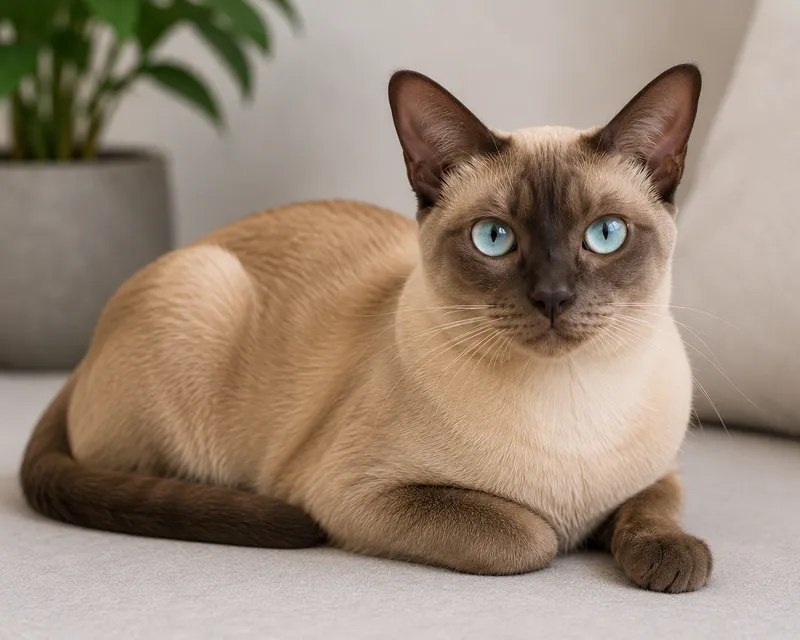
Tonkinese
The Tonkinese is a medium-sized, firmly muscular cat that feels surprisingly heavy for its apparent size. Its body is balanced between the compact Burmese and the long, slender Siamese, with a modified wedge-shaped…
Recognized by: CFA · GCCF · +1
Size
Medium
Weight
2.7–5.4 kg
Life span
12–16 years
Breed Traits
Energy Level
High energy
Energy Level: 4 of 5
Low energyHigh energyChild / Family Compatibility
Very high compatibility
Child / Family Compatibility: 5 of 5
Low compatibilityHigh compatibilityGrooming Need
Low grooming need
Grooming Need: 1 of 5
Low maintenanceHigh maintenanceTrainability
Very easy to train
Trainability: 5 of 5
Hard to trainEasy to trainApartment / Home Suitability
Excellent apartment fit
Apartment / Home Suitability: 5 of 5
Needs space / yardExcellent for apartmentsAlone-Time Tolerance
Very short alone time (a few hours)
Alone-Time Tolerance: 1 of 5
Needs frequent companyHandles long alone timeFirst-Time Owner Suitability
Suitable for many first-timers
First-Time Owner Suitability: 4 of 5
Needs experienced ownerGreat for first-time ownersCompatibility with Other Pets
Shows very high compatibility
Compatibility with Other Pets: 5 of 5
Single-pet homes are a better fitHighly compatible with other animals
The Tonkinese is a medium-sized, firmly muscular cat that feels surprisingly heavy for its apparent size. Its body is balanced between the compact Burmese and the long, slender Siamese, with a modified wedge-shaped head, blunt muzzle, expressive almond-shaped eyes, and a short, fine coat with a silky sheen.
Tonkinese occur in three genetically related coat-pattern groups commonly described by registries as solid or sepia, mink, and pointed. Mink-patterned cats usually have aquamarine eyes, pointed cats have blue eyes, and solid-patterned cats generally have green to yellow-green eyes. Accepted colors and terminology vary substantially between registries.
The modern pedigree Tonkinese was deliberately developed during the 1960s by breeders in the United States and Canada, particularly Jane Barletta and Margaret Conroy, using Siamese and Burmese lines to establish a moderate cat distinct from either parent breed. Wong Mau, the foundation female of the modern Burmese, is now widely interpreted by cat registries as having displayed the natural mink pattern associated with the Tonkinese.
Tonkinese cats are generally affectionate, confident, intelligent, playful, and intensely interested in people. Many follow household members between rooms, greet visitors, seek lap or shoulder contact, and expect to participate in almost every daily activity.
They commonly enjoy retrieving toys, climbing, puzzle feeders, interactive games, clicker training, and learning household routines. Their intelligence is combined with persistence and a strong will, so positive-reinforcement training and clear, consistent boundaries are more effective than punishment.
Well-socialized Tonkinese usually live successfully with respectful children, compatible cats, and cat-friendly dogs. Their unusually strong need for companionship makes them poorly suited to frequent prolonged isolation, and many benefit from living with another active and socially compatible cat.
The short, close-lying coat requires very little maintenance. Gentle brushing with a soft or rubber grooming tool once a week, or several times each month, is usually sufficient to remove loose hair and maintain the coat's natural shine. Bathing is rarely necessary outside show preparation or individual medical needs.
Daily life should include interactive play, stable climbing furniture, scratching surfaces, puzzle activities, and frequent social engagement. Tonkinese can adapt very well to apartment living, but a small home must still provide enough vertical space, stimulation, exercise, and companionship.
Routine care should include dental hygiene, nail trimming, ear checks, body-condition monitoring, and regular veterinary examinations. Tonkinese can gain excess weight when activity and feeding are poorly balanced, so portions should be adjusted according to the individual cat's age, muscular condition, and exercise level.
Progressive retinal atrophy rdAc is an autosomal recessive inherited eye disorder associated with a CEP290 variant found in several related breeds, including the Tonkinese. Affected cats begin life with normal vision, but retinal degeneration may develop during youth and can gradually progress to blindness. A DNA test can identify genetically clear, carrier, and affected cats.
The Burmese hypokalaemia variant is also considered appropriate for testing in Tonkinese. Genetically affected cats may experience episodes of low potassium and skeletal muscle weakness, including difficulty walking or holding the head normally. The Burmese head defect variant can likewise be tested in Tonkinese-related populations; cats inheriting two copies develop severe craniofacial abnormalities incompatible with survival, while one copy may influence facial structure.
Registry health guidance is not completely consistent. CFA describes Tonkinese as generally robust while noting a tendency toward gingivitis in older cats, and GCCF states that the breed has no specific health problems. TICA additionally lists dental disease, feline lower urinary tract disease, inflammatory bowel disease, and amyloidosis as concerns. These statements do not mean that every Tonkinese will develop these conditions, and no single test can exclude all possible disease.
Prospective owners should request documented PRA-rdAc results and ask whether hypokalaemia and Burmese head defect testing is relevant to the family line. They should also discuss dental health, urinary and digestive disease, family longevity, known illnesses, veterinary screening, and causes of death in related cats. This information is for general educational purposes and is not a substitute for diagnosis or treatment by a veterinarian.
Recognizing organizations
Independent registries that list this breed. Tap a badge to learn more.
These statuses reflect each registry’s recording and show systems. They are not a health, quality, or superiority score.
Frequently asked questions
Are Tonkinese cats good family pets?
Tonkinese cats are often affectionate, playful, and highly involved family companions. They commonly live well with respectful children who understand gentle handling and enjoy regular interactive play.
Do Tonkinese cats get along with other pets?
Well-socialized Tonkinese generally have a high potential to live successfully with compatible cats and cat-friendly dogs. Many individuals actively benefit from having another social and playful companion.
Can a Tonkinese live in an apartment?
A Tonkinese can adapt very well to apartment living when provided with climbing space, daily interactive play, scratching areas, puzzle activities, and frequent companionship. Social and mental enrichment are more important than the physical size of the home.
Can Tonkinese cats be left alone during the day?
Most adults can manage ordinary short absences, but the breed is poorly suited to frequent prolonged isolation. A predictable routine, extensive enrichment, and a compatible human or animal companion can help meet its strong social needs.
How much grooming does a Tonkinese need?
The silky short coat normally needs only light weekly brushing or grooming several times each month. Dental hygiene, nail trimming, ear checks, and body-condition monitoring generally require more attention than coat maintenance.
What is the difference between a Tonkinese, Siamese, and Burmese?
The Tonkinese has its own moderate standard rather than simply looking like a random cross. It is generally more muscular and moderate than the slender Siamese but less compact and rounded than the Burmese, with coat patterns and eye colors influenced by both related populations.
Do all Tonkinese cats have aqua eyes?
No. Aqua eyes are characteristic of mink-patterned Tonkinese. Pointed Tonkinese generally have blue eyes, while solid or sepia-patterned cats usually have green to yellow-green eyes, depending on the registry standard.
What health testing should a Tonkinese breeder discuss?
A responsible breeder should provide documented PRA-rdAc results and explain whether Burmese hypokalaemia and Burmese head defect testing is relevant to the breeding line. Buyers should also ask about dental, urinary, digestive, liver, and general family health.
More about Tonkinese
Pet profiles are coming soon. For now, keep exploring trusted breed knowledge in the Breed Guide.
Back to Breed Guide