

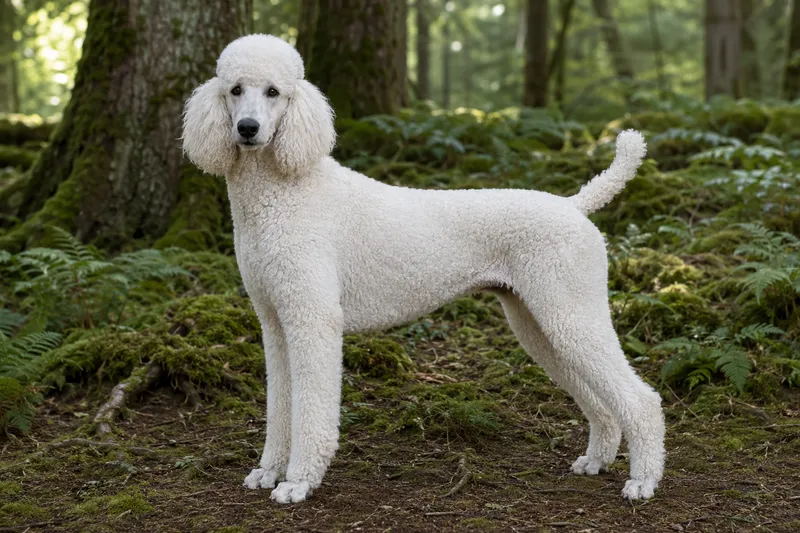
Standard Poodle
The Standard Poodle is a tall, squarely built, smoothly muscled dog with a refined head, long drop ears, proud carriage, and light but powerful movement. Major English-language standards place the variety above 38…
Recognized by: AKC · ANKC · +5
Size
Large
Weight
18–32 kg
Life span
10–18 years
Breed Traits
Energy Level
Very energetic
Energy Level: 5 of 5
Low energyHigh energyChild / Family Compatibility
High compatibility
Child / Family Compatibility: 4 of 5
Low compatibilityHigh compatibilityGrooming Need
Intensive grooming need
Grooming Need: 5 of 5
Low maintenanceHigh maintenanceTrainability
Very easy to train
Trainability: 5 of 5
Hard to trainEasy to trainApartment / Home Suitability
Moderate — depends on setup
Apartment / Home Suitability: 3 of 5
Needs space / yardExcellent for apartmentsAlone-Time Tolerance
Half-day is hard
Alone-Time Tolerance: 2 of 5
Needs frequent companyHandles long alone timeFirst-Time Owner Suitability
Manageable with guidance
First-Time Owner Suitability: 3 of 5
Needs experienced ownerGreat for first-time ownersCompatibility with Other Pets
Generally gets along well with other pets
Compatibility with Other Pets: 4 of 5
Single-pet homes are a better fitHighly compatible with other animals
The Standard Poodle is a tall, squarely built, smoothly muscled dog with a refined head, long drop ears, proud carriage, and light but powerful movement. Major English-language standards place the variety above 38 centimetres at the shoulder, and its dense coat may be curly or corded and presented in practical pet trims or approved show clips.
This is the original large Poodle from which the Miniature and Toy varieties were developed. Its ancestors worked as European water dogs, and the Standard Poodle became a skilled waterfowl retriever; the traditional clip reduced drag while retaining protective hair over important joints and body areas in cold water.
Beneath the formal appearance is a versatile working athlete capable of swimming, retrieving, tracking, and sustained training. Standard Poodles can excel in obedience, agility, scent work, assistance roles, hunt tests, dock diving, and active family life, provided their need for exercise, learning, grooming, and close human involvement is taken seriously.
Standard Poodles are typically intelligent, energetic, attentive, and strongly oriented toward their handlers. Many are friendly and playful with people they know while remaining observant or initially reserved around strangers, but excessive fearfulness or unstable behavior is not desirable.
They learn rapidly and often anticipate patterns, so training should combine clear expectations with variety and worthwhile rewards. Early socialization should include calm experiences with people, animals, travel, water, household sounds, grooming equipment, veterinary handling, and unfamiliar environments rather than relying on intelligence alone to produce a well-adjusted dog.
A well-socialized Standard Poodle can be an affectionate family companion and often lives successfully with respectful children and compatible pets. Its height, enthusiasm, and athletic power require adult supervision around young children, while chasing, exuberant greetings, or rough play should be managed through training rather than dismissed as harmless excitement.
Healthy adult Standard Poodles need substantial daily physical activity together with challenging mental work. Brisk walks, retrieving, swimming where conditions are safe, hiking, scent work, advanced training, and suitable dog sports can provide useful outlets, while growing puppies need controlled exercise that does not repeatedly overload developing joints.
The continuously growing, low-shedding coat is a major lifelong commitment. Even a short pet clip requires systematic brushing and combing to the skin, regular bathing and drying, and clipping at consistent intervals; longer or show coats demand much more frequent and skilled care to prevent tight, painful mats.
Routine maintenance also includes dental hygiene, nail trimming, and ear checks, with clean, dry ear canals monitored for irritation. Standard Poodles usually thrive as involved household dogs rather than isolated yard dogs, and alone-time should be introduced gradually with adequate exercise and enrichment arranged around absences.
Hip dysplasia and inherited eye disorders are important screening priorities in Standard Poodles. Other recognized concerns include sebaceous adenitis, von Willebrand disease type 1, neonatal encephalopathy with seizures, thyroid and other immune-mediated disorders, epilepsy, and certain cardiac conditions.
The deep-chested Standard Poodle is also at risk for gastric dilatation-volvulus, a rapidly life-threatening emergency. A swollen abdomen, repeated unproductive retching, heavy drooling, restlessness, weakness, or collapse requires immediate emergency veterinary care, and owners should discuss individual risk and preventive options with their veterinarian.
Breeding dogs should have documented hip and specialist eye evaluations, along with NEwS, vWD1, and thyroid results under programs that recommend them. Buyers should also ask about prcd-PRA or PRA-rcd4 testing where required, cardiac assessment, sebaceous adenitis evaluation, and verified health information for close relatives rather than treating one clear DNA result as complete screening. This information is for general educational purposes and is not a substitute for diagnosis or treatment by a veterinarian.
Recognizing organizations
Independent registries that list this breed. Tap a badge to learn more.
These statuses reflect each registry’s recording and show systems. They are not a health, quality, or superiority score.
AKCFull recognitionhttps://www.akc.org/dog-breeds/poodle-standard/ ANKCFull recognitionhttps://dogsaustralia.org.au/members/breeds/breed-standards/Poodle-%28Standard%29 CKCRecognized breedhttps://www.ckc.ca/en/Choosing-a-Dog/Choosing-a-Breed/Non-Sporting-Dogs/Poodle-Standard FCIDefinitive recognitionhttps://www.fci.be/en/nomenclature/POODLE-172.html NZKCRecognised breedhttps://www.dogsnz.org.nz/breeds/info/poodle-standard/756 RKCBreed Registerhttps://www.royalkennelclub.com/search/breeds-a-to-z/breeds/utility/poodle-standard/ UKCFull recognitionhttps://www.ukcdogs.com/breed-groups/standard-poodle
Frequently asked questions
How is a Standard Poodle different from a Miniature or Toy Poodle?
The Standard is the original and largest Poodle variety, with major English-language standards requiring a height above 38 centimetres at the shoulder. Its greater size and strength make its water-retrieving heritage especially apparent, although all Poodle varieties share the same basic intelligence, outline, and coat type.
Are Standard Poodles good family dogs?
A well-bred, well-socialized Standard Poodle can be an affectionate, playful, and highly trainable family companion. Its size and energetic movement mean interactions with young children should be supervised and calm household behavior should be deliberately taught.
How much exercise does a Standard Poodle need?
Most healthy adults need substantial daily exercise together with training or another form of mental work. Brisk walks, retrieving, safe swimming, hiking, scent activities, and dog sports can be combined according to the dog's age, health, conditioning, and individual drive.
Can a Standard Poodle live in an apartment?
Apartment living is possible when exercise, toilet access, training, enrichment, grooming, and companionship are consistently provided. The variety's size and activity level make a spacious home easier, but access to a garden does not replace purposeful daily exercise.
Can Standard Poodles be left alone during the day?
Standard Poodles can learn to tolerate reasonable periods alone, but frequent prolonged isolation is a poor match for their social and intelligent nature. Alone-time training should progress gradually, with physical activity, enrichment, and dependable interaction provided around absences.
Do Standard Poodles shed, and are they hypoallergenic?
They usually release relatively little loose hair because shed hairs remain trapped within the dense curly coat. No dog is guaranteed to be hypoallergenic, so a person with allergies should spend time with the individual dog and seek medical guidance before committing.
How much grooming does a Standard Poodle need?
A Standard Poodle in a short pet trim still needs regular brushing and combing to the skin plus bathing, drying, and clipping at consistent intervals. Longer coats mat quickly and require substantially more time, skill, equipment, and professional or experienced home care.
What health screening should a Standard Poodle breeder discuss?
A responsible breeder should provide verifiable hip and specialist eye evaluations and discuss NEwS, vWD1, and thyroid testing under the applicable national program. Buyers should also ask about relevant PRA tests, cardiac and sebaceous adenitis evaluations, gastric dilatation-volvulus history, and health information for close relatives.
More about Standard Poodle
Pet profiles are coming soon. For now, keep exploring trusted breed knowledge in the Breed Guide.
Back to Breed Guide