

Sokoke
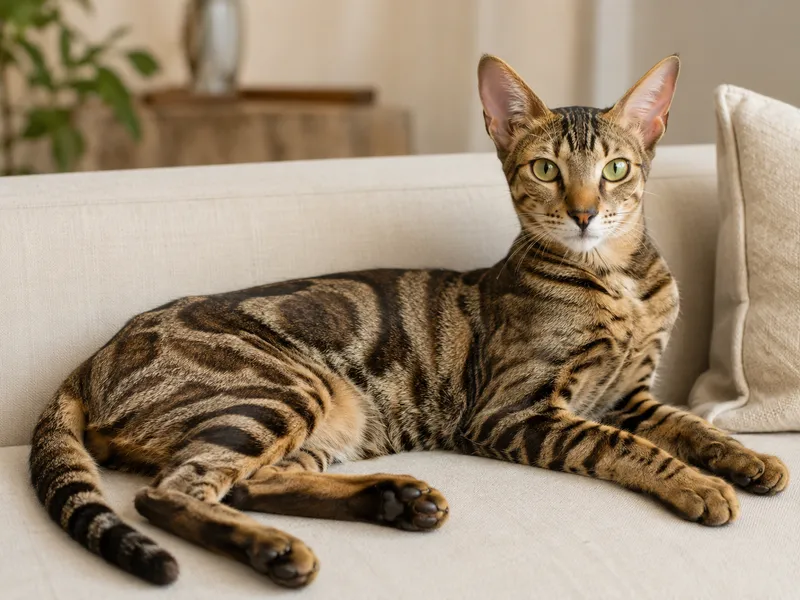
The Sokoke is a medium-sized, long and athletic cat with a slender but muscular body, a well-developed chest, long legs, and hind legs that are slightly longer than the forelegs. Its characteristic rear posture can…
Recognized by: FIFe · GCCF · +1
Size
Medium
Weight
2.3–4.5 kg
Life span
12–20 years
Breed Traits
Energy Level
Very energetic
Energy Level: 5 of 5
Low energyHigh energyChild / Family Compatibility
High compatibility
Child / Family Compatibility: 4 of 5
Low compatibilityHigh compatibilityGrooming Need
Low grooming need
Grooming Need: 1 of 5
Low maintenanceHigh maintenanceTrainability
Easy to train
Trainability: 4 of 5
Hard to trainEasy to trainApartment / Home Suitability
Fits apartments well
Apartment / Home Suitability: 4 of 5
Needs space / yardExcellent for apartmentsAlone-Time Tolerance
Very short alone time (a few hours)
Alone-Time Tolerance: 1 of 5
Needs frequent companyHandles long alone timeFirst-Time Owner Suitability
Manageable with guidance
First-Time Owner Suitability: 3 of 5
Needs experienced ownerGreat for first-time ownersCompatibility with Other Pets
Shows very high compatibility
Compatibility with Other Pets: 5 of 5
Single-pet homes are a better fitHighly compatible with other animals
The Sokoke is a medium-sized, long and athletic cat with a slender but muscular body, a well-developed chest, long legs, and hind legs that are slightly longer than the forelegs. Its characteristic rear posture can create a tiptoe-like gait, particularly when the cat is alert or excited. The head is a modified wedge with prominent cheekbones, large upright ears, and expressive eyes ranging from amber to light green.
The very short, close-lying coat has little or no undercoat and feels glossy rather than silky. The best-known pattern is a modified brown classic tabby in which ticking appears both in the lighter ground color and inside the darker markings. This creates hollow-looking pattern centres and a camouflage effect often compared with tree bark.
The modern breed was developed from free-ranging domestic cats found around Watamu and the greater Arabuko-Sokoke area of coastal Kenya. Jeni Slater began the organised breeding programme in 1978, and Gloria Moeldrop brought foundation cats to Denmark in 1983. Genetic research supports the Sokoke as a domestic cat population related to cats from coastal Kenya rather than a domestic-wildcat hybrid.
Sokokes are generally intelligent, alert, playful, athletic, and strongly attached to both their human and feline companions. Many greet visitors, follow familiar people through the home, communicate vocally, and prefer being involved in household activity rather than remaining isolated.
They are active climbers with quick reflexes and a strong interest in exploring elevated spaces. Tall climbing furniture, interactive hunting-style games, puzzle feeders, retrieving activities, and positive-reinforcement training provide useful outlets for their physical and mental energy.
Well-socialized Sokokes frequently live successfully with respectful children, compatible cats, and cat-friendly dogs. They can form especially deep social bonds, which may make prolonged isolation or rehoming more difficult than it is for a more independent cat.
The extremely short coat requires very little maintenance. Gentle weekly brushing or wiping with a soft grooming cloth is normally sufficient to remove loose hair and preserve the natural shine. The limited undercoat means that matting is not an expected concern.
Daily life should include tall and stable climbing furniture, scratching surfaces, energetic interactive play, puzzle activities, and secure observation points. Sokokes can adapt to apartment living, but only when the home provides substantial vertical space, stimulation, exercise, and regular companionship.
Routine care should include dental hygiene, nail trimming, ear checks, body-condition monitoring, parasite prevention appropriate to the cat's environment, and regular veterinary examinations. Their naturally lean and athletic appearance should be distinguished from unhealthy weight loss or poor muscle condition.
No single inherited disease is currently established as a defining health problem across the entire Sokoke breed. Available health information is limited because the international pedigree population is very small, so the absence of a widely reported disorder should not be interpreted as a guarantee that every individual or family line is free from disease.
A published genetic survey based on a small number of Sokokes measured comparatively low diversity and many fixed genetic markers within the sampled population. The limited sample cannot describe every current breeding line, but it supports careful pedigree management, avoidance of unnecessarily close matings, and responsible use of documented foundation ancestry where registry rules allow it.
There is no universal Sokoke-specific DNA testing panel. Prospective owners should ask about family longevity, heart and kidney health, mobility, dental disease, known illnesses, causes of death, veterinary records, pedigree diversity, and any line-specific tests selected by the breeder. This information is for general educational purposes and is not a substitute for diagnosis or treatment by a veterinarian.
Recognizing organizations
Independent registries that list this breed. Tap a badge to learn more.
These statuses reflect each registry’s recording and show systems. They are not a health, quality, or superiority score.
Frequently asked questions
Are Sokokes good family cats?
Sokokes can be affectionate, playful, and closely involved family companions. They generally live well with respectful children who understand gentle handling and can provide suitable interactive play.
Do Sokokes get along with other pets?
Well-socialized Sokokes often form strong relationships with compatible cats and cat-friendly dogs. Introductions should still be gradual because age, previous experience, and individual temperament affect every relationship.
Can a Sokoke live in an apartment?
A Sokoke can live successfully in an apartment when provided with substantial vertical space, stable climbing furniture, energetic daily play, puzzle activities, scratching areas, and regular companionship.
Can Sokokes be left alone during the day?
Most adults can manage ordinary short absences, but the breed is poorly suited to frequent prolonged isolation. Sokokes form deep social bonds and generally need a predictable routine, extensive enrichment, and dependable human or animal companionship.
How much grooming does a Sokoke need?
The very short coat normally needs only light weekly brushing or wiping with a soft cloth. Dental hygiene, nail trimming, ear checks, and body-condition monitoring usually require more attention than coat maintenance.
Is the Sokoke a wild-cat hybrid?
No. Although its athletic build and camouflage-like coat can create a wild appearance, genetic research supports the Sokoke as a domestic cat population associated with coastal Kenya rather than a domestic-wildcat hybrid.
What is the difference between a Sokoke, Bengal, and Ocicat?
The Sokoke is a natural Kenyan domestic breed with a distinctive ticked modified classic-tabby pattern. The Bengal was developed using Asian leopard cat ancestry, while the Ocicat was deliberately created entirely from established domestic breeds to produce a spotted appearance.
What health information should a Sokoke breeder provide?
A responsible breeder should discuss family longevity, known illnesses, causes of death, heart and kidney health, mobility, dental health, veterinary records, pedigree diversity, and any line-specific genetic or clinical screening used in the breeding programme.
More about Sokoke
Pet profiles are coming soon. For now, keep exploring trusted breed knowledge in the Breed Guide.
Back to Breed Guide