

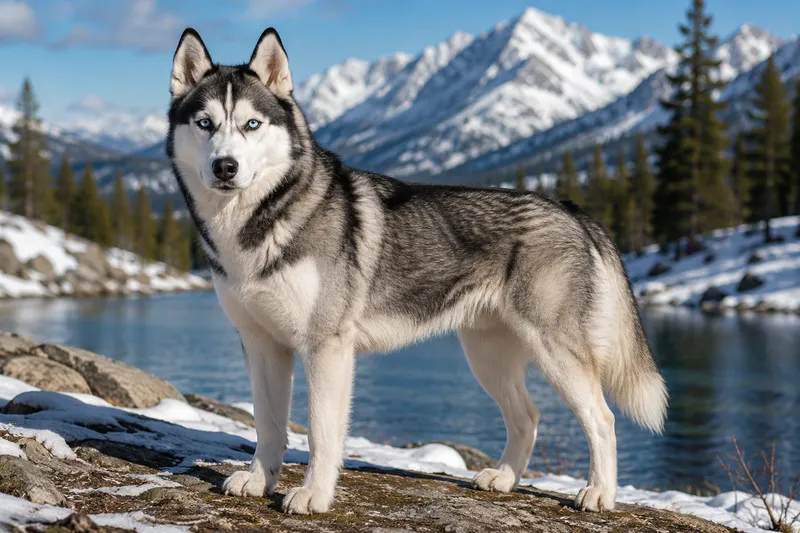
Siberian Husky
The Siberian Husky is a medium-sized northern working dog built to pull light loads at moderate speed across long distances. Moderate bone, balanced proportions, efficient movement, erect ears, a well-furred brush tail,…
Recognized by: AKC · ANKC · +5
Size
Medium
Weight
15.9–27.2 kg
Life span
12–14 years
Breed Traits
Energy Level
Very energetic
Energy Level: 5 of 5
Low energyHigh energyChild / Family Compatibility
High compatibility
Child / Family Compatibility: 4 of 5
Low compatibilityHigh compatibilityGrooming Need
High grooming need
Grooming Need: 4 of 5
Low maintenanceHigh maintenanceTrainability
Moderately trainable
Trainability: 3 of 5
Hard to trainEasy to trainApartment / Home Suitability
Struggles in small spaces
Apartment / Home Suitability: 2 of 5
Needs space / yardExcellent for apartmentsAlone-Time Tolerance
Half-day is hard
Alone-Time Tolerance: 2 of 5
Needs frequent companyHandles long alone timeFirst-Time Owner Suitability
Challenging for beginners
First-Time Owner Suitability: 2 of 5
Needs experienced ownerGreat for first-time ownersCompatibility with Other Pets
Can adapt with proper socialization
Compatibility with Other Pets: 3 of 5
Single-pet homes are a better fitHighly compatible with other animals
The Siberian Husky is a medium-sized northern working dog built to pull light loads at moderate speed across long distances. Moderate bone, balanced proportions, efficient movement, erect ears, a well-furred brush tail, and a dense double coat reflect endurance and economy rather than the massive power expected of a heavy freighting breed.
Its ancestors were developed by the Chukchi people of northeastern Siberia for transport in severe conditions while living closely with families. Dogs brought to Alaska in the early twentieth century became prominent in sled racing and expeditions, and Siberian teams were among those that carried lifesaving diphtheria serum toward Nome during the celebrated 1925 relay.
Modern Siberian Huskies continue to work in recreational and competitive mushing, skijoring, canicross, and other harness sports, while many live as active companions. Their striking appearance can obscure the practical realities of the breed: exceptional stamina, strong running and digging instincts, frequent vocalization, seasonal coat loss, and a need for secure containment and sustained daily involvement.
A typical Siberian Husky is friendly, gentle, alert, outgoing, and socially oriented, often showing enthusiasm toward visitors rather than the suspicion expected of a protection breed. Many enjoy children and other compatible dogs, but their exuberance and physical speed still call for supervision, considerate introductions, and practiced household manners.
Siberians are intelligent problem-solvers whose cooperation is not the same as automatic obedience. Reward-based training should begin early and emphasize engagement, recall foundations, leash skills, settling, handling, and impulse control, while owners remain realistic that an interesting trail, open gate, or moving animal can outweigh a familiar cue.
Howling, talking, digging, climbing, and testing barriers are normal possibilities rather than signs that the dog is deliberately misbehaving. Early socialization and calm, consistent boundaries are valuable, but successful ownership also depends on meeting the need for movement and companionship and preventing rehearsal of escape or chasing behavior through thoughtful management.
Healthy adult Siberian Huskies require substantial daily exercise and benefit from activities that provide a purposeful outlet for running and pulling. Long walks, hiking, controlled running, harness sports, scent games, and structured training can be combined according to age and conditioning, while growing puppies need age-appropriate activity that does not overload developing joints.
The double coat has a soft insulating undercoat beneath straighter guard hairs and sheds heavily when the undercoat is released, commonly once or twice a year. Thorough brushing several times a week and more often during these coat blows, along with nail trimming, dental care, and periodic ear and skin checks, is more appropriate than shaving a healthy coat for convenience.
Secure fencing, careful door routines, identification, and a leash or long line in unenclosed places are central safety measures because running and prey-chasing instincts can be powerful. The breed can live in warmer regions when owners provide shade, water, cool indoor rest, and exercise during cooler hours, but strenuous activity should stop when heat or humidity creates a risk of overheating.
Hip dysplasia and inherited eye disease are principal screening concerns in Siberian Huskies. Breeding dogs should receive a recognized hip evaluation and examination by a qualified veterinary ophthalmologist, with eye testing repeated at the intervals required by the applicable program because some abnormalities may emerge after an earlier normal result.
Two breed-specific neurologic conditions now addressed through DNA testing are Siberian Husky Shaking Puppy Syndrome Type 1 and Siberian Husky Polyneuropathy Type 1. Responsible use of these results can prevent affected matings without automatically removing every healthy carrier from the breeding population, which helps preserve genetic diversity while managing recessive disease risk.
A responsible breeder should provide verifiable hip, current ophthalmologist, SPS1, and SHPN1 results for both parents and explain any additional regional requirements such as gonioscopy for primary lens angle assessment. Buyers should also discuss vision, mobility, neurologic disease, longevity, and temperament among close relatives, while owners should seek veterinary assessment for persistent lameness, altered vision, tremors, weakness, unusual gait, or reduced exercise tolerance. This information is for general educational purposes and is not a substitute for diagnosis or treatment by a veterinarian.
Recognizing organizations
Independent registries that list this breed. Tap a badge to learn more.
These statuses reflect each registry’s recording and show systems. They are not a health, quality, or superiority score.
AKCFull recognitionhttps://www.akc.org/dog-breeds/siberian-husky/ ANKCFull recognitionhttps://dogsaustralia.org.au/members/breeds/breed-standards/Siberian-Husky CKCRecognized breedhttps://www.ckc.ca/en/Choosing-a-Dog/Choosing-a-Breed/Working-Dogs/Siberian-Husky FCIDefinitive recognitionhttps://www.fci.be/en/nomenclature/siberian-husky-270.html NZKCRecognised breedhttps://www.dogsnz.org.nz/breeds/info/siberian-husky/642 RKCBreed Registerhttps://www.royalkennelclub.com/search/breeds-a-to-z/breeds/working/siberian-husky/ UKCFull recognitionhttps://www.ukcdogs.com/siberian-husky
Frequently asked questions
Are Siberian Huskies good family dogs?
A well-socialized Siberian Husky is often friendly, playful, and affectionate with family members, including considerate children. Adults should supervise interactions, teach calm greetings, and ensure that the dog's exercise, training, companionship, and secure-management needs fit the household.
How much exercise does a Siberian Husky need?
Most healthy adults need substantial daily activity and mental engagement rather than only short neighborhood walks. Hiking, controlled running, harness sports, scent games, and training should be matched to the dog's age, conditioning, joint development, weather, and veterinary guidance.
Can a Siberian Husky live in an apartment?
Apartment life can work for an exceptionally committed household that provides sufficient outdoor exercise, enrichment, toilet access, training, and companionship every day. Vocalization, limited indoor space, shared walls, and the difficulty of providing safe running opportunities make this arrangement more demanding than a securely fenced home.
Can Siberian Huskies safely walk off leash?
A strong running instinct, curiosity, and prey drive can carry a Siberian far beyond recall range even when the dog understands the cue. Secure fenced areas and suitable leashes or long lines are generally safer than routine off-leash freedom in unenclosed locations.
Can Siberian Huskies live with cats and other pets?
Many Siberians enjoy compatible dogs because the breed was developed for cooperative team work, but responses to smaller animals vary considerably. Early exposure does not erase prey drive, so cats, rabbits, birds, livestock, and unfamiliar small dogs may require controlled introductions, separation, and lifelong supervision.
Do Siberian Huskies bark or howl frequently?
Siberians are often highly vocal and may howl, whine, yodel, or produce conversational sounds even if they are not persistent conventional barkers. Exercise, companionship, calm routines, and reinforced quiet behavior can reduce problem noise, but owners should not expect to remove a normal breed tendency entirely.
How much grooming does a Siberian Husky need?
The dense double coat needs regular thorough brushing and releases a large volume of undercoat during seasonal shedding periods. More frequent brushing during coat blows, together with nail, dental, ear, and skin care, is preferable to shaving a healthy coat for easier maintenance.
What health screening should a Siberian Husky breeder provide?
Current parent-club recommendations include hip evaluation, ophthalmologist examination, and DNA results for SPS1 and SHPN1. Buyers should verify the records for both parents and ask whether repeated eye testing, gonioscopy, or additional screening is required in the breeder's country or relevant to the bloodlines.
More about Siberian Husky
Pet profiles are coming soon. For now, keep exploring trusted breed knowledge in the Breed Guide.
Back to Breed Guide