

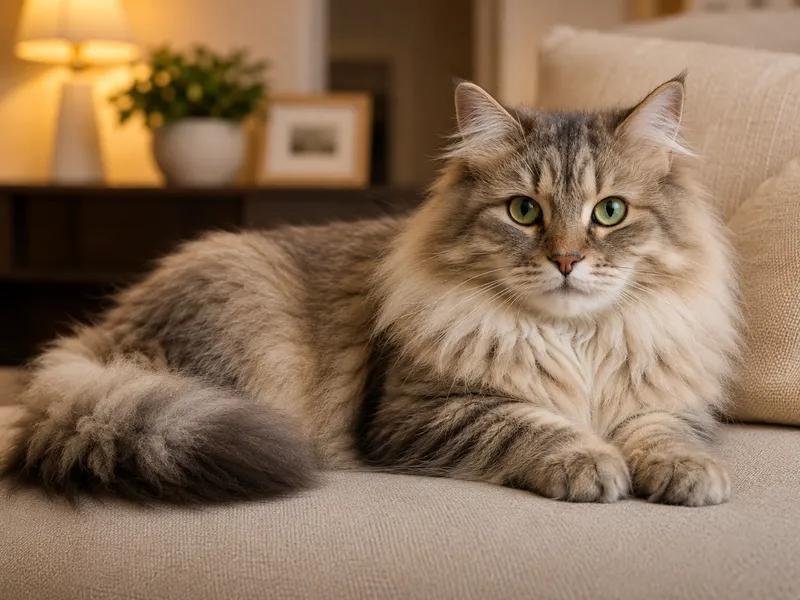
Siberian
The Siberian is a medium-to-large, powerfully built cat with substantial bone, strong musculature, rounded body contours, and hind legs that are slightly longer than the front legs. Its semi-long seasonal coat includes…
Recognized by: CFA · FIFe · +2
Size
Large
Weight
4–9 kg
Life span
11–18 years
Breed Traits
Energy Level
High energy
Energy Level: 4 of 5
Low energyHigh energyChild / Family Compatibility
Very high compatibility
Child / Family Compatibility: 5 of 5
Low compatibilityHigh compatibilityGrooming Need
High grooming need
Grooming Need: 4 of 5
Low maintenanceHigh maintenanceTrainability
Easy to train
Trainability: 4 of 5
Hard to trainEasy to trainApartment / Home Suitability
Fits apartments well
Apartment / Home Suitability: 4 of 5
Needs space / yardExcellent for apartmentsAlone-Time Tolerance
Handles a typical workday
Alone-Time Tolerance: 3 of 5
Needs frequent companyHandles long alone timeFirst-Time Owner Suitability
Suitable for many first-timers
First-Time Owner Suitability: 4 of 5
Needs experienced ownerGreat for first-time ownersCompatibility with Other Pets
Generally gets along well with other pets
Compatibility with Other Pets: 4 of 5
Single-pet homes are a better fitHighly compatible with other animals
The Siberian is a medium-to-large, powerfully built cat with substantial bone, strong musculature, rounded body contours, and hind legs that are slightly longer than the front legs. Its semi-long seasonal coat includes a dense undercoat and protective outer layers, becoming especially full during colder months.
The breed developed from longhaired domestic cat populations associated with Russia and the forested regions of Siberia. Cats of this general type have been described for generations, but documented pedigree development and formal breed standards largely emerged through organized Russian cat breeding during the late twentieth century.
Siberians mature slowly and may take up to five years to develop their full body, head shape, and adult coat. They combine a substantial appearance with agility, playful intelligence, and a strong interest in family life.
Siberians are generally affectionate, confident, playful, and closely engaged with their household. Many follow familiar people between rooms, greet them with chirps or soft vocalizations, and enjoy staying nearby without requiring constant physical attention.
Their intelligence and athletic ability are often expressed through climbing, retrieving toys, opening simple obstacles, investigating water, and learning household routines. They benefit from interactive games and reward-based training that give them appropriate ways to solve problems.
Well-socialized Siberians can live successfully with respectful children, compatible cats, and cat-friendly dogs. Individual personalities vary, and introductions should remain gradual so every animal has control over distance, interaction, and access to quiet retreat areas.
The dense semi-long coat should usually be combed several times a week to remove loose hair and prevent tangles. Grooming may need to become daily when the heavy winter coat is shed, with particular attention to the ruff, armpits, belly, and hindquarters.
Siberians need daily physical activity and mental stimulation despite their adaptable nature. Stable climbing furniture, sturdy scratching posts, puzzle feeders, retrieving games, and several interactive play sessions help maintain muscle condition and reduce boredom.
Routine care should include dental hygiene, nail trimming, ear checks, body-condition monitoring, and regular veterinary examinations. Food portions should reflect the individual cat's age, activity, health, and body condition because a naturally substantial frame should not be confused with excess weight.
Hypertrophic cardiomyopathy has been documented in Siberians and is an important condition for responsible breeding programs to monitor. There is currently no validated Siberian-specific DNA test that can rule out all forms of HCM, so veterinary cardiac assessment and an honestly documented family health history are more informative than unrelated breed-specific genetic tests.
Polycystic kidney disease and pyruvate kinase deficiency have also been monitored in some Siberian breeding lines, although they should not be presented as inevitable or equally common throughout the breed. Prospective owners can ask which tests are relevant to the specific pedigree and request copies of available results rather than accepting broad claims that a line is completely free from disease.
Regular veterinary care should monitor heart health, kidney function, dental condition, mobility, weight, and changes in breathing, stamina, appetite, or activity. This information is for general educational purposes and is not a substitute for diagnosis or treatment by a veterinarian.
Recognizing organizations
Independent registries that list this breed. Tap a badge to learn more.
These statuses reflect each registry’s recording and show systems. They are not a health, quality, or superiority score.
Frequently asked questions
Are Siberian cats good family pets?
Siberians are often affectionate, playful companions in households that provide regular interaction and respectful handling. They commonly adapt well to children and compatible pets, although every introduction should be supervised and gradual.
Can a Siberian cat live in an apartment?
A Siberian can live successfully in an apartment when it has stable vertical territory, scratching areas, daily play, and enough room to move comfortably. Their athletic ability makes strong, appropriately sized climbing furniture particularly important.
Can Siberian cats be left alone during the day?
Many adult Siberians can manage ordinary working-day absences when their environment is secure and enriched. They remain socially engaged cats and should receive predictable companionship, play, and attention before and after periods alone.
How much grooming does a Siberian need?
The coat usually needs thorough combing several times a week. During heavy seasonal shedding, daily grooming may be necessary to remove loose undercoat and prevent tangles around friction-prone areas.
Are Siberian cats hypoallergenic?
No cat breed can be guaranteed to be hypoallergenic. Some Siberians may produce lower amounts of certain allergens than some other cats, but individual levels and human reactions vary considerably.
How large do Siberian cats become?
Siberians are substantial medium-to-large cats, with males typically becoming larger than females. Healthy adult weight varies by sex, lineage, and body condition, and the breed may continue developing physically for several years.
Are Siberian cats easy to train?
Many Siberians respond well to short, positive training sessions because they are curious, food-motivated, and interested in interaction. They may learn retrieving games, carrier routines, recall cues, simple tricks, or harness skills.
What health screening should a Siberian breeder discuss?
A responsible breeder should discuss family cardiac history and the veterinary heart screening used for breeding cats. Depending on the pedigree, buyers may also ask about PKD and pyruvate kinase deficiency testing, while remembering that no single test guarantees lifelong health.
More about Siberian
Pet profiles are coming soon. For now, keep exploring trusted breed knowledge in the Breed Guide.
Back to Breed Guide