

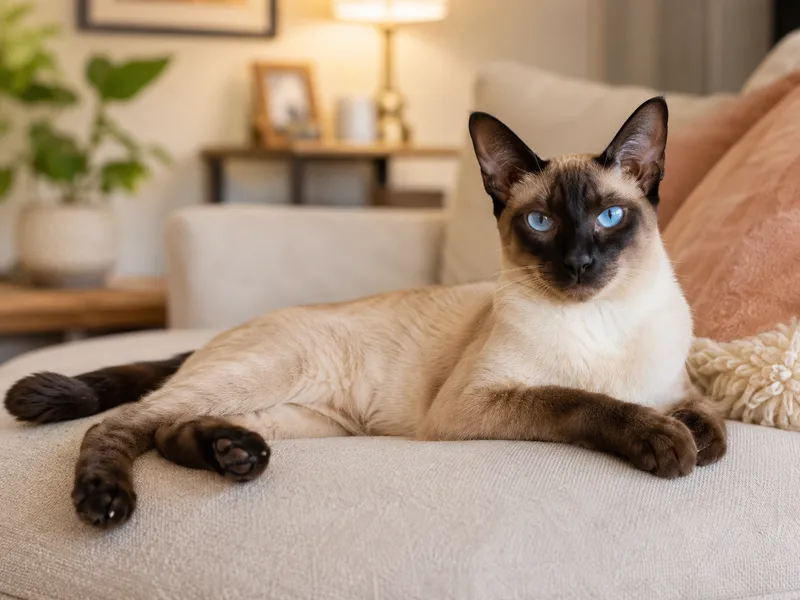
Siamese
The Siamese is a medium-sized, refined cat with a long tubular body, fine but strong bone, slender legs, a tapering tail, and a wedge-shaped head. Large ears and vivid blue almond-shaped eyes complete the breed's…
Recognized by: CFA · FIFe · +2
Size
Medium
Weight
2.3–6.8 kg
Life span
10–15 years
Breed Traits
Energy Level
Very energetic
Energy Level: 5 of 5
Low energyHigh energyChild / Family Compatibility
High compatibility
Child / Family Compatibility: 4 of 5
Low compatibilityHigh compatibilityGrooming Need
Low grooming need
Grooming Need: 1 of 5
Low maintenanceHigh maintenanceTrainability
Very easy to train
Trainability: 5 of 5
Hard to trainEasy to trainApartment / Home Suitability
Fits apartments well
Apartment / Home Suitability: 4 of 5
Needs space / yardExcellent for apartmentsAlone-Time Tolerance
Very short alone time (a few hours)
Alone-Time Tolerance: 1 of 5
Needs frequent companyHandles long alone timeFirst-Time Owner Suitability
Manageable with guidance
First-Time Owner Suitability: 3 of 5
Needs experienced ownerGreat for first-time ownersCompatibility with Other Pets
Generally gets along well with other pets
Compatibility with Other Pets: 4 of 5
Single-pet homes are a better fitHighly compatible with other animals
The Siamese is a medium-sized, refined cat with a long tubular body, fine but strong bone, slender legs, a tapering tail, and a wedge-shaped head. Large ears and vivid blue almond-shaped eyes complete the breed's distinctive angular appearance.
Its short, close-lying coat displays a colorpoint pattern, with darker pigment developing on the cooler areas of the body such as the face, ears, legs, and tail. Kittens are born pale, and their point color becomes more visible as they mature; accepted colors and patterns vary between registries.
The breed traces its heritage to pointed cats from Thailand, formerly Siam, that were described in historic Thai manuscripts and exported to Europe during the nineteenth century. Modern show Siamese were later developed toward a more elongated type, while the more moderate traditional form is recognized separately as the Thai by several registries.
Siamese cats are typically intelligent, active, vocal, and intensely interested in their household. Many follow people from room to room, respond to conversation, investigate daily activities, and use a wide range of sounds to request attention or express frustration.
They often enjoy retrieving toys, climbing, exploring puzzle feeders, learning simple cues, and participating in short reward-based training sessions. Their playful behavior commonly continues into adulthood, making daily mental and physical stimulation important.
Well-socialized Siamese can live successfully with respectful children, compatible cats, and cat-friendly dogs. Their strong social needs make them less suitable for homes where they would routinely spend long periods without interaction or environmental enrichment.
The short, fine coat is easy to maintain and usually needs only weekly gentle brushing or wiping to remove loose hair. The breed sheds, but its close-lying coat is not normally prone to tangles or mats.
Daily life should include interactive play, climbing structures, scratching areas, puzzle feeders, and opportunities to learn or explore. Siamese cats can adapt to apartment living, but their activity, vocal behavior, and need for companionship should be considered before choosing the breed.
Routine care should include dental hygiene, nail trimming, ear checks, body-condition monitoring, and regular veterinary examinations. Food portions should reflect the individual cat's age, activity, health, and body condition rather than being based on a single target weight.
Progressive retinal atrophy associated with the CEP290 rdAc variant occurs in Siamese and related breeds and may gradually impair vision. A DNA test is available to identify cats with zero, one, or two copies of this recessive variant, although it does not evaluate every possible cause of vision loss.
Mucopolysaccharidosis VI is a rare inherited lysosomal storage disorder with mild and severe forms for which DNA testing is available in Siamese and related breeds. Familial amyloidosis has also been reported in Siamese lines, often involving the liver, but its genetic basis is not fully resolved and there is no single routine DNA test that excludes every case.
Prospective owners should ask breeders about documented PRA rdAc and MPS VI results, family eye and liver health, longevity, and relevant veterinary records. This information is for general educational purposes and is not a substitute for diagnosis or treatment by a veterinarian.
Recognizing organizations
Independent registries that list this breed. Tap a badge to learn more.
These statuses reflect each registry’s recording and show systems. They are not a health, quality, or superiority score.
Frequently asked questions
Are Siamese cats good family pets?
Siamese cats can be affectionate and entertaining family companions when they receive regular interaction and respectful handling. They often enjoy children who understand how to play gently and allow the cat to move away when it needs space.
Are all Siamese cats very vocal?
Many Siamese are more vocal than the average cat and use different sounds to communicate with their household. Individual personalities vary, but prospective owners should be comfortable living with a cat that may frequently request attention or respond to conversation.
Can a Siamese cat live in an apartment?
A Siamese can live successfully in an apartment when provided with climbing areas, scratching surfaces, daily play, and regular companionship. Their vocal nature should also be considered in buildings where noise easily travels between homes.
Can Siamese cats be left alone during the day?
They can manage ordinary short absences, but they are poorly suited to frequent prolonged isolation. A predictable routine, enrichment, human attention, and sometimes a compatible animal companion can help meet their social needs.
How much grooming does a Siamese need?
The short coat usually needs only light weekly brushing or wiping to remove loose hair. Nail care, dental hygiene, ear checks, and routine veterinary care remain important even though coat maintenance is minimal.
Are Siamese cats easy to train?
Many Siamese learn quickly when training is brief, positive, and rewarding. They may learn carrier routines, recall cues, simple tricks, retrieving games, or harness skills, although participation should always remain voluntary.
Are Siamese cats hypoallergenic?
No cat breed is guaranteed to be hypoallergenic, and Siamese cats still produce common feline allergens. Their short coat may be easier to manage in the home, but coat length does not eliminate the risk of an allergic reaction.
What health testing should a Siamese breeder discuss?
A responsible breeder should discuss documented DNA screening for PRA rdAc and MPS VI, along with family eye and liver health. Buyers should also ask about longevity and unexplained liver disease in related cats because no single test can exclude every inherited condition.
More about Siamese
Pet profiles are coming soon. For now, keep exploring trusted breed knowledge in the Breed Guide.
Back to Breed Guide