

Serengeti
The Serengeti is a modern domestic breed created in California by conservation biologist and breeder Karen Sausman. Development began in 1995, using Bengal and Oriental Shorthair ancestry to produce a tall, spotted…
Recognized by: TICA
Size
Medium
Weight
3.6–6.8 kg
Life span
10–15 years
Breed Traits
Energy Level
Very energetic
Energy Level: 5 of 5
Low energyHigh energyChild / Family Compatibility
High compatibility
Child / Family Compatibility: 4 of 5
Low compatibilityHigh compatibilityGrooming Need
Low grooming need
Grooming Need: 1 of 5
Low maintenanceHigh maintenanceTrainability
Easy to train
Trainability: 4 of 5
Hard to trainEasy to trainApartment / Home Suitability
Moderate — depends on setup
Apartment / Home Suitability: 3 of 5
Needs space / yardExcellent for apartmentsAlone-Time Tolerance
Half-day is hard
Alone-Time Tolerance: 2 of 5
Needs frequent companyHandles long alone timeFirst-Time Owner Suitability
Manageable with guidance
First-Time Owner Suitability: 3 of 5
Needs experienced ownerGreat for first-time ownersCompatibility with Other Pets
Generally gets along well with other pets
Compatibility with Other Pets: 4 of 5
Single-pet homes are a better fitHighly compatible with other animals
The Serengeti is a modern domestic breed created in California by conservation biologist and breeder Karen Sausman. Development began in 1995, using Bengal and Oriental Shorthair ancestry to produce a tall, spotted companion cat inspired by the African serval's outline. Unlike the Savannah, the Serengeti was not developed through serval crosses and has no required recent wild-cat ancestry.
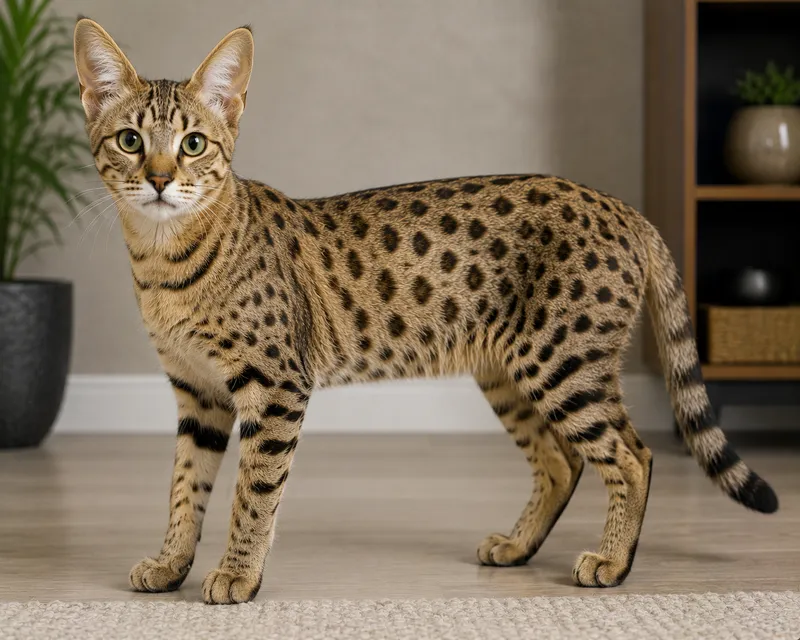
This is a medium-sized, long-legged, squarely built cat with firm musculature, an upright stance, a long neck, and a relatively small head. Exceptionally large, round-tipped ears are set high on the head, while the large round eyes are commonly gold to amber. The overall appearance should be graceful and statuesque rather than heavy.
The coat is short, close-lying, and silky. TICA describes yellow-to-gold cats with widely spaced black spots, solid black cats, cool grey cats with dark spotting, and silver cats with black spotting. A Serengeti should not be identified from appearance alone without reliable pedigree documentation.
Serengetis are generally confident, alert, outgoing, and strongly interested in household activity. Some may be briefly cautious in a new setting, but many become closely attached to familiar people and prefer to follow or supervise them throughout the home.
They are extremely agile and active cats that enjoy running, climbing, jumping, retrieving, food puzzles, and short training sessions. Oriental ancestry may contribute to a talkative communication style, and some individuals readily answer people with chirps, trills, and persistent meows.
Well-socialized Serengetis may live successfully with respectful children, compatible cats, and cat-friendly dogs after gradual introductions. Their high play intensity can overwhelm a timid companion, and normal feline hunting behaviour may make birds, rodents, fish, or other small animals unsafe housemates.
The short, tight coat is usually simple to maintain. Weekly brushing with a soft brush or grooming glove can remove loose hair and help reveal skin irritation, parasites, wounds, or changes in body condition. Additional grooming may be useful during seasonal shedding.
Daily physical and mental activity is essential. Provide tall, stable climbing structures, long scratching surfaces, interactive toys, food puzzles, training opportunities, and several energetic play sessions. Breakable objects, toxic plants, cords, cupboards, windows, and balconies should be secured for a persistent cat capable of powerful jumps.
Routine care should also include dental hygiene, nail trimming, clean litter facilities, and measured portions of a complete life-stage-appropriate diet. A safe indoor home or secure enclosure protects the cat and local wildlife, while regular hands-on body-condition checks help prevent excess weight without discouraging healthy muscle.
Published health research focused specifically on the Serengeti remains very limited, and no single inherited disorder is firmly established as a defining breed-wide condition. The absence of a well-documented disorder should not be interpreted as proof that every individual or family line is free from genetic disease.
The breed was developed from Bengal and Oriental Shorthair ancestry, but that history does not mean every disorder or DNA variant reported in either foundation breed is automatically present in the Serengeti. Genetic testing should be selected according to documented pedigree information, variants already identified in the family line, and veterinary guidance; a broad panel result does not provide complete health clearance.
Prospective owners should ask for family records covering longevity, heart and kidney health, vision, mobility, known illnesses, and causes of death. Breeders should combine veterinary examinations, pedigree review, genetic diversity, and line-appropriate testing rather than selecting only for appearance. This information is for general educational purposes and is not a substitute for diagnosis or treatment by a veterinarian.
Recognizing organizations
Independent registries that list this breed. Tap a badge to learn more.
These statuses reflect each registry’s recording and show systems. They are not a health, quality, or superiority score.
Frequently asked questions
Are Serengeti cats good family pets?
Serengetis can be affectionate and highly involved companions for active households. Families should be prepared for substantial daily play, climbing, training, and vocal interaction rather than expecting a quiet, low-demand cat.
Are Serengeti cats good with children?
Many well-socialized Serengetis may live successfully with respectful children who understand feline body language. Adults should supervise interactions because rough handling or uncontrolled chasing can frighten the cat, while vigorous feline play can overwhelm a young child.
Do Serengeti cats get along with other pets?
They may live successfully with compatible cats and confident cat-friendly dogs after slow introductions. Their speed and intense play style can be difficult for timid animals, and small prey species should be securely separated.
Can a Serengeti live in an apartment?
Apartment living is possible when the home provides extensive vertical territory, vigorous daily play, puzzle activities, and secure windows or balconies. A small environment without climbing routes or regular interaction is unlikely to meet this active breed's needs.
Can Serengeti cats be left alone during the day?
Many adults can manage ordinary short absences, but frequent prolonged isolation is not ideal for a social and energetic Serengeti. Enrichment and a compatible animal companion may help, but they do not replace dependable daily human interaction.
How much grooming does a Serengeti need?
The short, close coat usually needs only light weekly brushing. Nail care, dental hygiene, skin checks, and body-condition monitoring generally require more attention than coat maintenance.
Is the Serengeti part serval or the same as a Savannah?
No. The Serengeti was developed from domestic Bengal and Oriental Shorthair ancestry to resemble aspects of the serval's outline, while the Savannah descends from serval–domestic cat crosses. They are separate breeds with different histories and registry standards.
What health screening should a Serengeti breeder provide?
No universally accepted Serengeti-specific DNA panel guarantees overall health. Ask for veterinary records, a documented pedigree, family health and longevity information, and the reasons for any DNA or clinical screening selected for that particular breeding line.
More about Serengeti
Pet profiles are coming soon. For now, keep exploring trusted breed knowledge in the Breed Guide.
Back to Breed Guide