

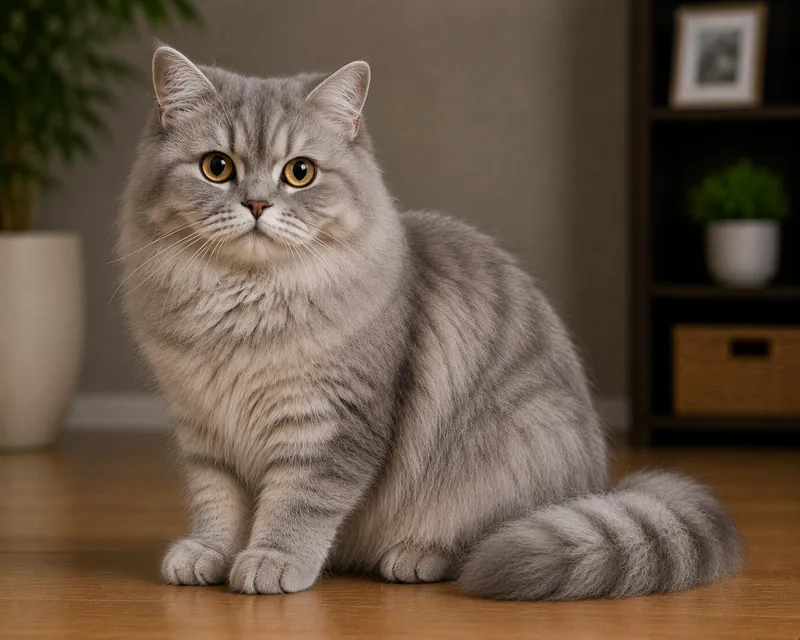
Scottish Straight Longhair
The Scottish Straight Longhair is the upright-eared, long-coated member of the Scottish breed group. Its history is inseparable from the Scottish Fold and traces to Susie, a white farm cat with naturally folded ears…
Recognized by: CFA · TICA
Size
Medium
Weight
3.2–4.5 kg
Life span
11–14 years
Breed Traits
Energy Level
Moderate energy
Energy Level: 3 of 5
Low energyHigh energyChild / Family Compatibility
High compatibility
Child / Family Compatibility: 4 of 5
Low compatibilityHigh compatibilityGrooming Need
High grooming need
Grooming Need: 4 of 5
Low maintenanceHigh maintenanceTrainability
Easy to train
Trainability: 4 of 5
Hard to trainEasy to trainApartment / Home Suitability
Excellent apartment fit
Apartment / Home Suitability: 5 of 5
Needs space / yardExcellent for apartmentsAlone-Time Tolerance
Half-day is hard
Alone-Time Tolerance: 2 of 5
Needs frequent companyHandles long alone timeFirst-Time Owner Suitability
Manageable with guidance
First-Time Owner Suitability: 3 of 5
Needs experienced ownerGreat for first-time ownersCompatibility with Other Pets
Generally gets along well with other pets
Compatibility with Other Pets: 4 of 5
Single-pet homes are a better fitHighly compatible with other animals
The Scottish Straight Longhair is the upright-eared, long-coated member of the Scottish breed group. Its history is inseparable from the Scottish Fold and traces to Susie, a white farm cat with naturally folded ears discovered in Scotland in 1961. Straight-eared kittens remained essential to breed development because they could be paired with folded-ear cats without deliberately producing homozygous fold offspring.
This is a medium-sized, rounded cat with a broad head, large round eyes, full cheeks, a short neck, a well-padded body, sturdy legs, and a flexible medium-to-long tail. The ears are upright, medium to small, rounded at the tips, and set widely enough to preserve the characteristic open expression.
The semi-long to long coat is dense and stands away from the body, with a full tail plume and possible ruff, britches, toe tufts, and ear furnishings. Many genetically possible colours and patterns occur. The name Highland Straight is also used for the longhaired straight-eared form in some breeding and testing contexts, but BondPals uses the registry name Scottish Straight Longhair.
Scottish Straight Longhairs are generally described as gentle, intelligent, inquisitive, and closely interested in household activity. Many follow familiar people between rooms and enjoy resting nearby without demanding continuous carrying or lap time.
They are moderately playful and often enjoy wand toys, retrieving games, food puzzles, and short training sessions. Their calm appearance should not be mistaken for inactivity; a healthy individual should move, climb, run, and jump comfortably, and a decline in normal movement deserves attention.
Well-socialized individuals may live successfully with respectful children, compatible cats, and calm cat-friendly dogs. They often value regular companionship and predictable routines, although individual confidence and tolerance vary. Gradual introductions and quiet retreat areas remain important.
The dense semi-long coat usually needs thorough combing several times a week, with daily attention during heavier seasonal shedding or whenever tangles begin to form. Focus on the ruff, belly, armpits, hindquarters, areas behind the ears, toe tufts, and tail plume.
Use a comb that reaches through the coat without scraping the skin, and remove small tangles before they tighten into painful mats. Scissors should not be used close to the skin because folded skin can be hidden inside a mat. Persistent greasiness, sudden matting, bald areas, dandruff, or skin irritation warrants veterinary assessment.
Daily care should also include interactive play, stable scratching and climbing furniture, dental hygiene, nail trimming, clean litter facilities, and measured portions of a complete life-stage-appropriate diet. Hands-on body-condition checks are important because the full coat and rounded outline can conceal gradual weight gain.
The intended Scottish Straight genotype is wild type at the fold-associated TRPV4 c.1024G>T locus. A true N/N cat does not carry that variant and therefore does not inherit Scottish Fold osteochondrodysplasia from it. Adult ear appearance alone is not reliable proof: a 2026 study found that some heterozygous cats developed folded ears as kittens and later appeared straight-eared, creating genetically affected cryptic folds.
Documented TRPV4 testing is therefore important before breeding or when ancestry is uncertain. A cat carrying one copy may have variable cartilage and skeletal effects even if its ears later appear upright, while two copies are associated with more severe disease. Stiffness, an altered gait, enlarged joints, an inflexible tail, reduced jumping, or pain when handled requires veterinary assessment.
The autosomal dominant PKD1 variant is also relevant, and veterinary genetics laboratories list Scottish Straight and Highland Straight as appropriate for testing. A negative result excludes the tested PKD1 variant but not every kidney disorder. Prospective owners should request TRPV4 and PKD1 results, veterinary records, and family information covering mobility, chronic pain, heart and kidney health, longevity, and causes of death. This information is for general educational purposes and is not a substitute for diagnosis or treatment by a veterinarian.
Recognizing organizations
Independent registries that list this breed. Tap a badge to learn more.
These statuses reflect each registry’s recording and show systems. They are not a health, quality, or superiority score.
Frequently asked questions
Are Scottish Straight Longhairs good family cats?
Scottish Straight Longhairs are generally gentle, affectionate, and comfortable in predictable family homes. They often enjoy staying near their people while retaining the freedom to withdraw when they want quiet.
Are Scottish Straight Longhairs good with children?
Many well-socialized individuals live successfully with respectful children. Adults should supervise interactions, prevent rough carrying, and teach children to let the cat leave whenever it chooses.
Do Scottish Straight Longhairs get along with other pets?
They often adapt to compatible cats and calm cat-friendly dogs after gradual introductions. Separate food, water, litter, hiding, and resting resources help prevent conflict and allow a reserved cat to settle at its own pace.
Can a Scottish Straight Longhair live in an apartment?
The variety is generally well suited to apartment living when provided with daily play, scratching surfaces, stable climbing furniture, observation points, and secure windows or balconies. Comfortable movement should be encouraged rather than restricted.
Can Scottish Straight Longhairs be left alone during the day?
Many adults can manage ordinary short absences when their routine is predictable. Frequent prolonged isolation is not ideal for a people-oriented cat, and enrichment does not fully replace dependable social contact.
How much grooming does a Scottish Straight Longhair need?
The dense semi-long coat usually needs combing several times a week and may need daily attention during heavy shedding. The ruff, belly, armpits, hindquarters, areas behind the ears, toe tufts, and tail plume are common areas for tangles.
What is the difference between a Scottish Straight Longhair and a Scottish Fold Longhair?
They share the same Scottish breed-group body type and long coat. The intended Straight Longhair is upright-eared and N/N for the fold-associated TRPV4 variant, while the Fold Longhair carries the variant; some carriers can later appear straight-eared, so DNA testing is more reliable than adult appearance alone.
What health screening should a Scottish Straight Longhair breeder provide?
Ask for documented TRPV4 testing confirming that the cat does not carry the fold-associated variant and for documented PKD1 results. Family health records and veterinarian-guided assessment of mobility, the heart, kidneys, and body condition remain important because no DNA panel guarantees complete health.
More about Scottish Straight Longhair
Pet profiles are coming soon. For now, keep exploring trusted breed knowledge in the Breed Guide.
Back to Breed Guide