

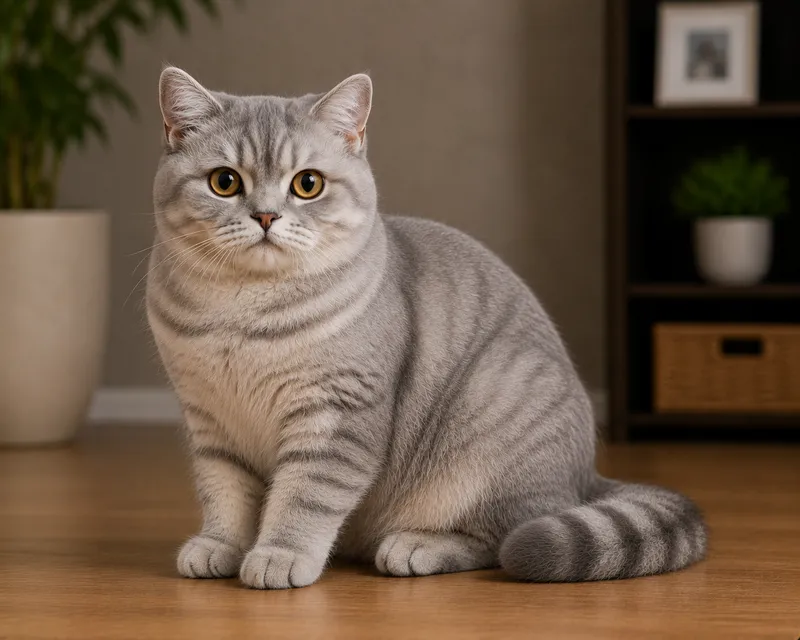
Scottish Straight
The Scottish Straight is the upright-eared, shorthaired member of the Scottish breed group. Its history is inseparable from the Scottish Fold and traces to Susie, a white farm cat with naturally folded ears discovered…
Recognized by: CFA · TICA
Size
Medium
Weight
3.2–4.5 kg
Life span
11–14 years
Breed Traits
Energy Level
Moderate energy
Energy Level: 3 of 5
Low energyHigh energyChild / Family Compatibility
High compatibility
Child / Family Compatibility: 4 of 5
Low compatibilityHigh compatibilityGrooming Need
Light grooming need
Grooming Need: 2 of 5
Low maintenanceHigh maintenanceTrainability
Easy to train
Trainability: 4 of 5
Hard to trainEasy to trainApartment / Home Suitability
Excellent apartment fit
Apartment / Home Suitability: 5 of 5
Needs space / yardExcellent for apartmentsAlone-Time Tolerance
Half-day is hard
Alone-Time Tolerance: 2 of 5
Needs frequent companyHandles long alone timeFirst-Time Owner Suitability
Manageable with guidance
First-Time Owner Suitability: 3 of 5
Needs experienced ownerGreat for first-time ownersCompatibility with Other Pets
Generally gets along well with other pets
Compatibility with Other Pets: 4 of 5
Single-pet homes are a better fitHighly compatible with other animals
The Scottish Straight is the upright-eared, shorthaired member of the Scottish breed group. Its history is inseparable from the Scottish Fold and traces to Susie, a white farm cat with naturally folded ears discovered in Scotland in 1961. Straight-eared kittens remained important within the developing population because the fold-associated trait follows dominant inheritance and responsible breeding avoids mating two variant-carrying cats.
This is a medium-sized, rounded cat with a broad head, large round eyes, full cheeks, a short neck, a well-padded body, medium boning, and sturdy legs ending in rounded paws. The ears are upright, medium to small, rounded at the tips, and set widely enough to preserve the characteristic open expression.
The short coat is dense, plush, resilient, and stands slightly away from the body rather than lying completely flat. Many colours, patterns, and eye colours occur according to registry rules. BondPals maintains Scottish Straight and Scottish Straight Longhair as separate Atlas records, while both remain members of the same Scottish breed family.
Scottish Straights are generally described as gentle, intelligent, inquisitive, and closely interested in household activity. Many follow familiar people between rooms and prefer remaining nearby without demanding continuous carrying or lap time.
They are moderately playful and often enjoy wand toys, retrieving games, food puzzles, and short training sessions. Many prefer stable surfaces and lower climbing routes rather than being carried frequently, but healthy individuals should still move, run, climb, and jump comfortably.
Well-socialized Scottish Straights may live successfully with respectful children, compatible cats, and calm cat-friendly dogs. They often value regular companionship and predictable routines, although individual confidence and tolerance vary. Gradual introductions and access to quiet resting places remain important.
The dense short coat usually benefits from weekly combing or brushing to remove loose hair and reduce shedding. Additional grooming may be useful during seasonal coat changes. The coat should also be checked for dandruff, parasites, skin irritation, lumps, or sudden changes in texture.
Daily interactive play is important because Scottish Straights may be enthusiastic eaters without being highly active. Provide scratching surfaces, stable climbing furniture, food puzzles, and measured portions of a complete life-stage-appropriate diet. Regular hands-on body-condition checks help identify weight gain before the rounded outline becomes misleading.
Routine care should also include dental hygiene, nail trimming, visible ear checks, clean litter facilities, and regular veterinary examinations. Reluctance to move, stiffness, an altered gait, reduced jumping, or sensitivity when handled should be assessed rather than attributed automatically to a calm breed temperament.
A genetically clear Scottish Straight has two normal copies of the fold-associated TRPV4 locus and does not inherit Scottish Fold osteochondrodysplasia from that variant. Adult ear appearance alone is not always sufficient proof: a 2026 study documented heterozygous cats whose initially folded ears became upright during maturation. Documented TRPV4 testing is therefore important for confirming that a straight-eared cat is N/N rather than a visually straightened variant carrier.
The autosomal dominant PKD1 variant is also relevant, and the UC Davis Veterinary Genetics Laboratory lists Scottish Straight as appropriate for testing. A negative result excludes the tested form of inherited polycystic kidney disease but does not rule out every possible kidney condition. Published breed-wide prevalence data for hypertrophic cardiomyopathy and other inherited disorders remain limited, so family history and veterinarian-guided cardiac assessment remain more informative than an unsupported breed-wide claim.
Prospective owners should request documented TRPV4 and PKD1 results together with veterinary records and family information covering mobility, chronic pain, heart and kidney health, longevity, and causes of death. Breeding programmes should use genetically clear Straights, appropriate clinical screening, verified pedigrees, and attention to genetic diversity; a DNA result does not guarantee overall health. This information is for general educational purposes and is not a substitute for diagnosis or treatment by a veterinarian.
Recognizing organizations
Independent registries that list this breed. Tap a badge to learn more.
These statuses reflect each registry’s recording and show systems. They are not a health, quality, or superiority score.
Frequently asked questions
Are Scottish Straights good family cats?
Scottish Straights are generally gentle, affectionate, and comfortable in predictable family homes. Well-socialized individuals often enjoy staying near their families while retaining the freedom to withdraw when they want quiet.
Are Scottish Straights good with children?
Many live successfully with respectful children who understand gentle handling and feline body language. Adults should supervise interactions, prevent rough carrying, and ensure that the cat can leave whenever it chooses.
Do Scottish Straights get along with other pets?
They often adapt to compatible cats and calm cat-friendly dogs after gradual introductions. Separate food, water, litter, hiding, and resting resources help prevent conflict and allow a reserved individual to settle at its own pace.
Can a Scottish Straight live in an apartment?
The breed is generally well suited to apartment living when provided with daily play, scratching surfaces, stable climbing furniture, observation points, and regular companionship. Windows and balconies should be securely protected.
Can Scottish Straights be left alone during the day?
Many adults can manage ordinary short absences when their routine is predictable. Frequent prolonged isolation is not ideal for a people-oriented cat, and enrichment does not fully replace dependable social contact.
How much grooming does a Scottish Straight need?
Weekly brushing or combing is sufficient for many shorthaired Scottish Straights. Grooming may need to increase during seasonal shedding, while dental care, nail trimming, and body-condition monitoring should remain part of the regular routine.
What is the difference between a Scottish Straight and a Scottish Fold?
They belong to the same Scottish breed group and share similar body type and temperament tendencies. A genetically clear Scottish Straight has upright ears and an N/N TRPV4 result, while a Scottish Fold carries the dominant variant responsible for folded ears and osteochondrodysplasia.
What health screening should a Scottish Straight breeder provide?
Ask for documented TRPV4 testing confirming N/N status and documented PKD1 results. Family health records and veterinarian-guided assessment of the heart, kidneys, mobility, and body condition remain important because no DNA panel guarantees complete health.
More about Scottish Straight
Pet profiles are coming soon. For now, keep exploring trusted breed knowledge in the Breed Guide.
Back to Breed Guide