

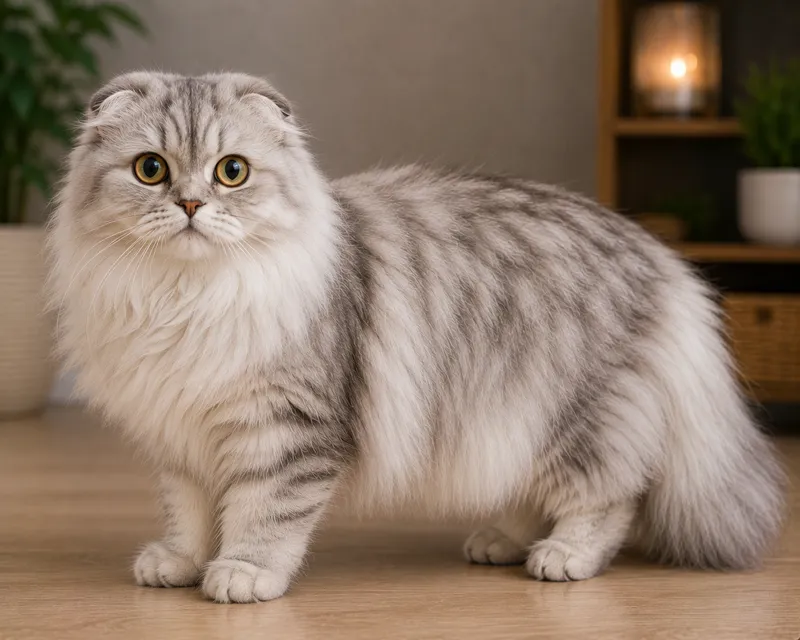
Scottish Fold Longhair
The Scottish Fold Longhair is the long-coated, folded-ear member of the Scottish breed group. The breed traces to Susie, a white farm cat with naturally folded ears found in Scotland in 1961. Her descendants were…
Recognized by: CFA · TICA
Size
Medium
Weight
3.2–4.5 kg
Life span
11–14 years
Breed Traits
Energy Level
Low energy
Energy Level: 2 of 5
Low energyHigh energyChild / Family Compatibility
High compatibility
Child / Family Compatibility: 4 of 5
Low compatibilityHigh compatibilityGrooming Need
High grooming need
Grooming Need: 4 of 5
Low maintenanceHigh maintenanceTrainability
Moderately trainable
Trainability: 3 of 5
Hard to trainEasy to trainApartment / Home Suitability
Excellent apartment fit
Apartment / Home Suitability: 5 of 5
Needs space / yardExcellent for apartmentsAlone-Time Tolerance
Half-day is hard
Alone-Time Tolerance: 2 of 5
Needs frequent companyHandles long alone timeFirst-Time Owner Suitability
Challenging for beginners
First-Time Owner Suitability: 2 of 5
Needs experienced ownerGreat for first-time ownersCompatibility with Other Pets
Generally gets along well with other pets
Compatibility with Other Pets: 4 of 5
Single-pet homes are a better fitHighly compatible with other animals
The Scottish Fold Longhair is the long-coated, folded-ear member of the Scottish breed group. The breed traces to Susie, a white farm cat with naturally folded ears found in Scotland in 1961. Her descendants were crossed with domestic and established pedigree cats, and longhaired offspring became part of the modern breed population.
This is a medium-sized, rounded cat with a broad head, large round eyes, a short neck, a well-padded body, and sturdy legs. Kittens are born with upright ears; in cats that inherit the fold-associated variant, the ears begin bending forward during the first weeks of life. The degree of folding varies, but ear shape does not reliably predict the severity of skeletal disease.
The semi-long to long coat stands away from the body and may include a ruff, britches, toe tufts, ear furnishings, and a full tail plume. Many genetically possible colours and patterns occur. BondPals treats Scottish Fold Longhair, Scottish Fold, Scottish Straight, and Scottish Straight Longhair as separate Atlas records because they are separate registry entries.
Scottish Fold Longhairs are generally described as gentle, affectionate, inquisitive, and closely attached to familiar people. Many prefer staying near household activity, following family members between rooms, and resting beside them rather than demanding continuous handling.
They are usually moderately playful rather than intensely athletic. Food puzzles, gentle retrieving games, wand toys, and accessible climbing areas can encourage movement and mental engagement. Reduced activity, reluctance to jump, or an unusual sitting posture should never automatically be interpreted as a charming breed habit because discomfort may alter behaviour.
Well-socialized individuals may live successfully with respectful children, compatible cats, and calm cat-friendly dogs. Interactions should remain gentle, and the cat should have quiet places where it can avoid handling or energetic companions. Frequent long periods without companionship may not suit this people-oriented breed.
The dense semi-long coat usually needs combing several times a week, and some cats benefit from daily attention during seasonal shedding. Focus on the ruff, belly, armpits, hindquarters, toe tufts, and tail plume, where loose coat and friction can produce tangles or mats.
Handle the ears, limbs, paws, spine, and tail gently. Never force the folded ears upright or repeatedly bend the tail to test flexibility. A stiff tail, swollen joints, altered gait, reluctance to jump, difficulty grooming, reduced play, or sensitivity when touched warrants veterinary assessment rather than more forceful handling.
Provide non-slip flooring, low-entry litter trays, stable steps or ramps, comfortable resting places, and play options that do not require repeated high-impact jumping. Measured portions of a complete life-stage-appropriate diet are important because excess weight adds strain to affected joints. Routine dental care, nail trimming, and regular veterinary examinations should accompany mobility monitoring.
The folded-ear phenotype is caused by an autosomal dominant TRPV4 c.1024G>T variant that alters cartilage and bone development. The same variant responsible for the ear shape is associated with Scottish Fold osteochondrodysplasia; it is not merely a cosmetic ear trait. Cats with two copies generally develop more severe disease, but heterozygous folded-ear cats can also develop skeletal abnormalities, osteoarthritis, pain, and reduced mobility with variable age of onset and severity.
Published studies do not agree on how often clinically obvious disease develops in responsibly bred heterozygous cats. Some reports document abnormalities in all examined folded-ear cats, while later controlled or smaller studies found much milder radiographic changes or clinical signs in only a minority. These differences do not establish the phenotype as harmless; they show that severity and progression are variable and that population-wide risk estimates remain uncertain.
Prospective owners should request the cat's TRPV4 result, parental genotypes, veterinary and mobility records, and family history of stiffness, lameness, joint enlargement, inflexible tails, and early arthritis. Breeding a folded-ear cat to a genetically clear straight-eared cat avoids homozygous kittens but does not remove the variant or guarantee that heterozygous folded-ear offspring will remain free from pain. This information is for general educational purposes and is not a substitute for diagnosis or treatment by a veterinarian.
Recognizing organizations
Independent registries that list this breed. Tap a badge to learn more.
These statuses reflect each registry’s recording and show systems. They are not a health, quality, or superiority score.
Frequently asked questions
Are Scottish Fold Longhairs good family cats?
They are often gentle, affectionate, and comfortable in calm family homes. Families must also be prepared for regular coat care, careful handling, and lifelong monitoring for pain or mobility changes associated with the fold-causing variant.
Are Scottish Fold Longhairs good with children?
Many well-socialized individuals can live with respectful children. Children should avoid carrying the cat against its wishes, manipulating the ears or tail, or encouraging high jumps, and adults should supervise interactions.
Do Scottish Fold Longhairs get along with other pets?
They often adapt to compatible cats and calm cat-friendly dogs after gradual introductions. A highly physical companion may be unsuitable for a cat that develops stiffness or joint discomfort, so play should be observed and separate resources provided.
Can a Scottish Fold Longhair live in an apartment?
The breed can adapt well to apartment living because activity levels are usually moderate. The home should still provide gentle daily play, non-slip surfaces, accessible resting places, low climbing routes, and secure windows or balconies.
How much grooming does a Scottish Fold Longhair need?
The semi-long coat generally needs combing several times a week and may need daily care during heavier shedding. The ruff, belly, armpits, hindquarters, toe tufts, and tail plume are common areas for tangles.
What is the difference between a Scottish Fold Longhair and a Scottish Straight Longhair?
Both belong to the same Scottish breed group and share the long coat and rounded body type. The Fold Longhair has folded ears and carries the TRPV4 variant, while a Scottish Straight Longhair has upright ears; documented genetic testing is needed to confirm whether an individual straight-eared cat is clear of the variant.
Does every Scottish Fold Longhair develop osteochondrodysplasia?
Every folded-ear cat carries the variant that alters cartilage, but the severity and timing of clinical disease vary. Some cats develop obvious pain, stiffness, or limb and tail changes, while others show milder signs; absence of symptoms when young is not a lifetime guarantee.
What health checks are important before obtaining a Scottish Fold Longhair?
Ask for documented TRPV4 testing, confirmation that a folded-ear cat was not produced from two variant-carrying parents, and veterinary records covering gait, joints, tail flexibility, and pain. Family history and ongoing veterinary mobility assessment remain important because DNA testing identifies the causal variant but cannot predict exact severity.
More about Scottish Fold Longhair
Pet profiles are coming soon. For now, keep exploring trusted breed knowledge in the Breed Guide.
Back to Breed Guide