

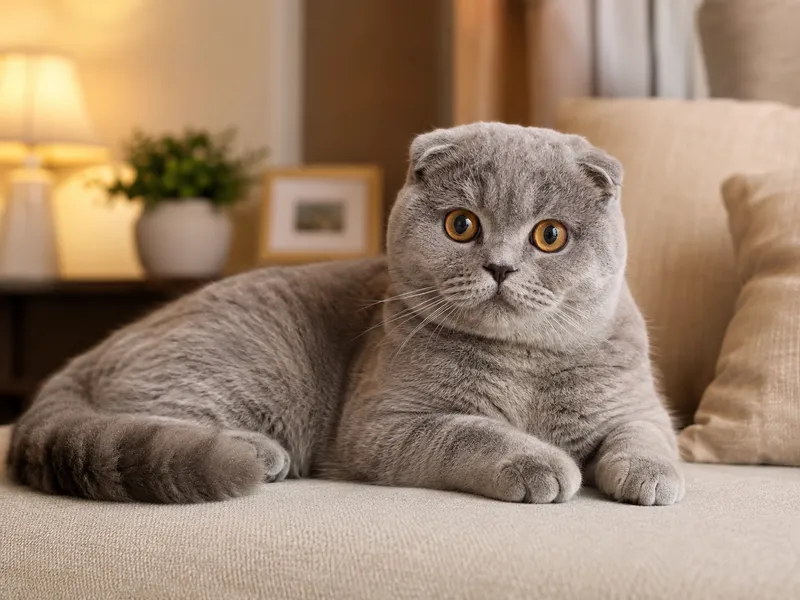
Scottish Fold
The Scottish Fold is a medium-sized, sturdy cat with a rounded head, large widely spaced eyes, a compact body, and a dense plush coat. This entry covers the shorthaired variety, whose defining feature is a pair of small…
Recognized by: CFA · TICA
Size
Medium
Weight
3.2–4.5 kg
Life span
11–14 years
Breed Traits
Energy Level
Moderate energy
Energy Level: 3 of 5
Low energyHigh energyChild / Family Compatibility
High compatibility
Child / Family Compatibility: 4 of 5
Low compatibilityHigh compatibilityGrooming Need
Light grooming need
Grooming Need: 2 of 5
Low maintenanceHigh maintenanceTrainability
Easy to train
Trainability: 4 of 5
Hard to trainEasy to trainApartment / Home Suitability
Excellent apartment fit
Apartment / Home Suitability: 5 of 5
Needs space / yardExcellent for apartmentsAlone-Time Tolerance
Half-day is hard
Alone-Time Tolerance: 2 of 5
Needs frequent companyHandles long alone timeFirst-Time Owner Suitability
Challenging for beginners
First-Time Owner Suitability: 2 of 5
Needs experienced ownerGreat for first-time ownersCompatibility with Other Pets
Generally gets along well with other pets
Compatibility with Other Pets: 4 of 5
Single-pet homes are a better fitHighly compatible with other animals
The Scottish Fold is a medium-sized, sturdy cat with a rounded head, large widely spaced eyes, a compact body, and a dense plush coat. This entry covers the shorthaired variety, whose defining feature is a pair of small ears that fold forward and downward close to the head.
Scottish Fold kittens are born with straight ears. In kittens that inherit the fold-associated variant, the ears usually begin folding during the first few weeks of life; straight-eared siblings are recognized separately by some registries as Scottish Straights.
The breed traces back to Susie, a naturally occurring folded-ear farm cat found in Scotland in 1961. Later breeding programs used selected domestic cats and established breeds to develop a consistent type, but the folded-ear feature remains directly linked to an inherited cartilage and bone disorder.
Scottish Folds are generally calm, observant, affectionate, and closely attached to familiar people. Many follow their owners between rooms, rest nearby, and enjoy gentle interaction without demanding constant attention.
They are moderately playful and may enjoy retrieving toys, puzzle feeders, interactive games, or short reward-based training sessions. Their activity level is usually lower than that of highly athletic breeds, but reduced movement should never automatically be dismissed as a personality trait.
Well-socialized Scottish Folds can live successfully with respectful children, compatible cats, and cat-friendly dogs. Handling should remain gentle, and no one should pull, bend, or manipulate the cat's tail, legs, or folded ears.
The short, dense coat usually benefits from weekly brushing to remove loose hair and maintain its plush texture. Additional grooming may be useful during seasonal shedding, while nail trimming, dental hygiene, ear checks, and routine veterinary care remain important.
Daily life should include moderate interactive play, accessible scratching surfaces, puzzle feeders, and stable furniture that does not require difficult jumps. Maintaining a healthy body condition is especially important because excess weight can place additional strain on already vulnerable joints.
Owners should regularly observe gait, willingness to jump, tail flexibility, activity level, and comfort during normal movement. A persistent change in any of these areas warrants veterinary assessment rather than being attributed to laziness or a naturally quiet temperament.
The folded ears are caused by a dominant variant in the TRPV4 gene that also alters cartilage and bone development throughout the body. Cats with one copy have folded ears and may develop Scottish Fold osteochondrodysplasia, including misshapen toes, a thick or inflexible tail, abnormal joints, and progressive osteoarthritis; cats with two copies are at risk of more severe disease.
DNA testing can determine whether a cat has zero, one, or two copies of the fold variant, but it cannot predict the exact age of onset or severity in a cat with one copy. Avoiding fold-to-fold matings prevents kittens with two copies, but it does not remove the skeletal disease risk carried by folded-ear kittens with one copy.
Prospective owners should ask for documented genotype results, family mobility history, and veterinary records, and should watch for stiffness, altered gait, reluctance to jump, swollen joints, or discomfort when handled. This information is for general educational purposes and is not a substitute for diagnosis or treatment by a veterinarian.
Recognizing organizations
Independent registries that list this breed. Tap a badge to learn more.
These statuses reflect each registry’s recording and show systems. They are not a health, quality, or superiority score.
Frequently asked questions
Are all Scottish Fold kittens born with folded ears?
No. All kittens are born with straight ears, and only kittens that inherit the fold-associated variant develop folded ears during the first few weeks of life. Straight-eared siblings may be registered separately as Scottish Straights.
Does every Scottish Fold have the joint-disease mutation?
Every folded-ear Scottish Fold carries at least one copy of the TRPV4 variant associated with osteochondrodysplasia. The age at which signs appear and their severity vary considerably, but the folded ear is not a harmless cosmetic feature.
Are Scottish Folds good family cats?
Scottish Folds are often calm and affectionate companions in homes that provide gentle handling and predictable routines. Children should be taught never to pull the tail, manipulate the joints, or treat quiet behavior as permission for unwanted handling.
Can a Scottish Fold live in an apartment?
Scottish Folds generally adapt well to apartment and indoor living. They still need daily play, scratching areas, comfortable resting places, and accessible furniture that does not require difficult jumps.
Can Scottish Folds be left alone during the day?
Many adults can manage ordinary short absences, but they usually prefer regular companionship and household involvement. Frequent prolonged isolation is not ideal, particularly when it makes changes in movement, appetite, or behavior harder to notice.
How much grooming does a Scottish Fold need?
A shorthaired Scottish Fold usually needs weekly brushing, with additional grooming during heavier shedding periods. Dental care, nail trimming, ear checks, weight monitoring, and observation of mobility are equally important.
What signs of joint discomfort should owners watch for?
Possible signs include a stiff or inflexible tail, limping, an altered gait, reluctance to jump, reduced activity, swollen joints, or discomfort when handled. These changes warrant veterinary assessment and should not simply be dismissed as laziness.
Why do some cat registries not recognize the Scottish Fold?
Recognition policies differ between organizations. Some registries accept the breed for championship competition, while others decline recognition because the ear-folding mutation is linked to inherited cartilage, bone, and joint disease.
More about Scottish Fold
Pet profiles are coming soon. For now, keep exploring trusted breed knowledge in the Breed Guide.
Back to Breed Guide