

Ragdoll
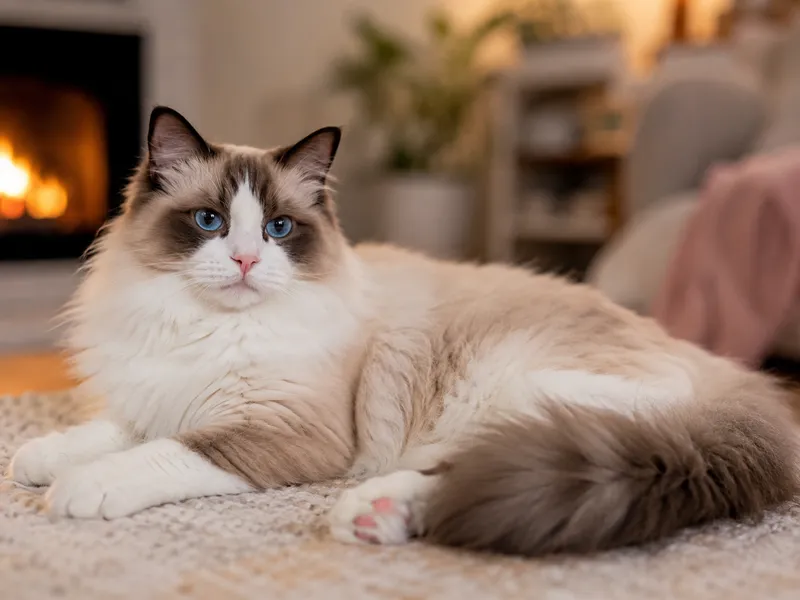
The Ragdoll is a large, muscular cat with a broad chest, substantial frame, vivid blue eyes, and a soft semi-long coat. Its pointed coloring produces darker shades on the face, ears, legs, and tail, while recognized…
Recognized by: CFA · FIFe · +2
Size
Large
Weight
4.5–9.1 kg
Life span
12–17 years
Breed Traits
Energy Level
Moderate energy
Energy Level: 3 of 5
Low energyHigh energyChild / Family Compatibility
High compatibility
Child / Family Compatibility: 4 of 5
Low compatibilityHigh compatibilityGrooming Need
Moderate grooming need
Grooming Need: 3 of 5
Low maintenanceHigh maintenanceTrainability
Easy to train
Trainability: 4 of 5
Hard to trainEasy to trainApartment / Home Suitability
Excellent apartment fit
Apartment / Home Suitability: 5 of 5
Needs space / yardExcellent for apartmentsAlone-Time Tolerance
Half-day is hard
Alone-Time Tolerance: 2 of 5
Needs frequent companyHandles long alone timeFirst-Time Owner Suitability
Suitable for many first-timers
First-Time Owner Suitability: 4 of 5
Needs experienced ownerGreat for first-time ownersCompatibility with Other Pets
Shows very high compatibility
Compatibility with Other Pets: 5 of 5
Single-pet homes are a better fitHighly compatible with other animals
The Ragdoll is a large, muscular cat with a broad chest, substantial frame, vivid blue eyes, and a soft semi-long coat. Its pointed coloring produces darker shades on the face, ears, legs, and tail, while recognized patterns include colorpoint, mitted, and bicolor.
The breed was developed in Riverside, California, during the 1960s by breeder Ann Baker from selected non-pedigreed domestic longhaired cats. Josephine, a white domestic longhair, is regarded as the foundation female, while later breeders helped establish a consistent standard and broader registry recognition.
Ragdolls mature slowly and may take several years to reach their full size, coat development, and adult coloring. Their substantial build and generally moderate activity level can suit indoor homes that provide companionship, appropriately sized equipment, and regular play.
Ragdolls are generally calm, affectionate, sociable, and strongly interested in their household. Many greet familiar people, follow them between rooms, rest nearby, and seek gentle attention without being constantly demanding.
They are moderately playful and may enjoy retrieving toys, puzzle feeders, wand games, or short reward-based training sessions. Kittens and young adults can be lively, while mature cats are often less intense than highly active breeds.
Well-socialized Ragdolls can live successfully with respectful children, compatible cats, and cat-friendly dogs. Not every individual goes limp when held, and the breed name should never be interpreted as permission for rough handling or unwanted carrying.
The Ragdoll's silky semi-long coat usually benefits from thorough combing once or twice a week to remove loose hair and prevent tangles. Extra attention may be needed around the armpits, chest, belly, and hindquarters, especially during seasonal shedding.
Daily care should include moderate interactive play, scratching areas, comfortable resting places, and stable climbing furniture sized for a large cat. Ragdolls often adapt well to indoor and apartment living, but regular movement and enrichment remain important for maintaining muscle condition and preventing boredom.
Routine care should include dental hygiene, nail trimming, ear checks, body-condition monitoring, and regular veterinary examinations. Food portions should reflect the individual cat's age, activity, health, and body condition because a large frame does not justify unrestricted feeding.
Hypertrophic cardiomyopathy is an important inherited health concern in Ragdolls. A breed-associated R820W variant in the MYBPC3 gene can be identified through DNA testing, but this test detects only that specific variant and cannot rule out every possible cause of feline HCM.
Polycystic kidney disease testing is also available for Ragdolls and may be relevant to particular pedigrees or breeding programs. Prospective owners should request documented HCM results, ask about family cardiac history and veterinary heart screening, and discuss any additional testing that is relevant to the specific line.
Regular veterinary care can help monitor heart health, kidney function, dental condition, body weight, and changes in breathing, stamina, appetite, or activity. This information is for general educational purposes and is not a substitute for diagnosis or treatment by a veterinarian.
Recognizing organizations
Independent registries that list this breed. Tap a badge to learn more.
These statuses reflect each registry’s recording and show systems. They are not a health, quality, or superiority score.
Frequently asked questions
Are Ragdoll cats good family pets?
Ragdolls are often affectionate family companions in homes that provide gentle handling, companionship, and predictable routines. They commonly live well with respectful children and compatible pets, although introductions and interactions should still be supervised.
Do all Ragdolls go limp when picked up?
No. Some Ragdolls relax deeply when held, while others prefer to keep control of their body or may not enjoy being carried. Each cat's boundaries should be respected rather than expecting a particular response because of the breed's name.
Can a Ragdoll live in an apartment?
Ragdolls generally adapt well to apartment living when they have daily play, scratching areas, stable climbing furniture, and enough room to move comfortably. Their moderate activity level does not remove the need for exercise and enrichment.
Can Ragdolls be left alone during the day?
Most adults can manage ordinary short absences, but they tend to value companionship and may struggle with frequent prolonged isolation. A predictable routine, enrichment, and dependable interaction before and after absences can help.
How much grooming does a Ragdoll need?
Combing once or twice a week is sufficient for many Ragdolls, although seasonal shedding or individual coat texture may increase the workload. Regular grooming also makes it easier to notice tangles, skin changes, or weight gain beneath the coat.
How large do Ragdoll cats become?
Adult females commonly weigh about 4.5 to 6.8 kilograms, while males often weigh about 6.8 to 9.1 kilograms. Healthy size varies with sex, lineage, and body condition, and the breed may take several years to mature fully.
Are Ragdoll cats easy to train?
Many Ragdolls respond well to brief, reward-based training because they are social and often food- or play-motivated. They may learn carrier routines, recall cues, retrieving games, simple tricks, or harness skills.
What health screening should a Ragdoll breeder discuss?
A responsible breeder should discuss DNA testing for the Ragdoll-associated HCM variant, family cardiac history, and any veterinary heart screening used for breeding cats. Buyers may also ask whether PKD1 testing is relevant to the pedigree, while remembering that no single test guarantees lifelong health.
More about Ragdoll
Pet profiles are coming soon. For now, keep exploring trusted breed knowledge in the Breed Guide.
Back to Breed Guide