

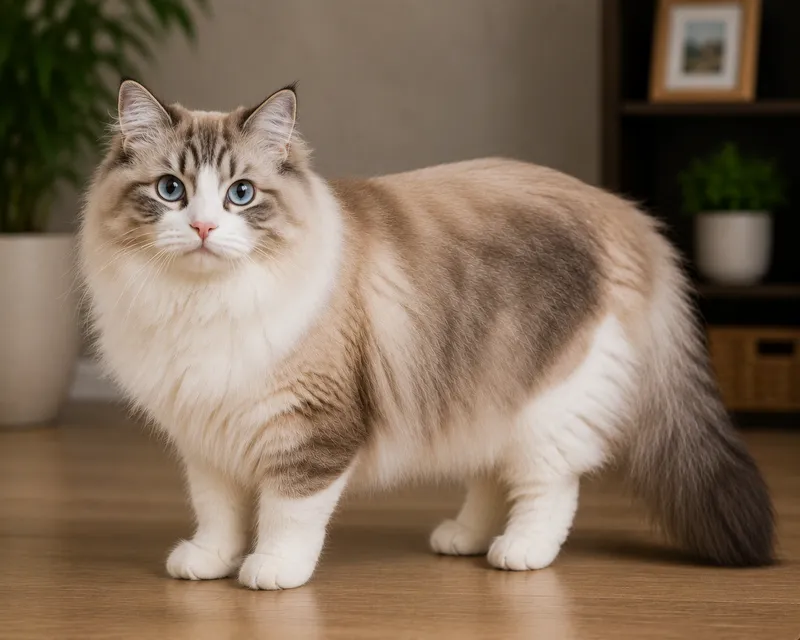
RagaMuffin
The RagaMuffin is a modern North American breed whose history is closely connected with the early Ragdoll breeding community. In 1994, a group of breeders left Ann Baker's International Ragdoll Cat Association and…
Recognized by: CFA · GCCF
Size
Large
Weight
4.5–9.1 kg
Life span
12–16 years
Breed Traits
Energy Level
Moderate energy
Energy Level: 3 of 5
Low energyHigh energyChild / Family Compatibility
High compatibility
Child / Family Compatibility: 4 of 5
Low compatibilityHigh compatibilityGrooming Need
Moderate grooming need
Grooming Need: 3 of 5
Low maintenanceHigh maintenanceTrainability
Easy to train
Trainability: 4 of 5
Hard to trainEasy to trainApartment / Home Suitability
Fits apartments well
Apartment / Home Suitability: 4 of 5
Needs space / yardExcellent for apartmentsAlone-Time Tolerance
Half-day is hard
Alone-Time Tolerance: 2 of 5
Needs frequent companyHandles long alone timeFirst-Time Owner Suitability
Manageable with guidance
First-Time Owner Suitability: 3 of 5
Needs experienced ownerGreat for first-time ownersCompatibility with Other Pets
Generally gets along well with other pets
Compatibility with Other Pets: 4 of 5
Single-pet homes are a better fitHighly compatible with other animals
The RagaMuffin is a modern North American breed whose history is closely connected with the early Ragdoll breeding community. In 1994, a group of breeders left Ann Baker's International Ragdoll Cat Association and established an independent programme. The proposed name Liebling was replaced by RagaMuffin, preserving a link to the breed's domestic-cat roots while creating a distinct registry identity.
Breeders retained a large, affectionate semi-longhaired companion type while using limited outcrossing to Domestic Longhairs and later Persians to broaden the foundation and develop a wider range of colours and patterns. CFA accepted the RagaMuffin for registration in 2003 and granted Championship status in 2011; GCCF granted Championship status in 2015.
A mature RagaMuffin is large, rectangular, muscular, and heavily boned, with a broad rounded head, full whisker pads, large walnut-shaped eyes, and a long plumed tail. The breed develops slowly and may not reach full physical maturity until about four years of age. Its soft, dense coat is medium to medium-long, and pointed cats are generally not eligible for championship exhibition under CFA and GCCF rules.
RagaMuffins are generally affectionate, trusting, even-tempered, and strongly interested in human companionship. Many greet family members, follow household activity, settle beside or on familiar people, and communicate without being persistently loud.
They are moderately active and often enjoy retrieving toys, food puzzles, gentle climbing, and short training sessions. Kittens and young adults can be lively, while mature cats commonly balance play with long periods of relaxed social contact.
Well-socialized individuals may live successfully with respectful children, compatible cats, and calm cat-friendly dogs. Their gentle nature can make them vulnerable to rough handling or an intrusive companion, so introductions should be gradual and the cat should always have quiet places to retreat.
The semi-long coat is soft, dense, and often relatively resistant to tangling, but it still benefits from thorough combing once or twice a week. Pay attention to the ruff, belly, armpits, hindquarters, and plumed tail, increasing grooming during seasonal shedding or whenever small tangles begin to form.
RagaMuffins are large, slow-maturing cats, so climbing furniture, carriers, beds, and litter trays should be stable and appropriately sized. Daily interactive play, scratching surfaces, food puzzles, and accessible observation areas help maintain muscle and prevent boredom without requiring constant high-intensity exercise.
Measured portions of a complete life-stage-appropriate diet and regular body-condition checks are important because the plush coat and substantial build can conceal gradual weight gain. Routine care should also include dental hygiene, nail trimming, clean litter facilities, and regular veterinary examinations.
Published breed-specific health prevalence data for the RagaMuffin remain limited. The Ragdoll-associated MYBPC3 R820W variant has been detected in some RagaMuffins, and the UC Davis Veterinary Genetics Laboratory lists the breed as appropriate for that test. A negative result excludes the tested variant but does not rule out other causes of hypertrophic cardiomyopathy, so family history and veterinarian-guided cardiac screening remain important.
The autosomal dominant PKD1 variant is also relevant because of Persian and related ancestry, and RagaMuffin is listed as appropriate for PKD1 testing. A positive result indicates risk of inherited polycystic kidney disease, while a negative result does not exclude every possible kidney disorder. Breeding cats should have documented results rather than relying on verbal assurances.
Prospective owners should request HCM and PKD1 test records, family information covering heart disease, kidney disease, sudden death, and longevity, and routine veterinary records. Blood typing is also valuable before breeding or transfusion because type incompatibility can have serious consequences; no single DNA panel guarantees overall health. This information is for general educational purposes and is not a substitute for diagnosis or treatment by a veterinarian.
Recognizing organizations
Independent registries that list this breed. Tap a badge to learn more.
These statuses reflect each registry’s recording and show systems. They are not a health, quality, or superiority score.
Frequently asked questions
Are RagaMuffins good family cats?
RagaMuffins are generally affectionate, patient, and strongly interested in family life. They may suit households that can provide gentle handling, regular companionship, play, and consistent coat care.
Are RagaMuffins good with children?
Many well-socialized RagaMuffins live successfully with respectful children. Adults should supervise interactions, prevent rough carrying or dressing-up play, and teach children to let the cat leave whenever it chooses.
Do RagaMuffins get along with other pets?
Many adapt well to compatible cats and calm cat-friendly dogs after gradual introductions. Because some are unusually trusting and non-confrontational, owners should make sure a more assertive animal does not block access to food, litter trays, or resting places.
Can a RagaMuffin live in an apartment?
The breed can adapt well to apartment living when provided with daily play, sturdy climbing and scratching furniture, comfortable observation areas, and regular human contact. Windows and balconies should be secured, and equipment should be large enough for a substantial adult cat.
Can RagaMuffins be left alone during the day?
Many adults can manage ordinary short absences, but frequent prolonged isolation is not ideal for this people-oriented breed. A predictable routine and varied enrichment help, although they do not replace dependable companionship.
How much grooming does a RagaMuffin need?
Combing once or twice a week is sufficient for many cats because the coat often resists severe tangling. Grooming should be increased during seasonal shedding and whenever knots begin forming around the ruff, belly, armpits, hindquarters, or tail.
What is the difference between a RagaMuffin and a Ragdoll?
The breeds share part of their early history, but they now have separate standards and registry identities. RagaMuffins occur in a broader range of show colours and patterns and are not defined by the blue-eyed pointed appearance required of traditional Ragdolls.
What health screening should a RagaMuffin breeder provide?
Ask for documented testing for the Ragdoll-associated MYBPC3 HCM variant and PKD1, together with family history and veterinary records. Cardiac assessment, kidney monitoring, blood typing for breeding cats, and attention to genetic diversity remain important because negative DNA results do not guarantee complete health.
More about RagaMuffin
Pet profiles are coming soon. For now, keep exploring trusted breed knowledge in the Breed Guide.
Back to Breed Guide