

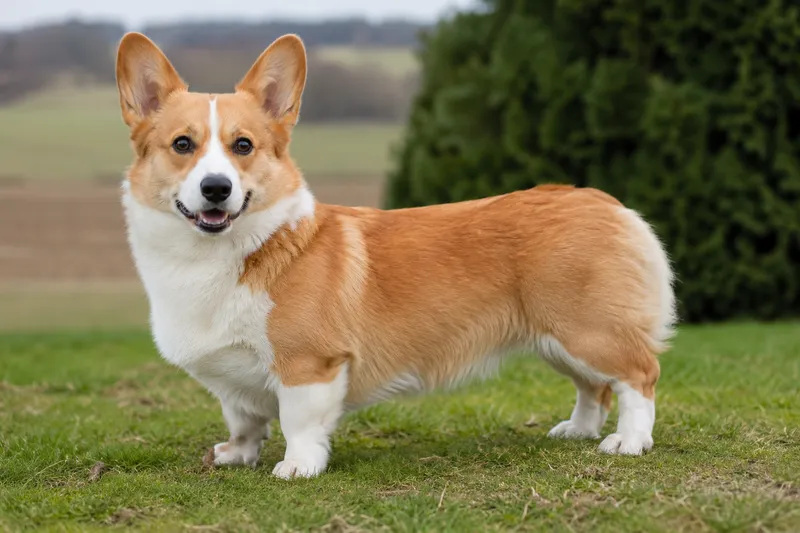
Pembroke Welsh Corgi
The Pembroke Welsh Corgi is a compact herding breed developed in Wales to help move cattle and perform other farm work. Its distant ancestry is debated, so stories linking it to one exact ancient breed should be treated…
Recognized by: AKC · ANKC · +5
Size
Small
Weight
9–13.6 kg
Life span
12–15 years
Breed Traits
Energy Level
High energy
Energy Level: 4 of 5
Low energyHigh energyChild / Family Compatibility
High compatibility
Child / Family Compatibility: 4 of 5
Low compatibilityHigh compatibilityGrooming Need
Moderate grooming need
Grooming Need: 3 of 5
Low maintenanceHigh maintenanceTrainability
Very easy to train
Trainability: 5 of 5
Hard to trainEasy to trainApartment / Home Suitability
Fits apartments well
Apartment / Home Suitability: 4 of 5
Needs space / yardExcellent for apartmentsAlone-Time Tolerance
Handles a typical workday
Alone-Time Tolerance: 3 of 5
Needs frequent companyHandles long alone timeFirst-Time Owner Suitability
Suitable for many first-timers
First-Time Owner Suitability: 4 of 5
Needs experienced ownerGreat for first-time ownersCompatibility with Other Pets
Generally gets along well with other pets
Compatibility with Other Pets: 4 of 5
Single-pet homes are a better fitHighly compatible with other animals
The Pembroke Welsh Corgi is a compact herding breed developed in Wales to help move cattle and perform other farm work. Its distant ancestry is debated, so stories linking it to one exact ancient breed should be treated as theories rather than settled history. The Pembroke and Cardigan Welsh Corgis are separate breeds with different standards, not coat or tail varieties of one Corgi.
A Pembroke is low-set because it is a chondrodysplastic breed, yet the intended dog is strong, athletic, and capable of free movement. It has upright ears, an alert expression, a weather-resistant double coat, and a body of moderate rather than exaggerated length. Accepted colors include red, sable, fawn, and black and tan, with or without permitted white markings.
Not every Pembroke is born without a tail. Individuals may have a natural bobtail or a full natural tail, while docking history and current law differ between countries. Royal patronage, particularly the association with Queen Elizabeth II, increased the breed's public visibility, but its working intelligence and active nature remain more important to daily life than its famous appearance.
Pembrokes are typically outgoing, alert, bold, and strongly engaged with their households. Many closely monitor people, movement, and sounds around the home, which can make them entertaining companions and effective alert dogs. The same vigilance may produce frequent barking if quiet behavior is never taught.
This is a quick-learning breed that often excels in obedience, rally, scent work, agility, and herding activities. Reward-based training should begin early and include impulse control, recall, calm greetings, and settling on cue. Their intelligence can also support demanding or self-directed behavior when rules are inconsistent or daily life lacks mental stimulation.
Herding instinct may appear as chasing, circling, or nipping at moving heels, especially during excited play. This behavior should be redirected calmly rather than punished harshly. Thoughtful socialization helps the dog respond appropriately to children, visitors, other dogs, livestock, surfaces, sounds, and unfamiliar environments.
Most healthy adult Pembrokes need daily physical exercise and purposeful mental activity. Walks, controlled games, scent searches, training sessions, and suitable dog sports can provide a balanced routine, with up to about one hour of exercise per day serving as a broad starting point rather than a rigid rule. Repetitive high-impact jumping should be limited, particularly in growing puppies, overweight dogs, or individuals with orthopedic or spinal concerns.
The straight double coat sheds throughout the year and often releases much more undercoat seasonally. Brushing several times a week, and more frequently during heavy shedding, helps remove loose hair and detect skin problems. Routine care also includes nail trimming, dental hygiene, ear checks, and bathing when needed; shaving the protective double coat is generally unnecessary.
Weight control is especially important because extra body mass increases strain on the hips, limbs, and spine. Measure a complete diet, include treats in the daily allowance, and monitor body condition with veterinary guidance. A Pembroke can adapt to a smaller home when exercise and enrichment are reliable, but shared-wall living may require deliberate barking management.
The Pembroke Welsh Corgi Club of America and the AKC identify hip evaluation and ophthalmologist examination as core screening for breeding dogs. The breed club also discusses testing for von Willebrand disease, while additional evaluations may include elbows, cardiac health, and degenerative myelopathy. Prospective owners should request verifiable results rather than accepting statements that the parents were simply "vet checked."
Health concerns reported in the breed include hip dysplasia, inherited eye disorders, von Willebrand disease, and degenerative myelopathy. Their short-legged, moderately long build also makes maintaining a lean body condition, strong supporting muscles, and sensible handling important for spinal and joint health. A degenerative myelopathy DNA result indicates genetic risk rather than confirming that a dog currently has or will inevitably develop the disease, so it should be interpreted in context.
Routine veterinary care should address dental health, vaccination, parasite prevention, weight, mobility, and age-related changes. Limping, back pain, reluctance to jump, dragging or weakness of the hind limbs, unusual bruising or bleeding, or changes in vision require veterinary assessment. This information is for general educational purposes and is not a substitute for diagnosis or treatment by a veterinarian.
Recognizing organizations
Independent registries that list this breed. Tap a badge to learn more.
These statuses reflect each registry’s recording and show systems. They are not a health, quality, or superiority score.
AKCFull recognitionhttps://www.akc.org/dog-breeds/pembroke-welsh-corgi/ ANKCFull recognitionhttps://dogsaustralia.org.au/members/breeds/breed-standards/Welsh-Corgi-(Pembroke) CKCRecognized breedhttps://www.ckc.ca/en/Choosing-a-Dog/Choosing-a-Breed/Herding-Dogs/Welsh-Corgi-Pembroke FCIDefinitive recognitionhttps://www.fci.be/en/nomenclature/WELSH-CORGI-PEMBROKE-39.html NZKCRecognised breedhttps://www.dogsnz.org.nz/breeds/info/welsh-corgi-pembroke/552 RKCBreed Registerhttps://www.royalkennelclub.com/search/breeds-a-to-z/breeds/pastoral/welsh-corgi-pembroke/ UKCFull recognitionhttps://www.ukcdogs.com/pembroke-welsh-corgi
Frequently asked questions
Are Pembroke Welsh Corgis good apartment dogs?
Pembrokes can live successfully in apartments when they receive consistent exercise, training, and mental enrichment. Their size is convenient, but their activity level and alert barking can be challenging in shared buildings. Owners should provide frequent outdoor breaks and teach calm, quiet behavior from an early age.
How much exercise does a Pembroke Welsh Corgi need?
A healthy adult commonly benefits from daily walks, play, and training, with up to about one hour per day providing a useful general guide. Individual needs vary with age, fitness, weather, and health. Controlled activities that engage the brain are as important as simply covering distance.
Are Pembroke Welsh Corgis good with children?
Well-socialized Pembrokes can be affectionate and playful family dogs. Their herding instinct may lead them to chase or nip at running heels, so adults should redirect this behavior early and supervise interactions. Children should also learn to respect the dog's food, sleep, and need for personal space.
Can Pembroke Welsh Corgis live with other pets?
Many Pembrokes live well with compatible dogs and cats after gradual introductions. Some may try to herd other animals or become controlling around movement and resources, making supervision and training important. Small caged pets require secure separation because individual prey interest varies.
Do Pembroke Welsh Corgis shed a lot?
Yes, the dense double coat sheds regularly and often sheds heavily during seasonal coat changes. Brushing several times a week helps control loose undercoat, while daily grooming may be useful during peak shedding. The coat normally needs routine bathing and brushing rather than shaving or elaborate trimming.
Are Pembroke Welsh Corgis easy to train?
Pembrokes are intelligent and often learn new behaviors quickly, but they can also be assertive and easily bored. Short reward-based sessions with clear, consistent rules are usually effective. Recall, quiet behavior, impulse control, and polite responses to moving people should receive particular attention.
What health tests should a Pembroke Welsh Corgi breeder perform?
Core recommendations include hip evaluation and examination by a veterinary ophthalmologist. Buyers should also ask about von Willebrand disease testing and any elbow, cardiac, or degenerative myelopathy evaluations used in the breeding program. Results should be verifiable for both parents and considered alongside temperament, structure, and family health history.
What is the difference between a Pembroke and a Cardigan Welsh Corgi?
The Pembroke and Cardigan are distinct Welsh breeds, not two sizes or coat varieties of one breed. Cardigans are generally larger, have more rounded ears, and traditionally retain a long tail, while Pembrokes may have a natural bobtail or a full tail. An individual dog's identity should be based on pedigree and breed type rather than tail length alone.
More about Pembroke Welsh Corgi
Pet profiles are coming soon. For now, keep exploring trusted breed knowledge in the Breed Guide.
Back to Breed Guide