

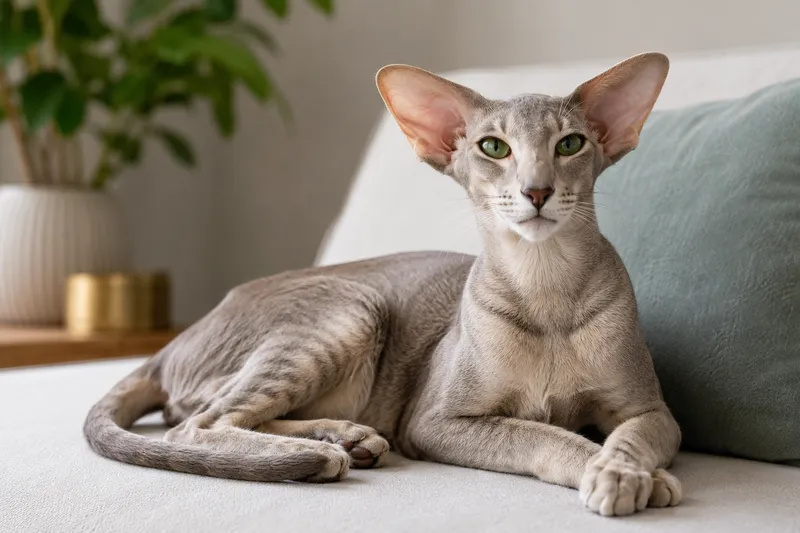
Oriental Shorthair
The Oriental Shorthair is a medium-sized, long-lined cat with a slender but muscular body, long legs, a tapering tail, a wedge-shaped head, and strikingly large ears. Its very short, fine, glossy coat lies close to the…
Recognized by: CFA · FIFe · +2
Size
Medium
Weight
2.3–5.4 kg
Life span
12–15 years
Breed Traits
Energy Level
Very energetic
Energy Level: 5 of 5
Low energyHigh energyChild / Family Compatibility
Very high compatibility
Child / Family Compatibility: 5 of 5
Low compatibilityHigh compatibilityGrooming Need
Low grooming need
Grooming Need: 1 of 5
Low maintenanceHigh maintenanceTrainability
Very easy to train
Trainability: 5 of 5
Hard to trainEasy to trainApartment / Home Suitability
Fits apartments well
Apartment / Home Suitability: 4 of 5
Needs space / yardExcellent for apartmentsAlone-Time Tolerance
Very short alone time (a few hours)
Alone-Time Tolerance: 1 of 5
Needs frequent companyHandles long alone timeFirst-Time Owner Suitability
Manageable with guidance
First-Time Owner Suitability: 3 of 5
Needs experienced ownerGreat for first-time ownersCompatibility with Other Pets
Shows very high compatibility
Compatibility with Other Pets: 5 of 5
Single-pet homes are a better fitHighly compatible with other animals
The Oriental Shorthair is a medium-sized, long-lined cat with a slender but muscular body, long legs, a tapering tail, a wedge-shaped head, and strikingly large ears. Its very short, fine, glossy coat lies close to the body and occurs in an exceptionally broad range of colors and patterns.
The breed shares its general body type and much of its ancestry with the Siamese. Modern Oriental breeding programs developed primarily in Britain from the 1950s onward as breeders worked to produce Siamese-type cats in additional coat colors and patterns, with later programs expanding the breed internationally.
Despite its refined appearance, the Oriental Shorthair is a strong, athletic, and highly active cat. It is best suited to an indoor household that welcomes frequent vocal interaction, close companionship, climbing, play, and daily mental stimulation.
Oriental Shorthairs are generally affectionate, outgoing, intelligent, and intensely interested in household activity. Many follow their owners between rooms, comment vocally on daily events, seek physical contact, and form strong attachments to familiar people.
They remain playful well into adulthood and commonly enjoy retrieving toys, climbing, puzzle feeders, learning routines, and participating in positive-reinforcement training. Their intelligence and curiosity can also lead to unwanted exploration when the environment offers too little activity.
Well-socialized Oriental Shorthairs often live successfully with respectful children, compatible cats, and cat-friendly dogs. They usually prefer an active social home and may struggle when expected to spend frequent prolonged periods without human or animal companionship.
The short, close-lying coat is low maintenance and usually needs only gentle hand grooming or light combing every one or two weeks. More frequent grooming may be useful during shedding, while harsh brushing is unnecessary and may irritate the fine coat or skin.
Daily life should include energetic interactive play, tall and stable climbing furniture, scratching surfaces, puzzle activities, and opportunities to explore safely. Household cupboards, shelves, fragile objects, and food storage may need additional security because this breed is agile, persistent, and highly curious.
Routine care should include dental hygiene, nail trimming, ear checks, body-condition monitoring, and regular veterinary examinations. Oriental Shorthairs are lean by design, but healthy slenderness should be distinguished from inadequate weight, muscle loss, or illness.
Progressive retinal atrophy associated with the CEP290 variant, commonly called PRA-rdAc, has been identified in Oriental Shorthairs. The condition causes gradual loss of vision, and a DNA test is available to identify clear, carrier, and genetically affected cats.
Mucopolysaccharidosis VI is an inherited lysosomal storage disorder for which genetic testing is also available in the breed. Familial hepatic amyloidosis has been described within the Oriental and Siamese breed family, but there is currently no simple DNA test that can reliably exclude every inherited form.
Prospective owners should request documented PRA-rdAc and MPS VI results and ask about family liver and kidney health, longevity, known illnesses, and causes of death in related cats. The availability of a genetic test does not mean that a condition is common in every population, and no test panel can guarantee lifelong health. This information is for general educational purposes and is not a substitute for diagnosis or treatment by a veterinarian.
Recognizing organizations
Independent registries that list this breed. Tap a badge to learn more.
These statuses reflect each registry’s recording and show systems. They are not a health, quality, or superiority score.
Frequently asked questions
Are Oriental Shorthairs good family cats?
Oriental Shorthairs are often affectionate, playful, and highly involved family companions. They commonly live well with respectful children, although their intense activity and social demands may not suit every household.
Do Oriental Shorthairs get along with other pets?
Well-socialized Oriental Shorthairs generally have a high potential to live successfully with compatible cats and cat-friendly dogs. Gradual introductions remain important because individual temperament, age, and previous experience affect the outcome.
Can an Oriental Shorthair live in an apartment?
The breed can adapt well to apartment living when provided with tall climbing areas, daily energetic play, scratching surfaces, and mental challenges. Owners should also consider the breed's frequent vocalization in homes with noise-sensitive neighbors.
Can Oriental Shorthairs be left alone during the day?
They can manage ordinary short absences, but they generally dislike frequent prolonged isolation. A predictable routine, extensive enrichment, and a compatible human or animal companion are particularly valuable for this social breed.
How much grooming does an Oriental Shorthair need?
The short, fine coat is very low maintenance and normally needs only light grooming every one or two weeks. Routine dental care, nail trimming, ear checks, and body-condition monitoring remain more important than extensive coat care.
Are Oriental Shorthairs very vocal?
Many Oriental Shorthairs communicate frequently and use a broad range of sounds to seek attention or respond to household activity. People who strongly prefer a quiet and independent cat may find the breed demanding.
What is the difference between an Oriental Shorthair and a Siamese?
The breeds share a similar long, slender body type and closely related ancestry. Oriental Shorthairs are distinguished primarily by their much broader range of coat colors and patterns, while traditional Siamese are defined by colorpoint markings and blue eyes.
What health testing should an Oriental Shorthair breeder discuss?
A responsible breeder should discuss documented PRA-rdAc and MPS VI test results and the liver, kidney, and longevity history of related cats. Buyers should remember that genetic screening reduces specific risks but cannot guarantee that a cat will never develop illness.
More about Oriental Shorthair
Pet profiles are coming soon. For now, keep exploring trusted breed knowledge in the Breed Guide.
Back to Breed Guide