

Ocicat
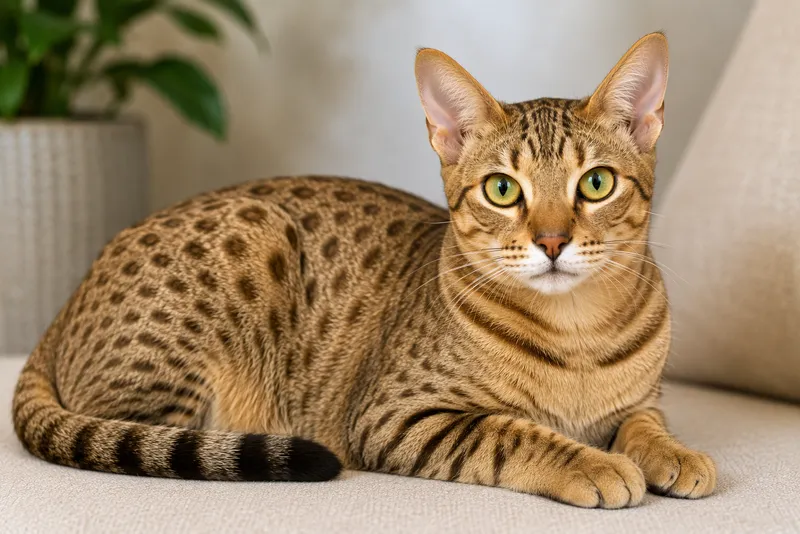
The Ocicat is a medium-to-large, athletic cat with substantial bone, firm musculature, a deep chest, and a long, powerful body that remains graceful rather than bulky. Its large almond-shaped eyes, moderately large…
Recognized by: CFA · FIFe · +2
Size
Large
Weight
2.7–6.4 kg
Life span
15–18 years
Breed Traits
Energy Level
Very energetic
Energy Level: 5 of 5
Low energyHigh energyChild / Family Compatibility
Very high compatibility
Child / Family Compatibility: 5 of 5
Low compatibilityHigh compatibilityGrooming Need
Low grooming need
Grooming Need: 1 of 5
Low maintenanceHigh maintenanceTrainability
Very easy to train
Trainability: 5 of 5
Hard to trainEasy to trainApartment / Home Suitability
Fits apartments well
Apartment / Home Suitability: 4 of 5
Needs space / yardExcellent for apartmentsAlone-Time Tolerance
Very short alone time (a few hours)
Alone-Time Tolerance: 1 of 5
Needs frequent companyHandles long alone timeFirst-Time Owner Suitability
Suitable for many first-timers
First-Time Owner Suitability: 4 of 5
Needs experienced ownerGreat for first-time ownersCompatibility with Other Pets
Shows very high compatibility
Compatibility with Other Pets: 5 of 5
Single-pet homes are a better fitHighly compatible with other animals
The Ocicat is a medium-to-large, athletic cat with substantial bone, firm musculature, a deep chest, and a long, powerful body that remains graceful rather than bulky. Its large almond-shaped eyes, moderately large ears, and clearly defined thumbprint-shaped spots create the appearance of a small wild cat.
Despite its exotic appearance and name, the Ocicat contains no wild-cat ancestry. The breed was developed entirely from established domestic breeds, principally the Siamese, Abyssinian, and American Shorthair. Its short, close-lying coat occurs in twelve commonly recognised color combinations, including tawny, chocolate, cinnamon, blue, lilac, fawn, and the silver versions of those colors.
The first spotted kitten associated with the breed, Tonga, was born in Michigan in 1964 during Virginia Daly's attempt to produce an Abyssinian-pointed Siamese. Tonga did not enter the breeding program, but repeated matings produced further spotted kittens, and additional breeders later helped establish a consistent breed. Some registries separately recognise a classic-tabby counterpart called the Ocicat Classic; this page covers the spotted Ocicat.
Ocicats are generally confident, outgoing, intelligent, and strongly interested in people. Many greet visitors, follow household members between rooms, and seek active participation in everyday activities rather than remaining quiet or distant observers.
They are highly playful and can often learn retrieving games, household routines, simple verbal cues, harness walking, and other behaviors through positive-reinforcement training. Their physical strength, curiosity, and problem-solving ability make climbing structures, puzzle feeders, and interactive play important parts of daily life.
Well-socialized Ocicats commonly live successfully with respectful children, compatible cats, and cat-friendly dogs. Their social nature means that they may become frustrated, vocal, or destructive when regularly left without companionship or meaningful activity for long periods.
The short, smooth coat is very easy to maintain and usually requires only occasional brushing with a soft or rubber grooming tool. A gentle wipe with a soft cloth can remove loose hair and enhance the coat's natural satin sheen. Frequent bathing is generally unnecessary.
Daily care should include energetic interactive play, stable climbing furniture, scratching surfaces, puzzle activities, and opportunities to explore safely. Ocicats can adapt to apartment living, but the home must provide enough vertical space, exercise, mental stimulation, and social interaction for this active breed.
Routine care should include dental hygiene, nail trimming, ear checks, body-condition monitoring, and regular veterinary examinations. Their naturally muscular build can make gradual excess weight difficult to notice, so feeding should be adjusted according to the individual cat's age, activity, and body condition.
Progressive retinal atrophy rdAc is an autosomal recessive inherited eye disorder associated with a CEP290 variant that has been identified in some Ocicats. Affected cats are born with normal vision, but retinal degeneration may begin during youth and gradually progress to severe vision loss or blindness. A DNA test is available to identify genetically clear, carrier, and affected cats.
Hypertrophic cardiomyopathy and amyloidosis have also been discussed as possible concerns in some Ocicat family lines because related conditions occur in the domestic breeds used during the breed's development. No currently available Ocicat-specific DNA test can exclude every form of either condition, and their presence should not be assumed in every cat. Family health records and appropriate veterinary assessment remain important.
Responsible breeders should provide documented PRA rdAc results and discuss family heart health, kidney and liver disease, longevity, known illnesses, and causes of death. Genetic testing covers only the tested variants and cannot guarantee lifelong health. This information is for general educational purposes and is not a substitute for diagnosis or treatment by a veterinarian.
Recognizing organizations
Independent registries that list this breed. Tap a badge to learn more.
These statuses reflect each registry’s recording and show systems. They are not a health, quality, or superiority score.
Frequently asked questions
Does the Ocicat have wild-cat ancestry?
No. The Ocicat was developed entirely from domestic cat breeds and has no ocelot or other wild-cat ancestry. Its name and appearance reflect its spotted coat rather than a wild hybrid background.
Are Ocicats good family cats?
Ocicats are often affectionate, playful, and involved family companions. They commonly live well with respectful children who understand gentle handling and provide suitable interactive play.
Do Ocicats get along with other pets?
Well-socialized Ocicats generally have a high potential to live successfully with compatible cats and cat-friendly dogs. Gradual introductions remain important, and companion animals should be able to tolerate the Ocicat's confident and energetic play style.
Can an Ocicat live in an apartment?
An Ocicat can live successfully in an apartment when provided with tall climbing furniture, energetic daily play, scratching surfaces, puzzle activities, and frequent social interaction. A poorly enriched environment is unlikely to meet this active breed's needs.
Can Ocicats be left alone during the day?
Most adult Ocicats can manage ordinary short absences, but they are poorly suited to frequent prolonged isolation. A predictable routine, extensive enrichment, and a compatible human or animal companion can help meet their strong social needs.
How much grooming does an Ocicat need?
The short coat normally requires only occasional gentle brushing or polishing with a soft cloth. Dental hygiene, nail trimming, ear checks, and body-condition monitoring generally require more attention than coat care.
Are Ocicats easy to train?
Ocicats are intelligent and often respond very well to positive-reinforcement training. Many can learn retrieving games, simple verbal cues, household routines, puzzle tasks, and harness walking.
What health testing should an Ocicat breeder discuss?
A responsible breeder should provide documented PRA rdAc DNA results and discuss family heart, kidney, and liver health. Buyers should also ask about longevity, known illnesses, veterinary screening practices, and causes of death in related cats.
More about Ocicat
Pet profiles are coming soon. For now, keep exploring trusted breed knowledge in the Breed Guide.
Back to Breed Guide