

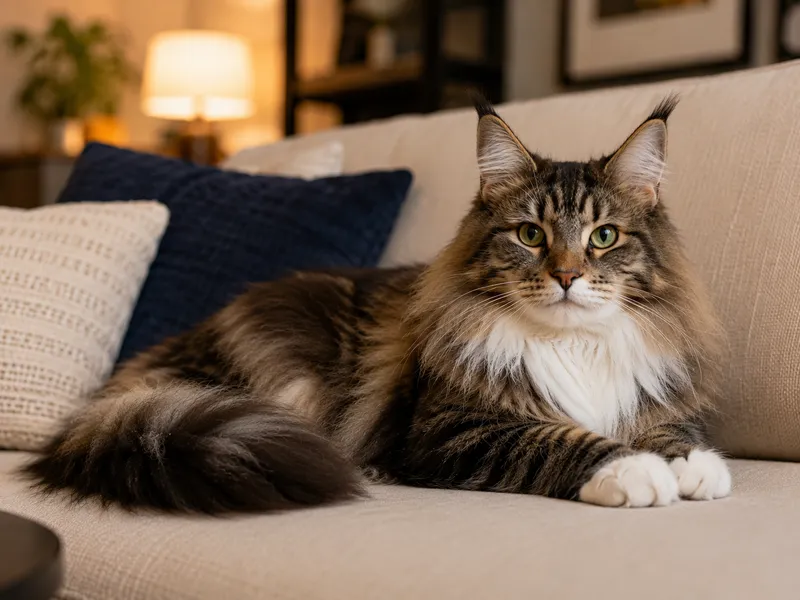
Norwegian Forest Cat
The Norwegian Forest Cat is a large, strongly built cat with a long muscular body, substantial bone, powerful hind legs, a bushy tail, and a distinctive triangular head. Its semi-long double coat consists of a dense…
Recognized by: CFA · FIFe · +2
Size
Large
Weight
3.6–8.2 kg
Life span
13–16 years
Breed Traits
Energy Level
High energy
Energy Level: 4 of 5
Low energyHigh energyChild / Family Compatibility
High compatibility
Child / Family Compatibility: 4 of 5
Low compatibilityHigh compatibilityGrooming Need
Moderate grooming need
Grooming Need: 3 of 5
Low maintenanceHigh maintenanceTrainability
Easy to train
Trainability: 4 of 5
Hard to trainEasy to trainApartment / Home Suitability
Fits apartments well
Apartment / Home Suitability: 4 of 5
Needs space / yardExcellent for apartmentsAlone-Time Tolerance
Handles a typical workday
Alone-Time Tolerance: 3 of 5
Needs frequent companyHandles long alone timeFirst-Time Owner Suitability
Suitable for many first-timers
First-Time Owner Suitability: 4 of 5
Needs experienced ownerGreat for first-time ownersCompatibility with Other Pets
Generally gets along well with other pets
Compatibility with Other Pets: 4 of 5
Single-pet homes are a better fitHighly compatible with other animals
The Norwegian Forest Cat is a large, strongly built cat with a long muscular body, substantial bone, powerful hind legs, a bushy tail, and a distinctive triangular head. Its semi-long double coat consists of a dense insulating undercoat covered by smoother water-resistant guard hairs, with a fuller ruff and coat during colder seasons.
The breed developed from longhaired domestic cats adapted to Norway's cold and demanding climate. Its exact early ancestry is uncertain, and associations with Viking ships and Norse mythology belong partly to tradition rather than fully documented breed history.
By the twentieth century, uncontrolled crossing threatened the survival of the distinct Norwegian type. Organized preservation and breeding programs established the modern pedigree breed, which remains slow to mature and may take four to five years to reach full physical development.
Norwegian Forest Cats are generally gentle, friendly, intelligent, and quietly confident. They often enjoy being part of family life while retaining an independent side and may prefer resting beside their owners rather than remaining on a lap for long periods.
They are athletic climbers with a playful hunting instinct and commonly enjoy tall cat trees, climbing platforms, interactive toys, food puzzles, and games that involve chasing or retrieving. Their activity is usually purposeful rather than constantly demanding, but they need regular opportunities to move and explore.
Well-socialized individuals often live successfully with respectful children, compatible cats, and cat-friendly dogs. They may initially observe unfamiliar people or animals from a distance, so introductions should be gradual and allow the cat access to secure elevated resting places.
The double coat is less prone to continuous matting than some longhaired coats, but it still benefits from thorough weekly combing. Grooming should become more frequent during seasonal shedding, especially when the dense winter undercoat is being released in spring.
Daily life should include sturdy climbing furniture, scratching surfaces, interactive play, puzzle feeders, and enough room to exercise safely. Because adults can be large and powerful, furniture and wall-mounted platforms should be stable and designed to support their weight.
Routine care should include dental hygiene, nail trimming, ear checks, body-condition monitoring, and regular veterinary examinations. Food portions should be adjusted to the individual cat's age, activity, health, and body condition because a thick coat can make gradual weight gain difficult to notice.
Glycogen storage disease type IV is a severe autosomal recessive disorder associated with the Norwegian Forest Cat. Affected kittens may die around birth or develop progressive neuromuscular and organ disease during the first months of life, while carrier cats remain clinically unaffected but can pass the variant to their offspring. A DNA test is available to identify clear, carrier, and affected genotypes.
Pyruvate kinase deficiency is another autosomal recessive condition that can cause intermittent hemolytic anemia, and genetic testing is available. Hypertrophic cardiomyopathy has also been diagnosed in the breed, but there is currently no validated Norwegian Forest Cat-specific DNA test capable of excluding all forms of HCM.
Prospective owners should ask for documented GSD IV and PK deficiency results, family cardiac history, relevant heart-screening information, longevity records, and known causes of illness or death in related cats. This information is for general educational purposes and is not a substitute for diagnosis or treatment by a veterinarian.
Recognizing organizations
Independent registries that list this breed. Tap a badge to learn more.
These statuses reflect each registry’s recording and show systems. They are not a health, quality, or superiority score.
Frequently asked questions
Are Norwegian Forest Cats good family pets?
Norwegian Forest Cats are often gentle and affectionate family companions. They commonly live well with respectful children when handling is calm and the cat has access to quiet resting areas.
Do Norwegian Forest Cats get along with other pets?
Well-socialized Norwegian Forest Cats often live successfully with compatible cats and cat-friendly dogs. Introductions should still be gradual, and smaller animals must be protected because the breed retains a natural hunting instinct.
Can a Norwegian Forest Cat live in an apartment?
The breed can adapt to apartment living when provided with sturdy vertical space, daily play, scratching areas, and mental stimulation. A poorly enriched apartment may not meet the needs of this large and athletic cat.
How much grooming does a Norwegian Forest Cat need?
Weekly combing is usually suitable during much of the year. Grooming should increase during seasonal coat changes, when the dense undercoat may shed heavily and form tangles if loose hair is not removed.
Are Norwegian Forest Cats lap cats?
Many are affectionate and enjoy staying close to their owners, but they may prefer sitting beside someone or observing from a nearby elevated position. Individual cats vary, and physical contact should remain voluntary.
Can Norwegian Forest Cats be left alone during the day?
Many adults tolerate ordinary working-day absences when they have enrichment and a predictable routine. They still need dependable daily interaction and should not be regularly isolated for prolonged periods.
Are Norwegian Forest Cats the same as Maine Coons?
No. They are separate breeds with different standards, histories, head shapes, body proportions, and coat characteristics. Both are large, semi-longhaired cats, which can make them appear similar to unfamiliar observers.
What health testing should a Norwegian Forest Cat breeder provide?
A responsible breeder should provide documented DNA results for GSD IV and pyruvate kinase deficiency. Buyers should also ask about family heart health, cardiac screening practices, longevity, and veterinary records in related cats.
More about Norwegian Forest Cat
Pet profiles are coming soon. For now, keep exploring trusted breed knowledge in the Breed Guide.
Back to Breed Guide