

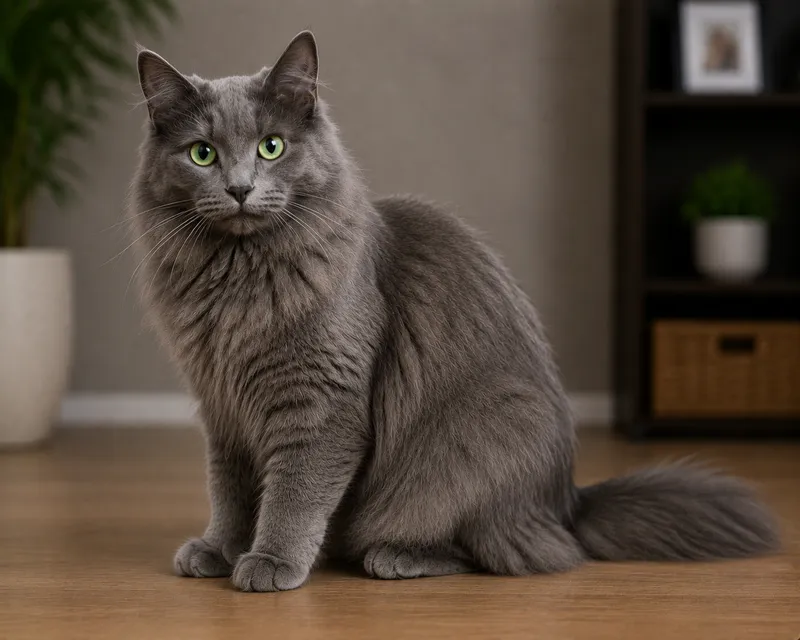
Nebelung
The Nebelung is a modern pedigree breed developed in the United States during the 1980s. Breeder Cora Cobb established the line from two blue longhaired cats, Siegfried and Brunhilde, born in 1984 and 1985. TICA…
Recognized by: GCCF · TICA
Size
Medium
Weight
3.5–6 kg
Life span
11–18 years
Breed Traits
Energy Level
Moderate energy
Energy Level: 3 of 5
Low energyHigh energyChild / Family Compatibility
Moderate compatibility
Child / Family Compatibility: 3 of 5
Low compatibilityHigh compatibilityGrooming Need
Moderate grooming need
Grooming Need: 3 of 5
Low maintenanceHigh maintenanceTrainability
Easy to train
Trainability: 4 of 5
Hard to trainEasy to trainApartment / Home Suitability
Fits apartments well
Apartment / Home Suitability: 4 of 5
Needs space / yardExcellent for apartmentsAlone-Time Tolerance
Handles a typical workday
Alone-Time Tolerance: 3 of 5
Needs frequent companyHandles long alone timeFirst-Time Owner Suitability
Suitable for many first-timers
First-Time Owner Suitability: 4 of 5
Needs experienced ownerGreat for first-time ownersCompatibility with Other Pets
Generally gets along well with other pets
Compatibility with Other Pets: 4 of 5
Single-pet homes are a better fitHighly compatible with other animals
The Nebelung is a modern pedigree breed developed in the United States during the 1980s. Breeder Cora Cobb established the line from two blue longhaired cats, Siegfried and Brunhilde, born in 1984 and 1985. TICA accepted the developing breed and later granted Championship status in 1997.
The name combines the German word Nebel, meaning mist or fog, with a reference to the medieval Nibelungenlied. It reflects the breed's luminous blue coat rather than a claim that the modern breed originated in Germany or Russia. Russian Blue cats were used as an approved outcross during development, but the Nebelung has its own registry identity and should not be described simply as a longhaired Russian Blue.
This is a medium-sized, long-bodied, firmly muscled cat with long legs, a well-plumed tail, large ears, and wide-set eyes that mature toward green. The dense semi-long coat is blue to the roots, with lighter guard-hair tips creating a silvered, mist-like sheen. Seasonal coat changes are expected, and the full adult coat may take up to two years to develop.
Nebelungs are generally gentle, intelligent, playful, and deeply attached to familiar people. Many follow trusted family members through the home, enjoy quiet affection, and communicate with a soft voice rather than demanding attention loudly.
They can be reserved with visitors, unfamiliar environments, and very active young children. Kittens and adults often settle best when allowed to approach at their own pace, with predictable routines, hiding places, and calm introductions instead of forced handling.
Although usually moderate rather than relentless in activity, Nebelungs enjoy retrieving, climbing, watching from high places, and solving food puzzles. Well-socialized individuals may live successfully with respectful children, compatible cats, and cat-friendly dogs, but individual history and gradual introductions remain important.
The dense semi-long double coat should be combed thoroughly at least once or twice a week, with more frequent attention during seasonal shedding. Focus on the ruff, belly, armpits, hindquarters, areas behind the ears, toe furnishings, and plumed tail, where loose undercoat and friction can create tangles.
The coat should be checked for mats, dandruff, parasites, wounds, or sudden texture changes. Small tangles are easier to address before they tighten against the skin; extensive matting or a cat that cannot tolerate grooming may require help from a veterinarian or an experienced feline groomer.
Provide daily interactive play, stable climbing and scratching furniture, food puzzles, quiet resting places, dental hygiene, nail care, and clean litter facilities. Measured portions of a complete life-stage-appropriate diet and hands-on body-condition checks are useful because the full coat can conceal gradual weight gain.
Published health data focused specifically on the Nebelung remain limited, and no single inherited disorder is firmly established as a defining breed-wide condition. Limited evidence should not be interpreted as proof that every cat or family line is free from genetic or acquired disease.
No universally accepted Nebelung-specific disease-testing panel is established in the official and scientific sources reviewed. Screening should therefore be guided by veterinary examination, documented ancestry, family history, and any health problems reported within the breeding line rather than by visual similarity to the Russian Blue or by a broad commercial DNA panel alone.
Prospective owners should request veterinary records and ask about family longevity, heart and kidney health, mobility, dental health, known illnesses, and causes of death. Routine examinations, risk-based vaccination and parasite control, oral-health assessment, and monitoring of weight, appetite, thirst, activity, breathing, and litter-box habits remain important throughout life. This information is for general educational purposes and is not a substitute for diagnosis or treatment by a veterinarian.
Recognizing organizations
Independent registries that list this breed. Tap a badge to learn more.
These statuses reflect each registry’s recording and show systems. They are not a health, quality, or superiority score.
Frequently asked questions
Are Nebelungs good family cats?
Nebelungs can be affectionate and devoted family companions in calm, predictable homes. They usually do best with people who respect their initial reserve and allow them to approach new situations at their own pace.
Are Nebelungs good with children?
Many well-socialized Nebelungs can live successfully with gentle, respectful children. A noisy or highly physical household may overwhelm a shy individual, so adults should supervise interactions and provide quiet retreat areas.
Do Nebelungs get along with other pets?
They may live successfully with compatible cats and calm cat-friendly dogs after gradual introductions. Separate resources and controlled first meetings are important because a reserved Nebelung may need more time than an outgoing cat to feel secure.
Can a Nebelung live in an apartment?
A Nebelung can adapt well to apartment living when provided with climbing furniture, scratching areas, daily play, observation points, and a stable routine. Secure windows and balconies are essential, and the home should include quiet places away from visitors or noise.
Can Nebelungs be left alone during the day?
Many adults can manage ordinary short absences, especially when their routine is predictable and enrichment is available. Frequent prolonged isolation is not ideal for a cat that forms close family bonds, and individual tolerance varies.
How much grooming does a Nebelung need?
Most need thorough combing once or twice a week, with additional grooming during seasonal shedding. The ruff, armpits, belly, hindquarters, areas behind the ears, and plumed tail deserve particular attention.
Is a Nebelung the same as a longhaired Russian Blue?
No. The breeds are closely related in development and appearance, and Russian Blue was used as an approved outcross, but registries maintain the Nebelung as a separate breed with its own standard. A blue longhaired cat without pedigree documentation is not automatically a Nebelung.
What health screening should a Nebelung breeder provide?
There is no single Nebelung-specific DNA panel that guarantees overall health. Ask for veterinary records, documented ancestry, family health and longevity information, and any veterinarian-guided screening selected for problems known within that breeding line.
More about Nebelung
Pet profiles are coming soon. For now, keep exploring trusted breed knowledge in the Breed Guide.
Back to Breed Guide