

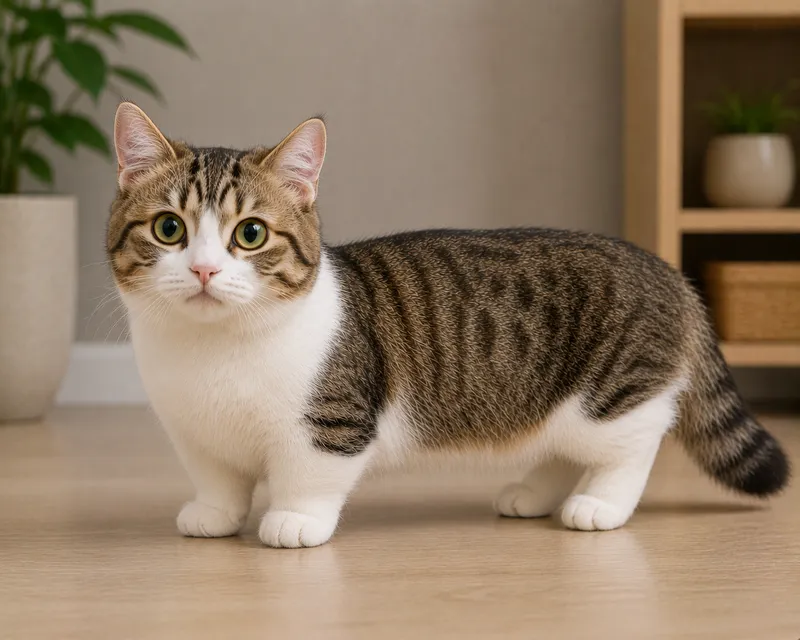
Munchkin
The Munchkin is a modern pedigree cat defined by disproportionately short limbs. Although short-legged cats had been reported earlier, the present breed was developed from cats found in Louisiana during the 1980s,…
Recognized by: TICA
Size
Medium
Weight
2.3–4.5 kg
Life span
12–16 years
Breed Traits
Energy Level
High energy
Energy Level: 4 of 5
Low energyHigh energyChild / Family Compatibility
High compatibility
Child / Family Compatibility: 4 of 5
Low compatibilityHigh compatibilityGrooming Need
Light grooming need
Grooming Need: 2 of 5
Low maintenanceHigh maintenanceTrainability
Easy to train
Trainability: 4 of 5
Hard to trainEasy to trainApartment / Home Suitability
Fits apartments well
Apartment / Home Suitability: 4 of 5
Needs space / yardExcellent for apartmentsAlone-Time Tolerance
Half-day is hard
Alone-Time Tolerance: 2 of 5
Needs frequent companyHandles long alone timeFirst-Time Owner Suitability
Challenging for beginners
First-Time Owner Suitability: 2 of 5
Needs experienced ownerGreat for first-time ownersCompatibility with Other Pets
Generally gets along well with other pets
Compatibility with Other Pets: 4 of 5
Single-pet homes are a better fitHighly compatible with other animals
The Munchkin is a modern pedigree cat defined by disproportionately short limbs. Although short-legged cats had been reported earlier, the present breed was developed from cats found in Louisiana during the 1980s, particularly a female named Blackberry and her descendants. TICA accepted the breed into development in 1994 and granted Championship status in 2003.
A mature Munchkin has an average-sized body carried low on shortened legs rather than a permanently kitten-sized frame. The chest is rounded, the body is moderately long, and the hind legs may be slightly longer than the forelegs. The long bones can show shortening and some bowing, while overall proportions and mobility vary between individuals.
Munchkins occur in many colours and patterns and in both shorthaired and longhaired forms. BondPals maintains separate Munchkin Longhair and Munchkin Shorthair pages because they are distinct registry entries, while this page covers the broader breed family. Long-legged offspring may be described in breeding terminology as non-standard Munchkins, but they do not display the defining short-legged phenotype.
Munchkins are generally described as sociable, curious, playful, and interested in household activity. Many enjoy retrieving toys, exploring accessible spaces, learning routines, and following familiar people from room to room.
Their shortened limbs do not eliminate the desire to run, chase, climb, or investigate, but they may reach high places through lower intermediate steps rather than a single large jump. Individual ability varies, and reluctance to move or a decline in normal activity should not be dismissed as a typical feature of the breed.
Well-socialized individuals may live successfully with respectful children, compatible cats, and cat-friendly dogs. Introductions should still be gradual, and children must not treat the cat as a novelty or encourage unsafe jumping. Frequent prolonged isolation may be difficult for a people-oriented individual without adequate enrichment and companionship.
Grooming depends on coat length. Shorthaired Munchkins usually benefit from weekly brushing, while longhaired individuals may need brushing or combing several times a week, especially around the belly, armpits, hindquarters, and tail. Owners should check whether the cat can comfortably reach every part of its body and assist with coat care when needed.
An accessible home can reduce unnecessary strain. Stable low platforms, ramps or closely spaced steps, non-slip surfaces, low-entry litter trays, and food and water placed within comfortable reach can support normal daily activity. Climbing and play remain important, but furniture should offer safe routes rather than requiring repeated high-impact jumps.
Keep the cat lean with measured portions of a complete life-stage-appropriate diet because excess weight adds load to shortened and potentially misaligned limbs. Routine care should also include dental hygiene, nail trimming, regular veterinary examinations, and prompt assessment of changes in gait, jumping, grooming, litter-box use, or willingness to play.
The short-legged standard Munchkin phenotype is a form of disproportionate dwarfism or chondrodysplasia. A structural variant in UGDH is strongly associated with the phenotype and is inherited in an autosomal dominant pattern. No cats with two copies of the variant were identified in the genetic study, supporting the concern that the homozygous state may be lethal early in embryonic development.
The long-term clinical consequences are not yet defined by large breed-wide studies. In a small imaging study, all five cats with feline disproportionate dwarfism had angular limb deformities; spinal MRI was performed in only two cats and found no spinal pathology, leaving the incidence of intervertebral disc disease inconclusive. Lordosis, pectus excavatum, osteoarthritis, pain, and reduced mobility have been reported or raised as welfare concerns, but their prevalence specifically across the Munchkin population remains insufficiently quantified.
Owners should monitor for stiffness, an altered gait, reluctance to jump or climb, reduced play, difficulty grooming, sensitivity when handled, or changes in litter-box habits. Breeders should understand the inheritance of the UGDH variant, avoid treating a DNA result as complete health clearance, and use veterinary examination, family history, mobility assessment, and genetic diversity when making breeding decisions. This information is for general educational purposes and is not a substitute for diagnosis or treatment by a veterinarian.
Recognizing organizations
Independent registries that list this breed. Tap a badge to learn more.
These statuses reflect each registry’s recording and show systems. They are not a health, quality, or superiority score.
Frequently asked questions
Are Munchkin cats good family pets?
Many Munchkins are affectionate, playful, and interested in family life. Children should handle them gently, avoid forcing them to jump, and understand that the cat's shortened limbs are a structural condition rather than a toy-like feature.
Do Munchkin cats get along with other pets?
Well-socialized Munchkins may live successfully with compatible cats and calm, cat-friendly dogs. Introductions should be gradual, and a larger or highly physical companion should not be allowed to overwhelm a cat with reduced reach or mobility.
Can a Munchkin live in an apartment?
A Munchkin can adapt to apartment living when provided with interactive play and accessible vertical territory. Ramps, low platforms, closely spaced steps, non-slip surfaces, and secure windows or balconies can make the environment safer and easier to navigate.
Can Munchkin cats be left alone during the day?
Many adults can manage ordinary short absences, but frequent prolonged isolation may lead to boredom in this sociable breed. A predictable routine, puzzle activities, accessible observation points, and dependable companionship are helpful.
How much grooming does a Munchkin need?
Shorthaired Munchkins usually need weekly brushing, while longhaired cats may need grooming several times a week. Owners should also check whether the cat can comfortably groom its belly, hindquarters, and other less accessible areas.
What is the difference between Munchkin, Munchkin Longhair, and Munchkin Shorthair?
They belong to the same short-legged breed family and differ primarily in coat classification. BondPals maintains separate Atlas records for the general Munchkin entry and the registry-listed Longhair and Shorthair entries, so each page can address the relevant coat and care needs.
Do all Munchkin cats develop mobility problems?
No single outcome applies to every cat, and some remain active for many years. However, the defining UGDH-associated chondrodysplasia alters limb development, and current research is too limited to guarantee that the phenotype is harmless; changes in movement, jumping, grooming, or comfort warrant veterinary assessment.
Why do some cat registries not recognise the Munchkin?
Recognition policies differ because the breed's defining feature is disproportionate dwarfism. TICA grants Championship status, while CFA does not list the breed and FIFe and GCCF exclude it under welfare policies concerning shortened limbs and associated health risks.
More about Munchkin
Pet profiles are coming soon. For now, keep exploring trusted breed knowledge in the Breed Guide.
Back to Breed Guide