

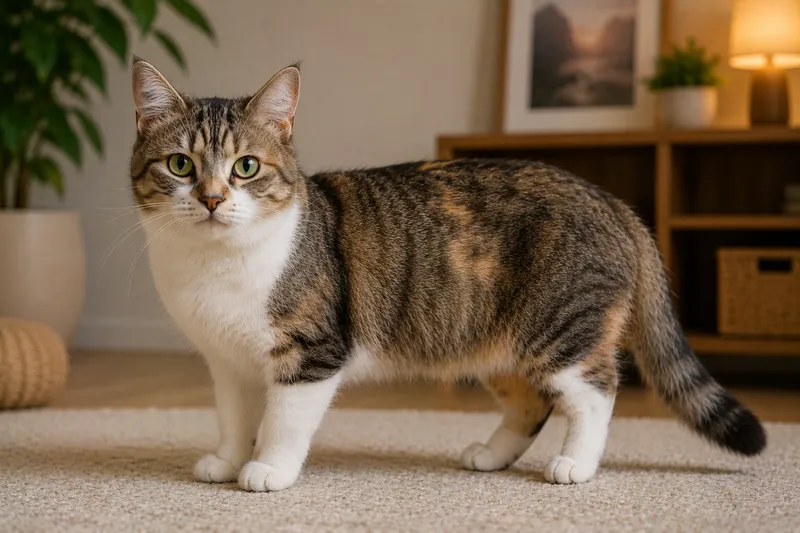
Mixed Breed
Mixed Breed is a broad category for cats whose ancestry combines more than one genetic background rather than conforming to a single documented pedigree breed. Some have known parents of different breeds, while many…
Size
Medium
Weight
2.5–7 kg
Life span
12–18 years
Breed Traits
Energy Level
Moderate energy
Energy Level: 3 of 5
Low energyHigh energyChild / Family Compatibility
Moderate compatibility
Child / Family Compatibility: 3 of 5
Low compatibilityHigh compatibilityGrooming Need
Moderate grooming need
Grooming Need: 3 of 5
Low maintenanceHigh maintenanceTrainability
Moderately trainable
Trainability: 3 of 5
Hard to trainEasy to trainApartment / Home Suitability
Fits apartments well
Apartment / Home Suitability: 4 of 5
Needs space / yardExcellent for apartmentsAlone-Time Tolerance
Handles a typical workday
Alone-Time Tolerance: 3 of 5
Needs frequent companyHandles long alone timeFirst-Time Owner Suitability
Suitable for many first-timers
First-Time Owner Suitability: 4 of 5
Needs experienced ownerGreat for first-time ownersCompatibility with Other Pets
Can adapt with proper socialization
Compatibility with Other Pets: 3 of 5
Single-pet homes are a better fitHighly compatible with other animals
Mixed Breed is a broad category for cats whose ancestry combines more than one genetic background rather than conforming to a single documented pedigree breed. Some have known parents of different breeds, while many have ancestry that is only partly known or cannot be reliably reconstructed. The label therefore describes ancestry rather than one standardized appearance or temperament.
Mixed Breed cats can have almost any combination of body size, head shape, coat length, coat texture, colour, pattern, eye colour, and other physical characteristics found in domestic cats. Even littermates can differ noticeably when their parents carry diverse traits. Visual resemblance to a recognized breed does not by itself establish that breed ancestry.
The term can overlap in everyday use with non-pedigree, random-bred, or domestic cat, but these descriptions are not always interchangeable. A cat can have mixed ancestry that includes known pedigree breeds, while a Domestic Shorthair, Domestic Medium Hair, or Domestic Longhair label usually describes a non-pedigree cat partly by coat length. For identification and care, the individual cat's known history and physical characteristics are more useful than assumptions based on appearance alone.
There is no single Mixed Breed temperament. Individual cats may be highly social or reserved, energetic or relaxed, vocal or quiet, independent or strongly people-oriented. Genetics can influence behaviour, but early socialization, previous experiences, health, age, reproductive status, and the current environment also play major roles.
Daily enrichment should therefore be matched to the individual. Interactive play, scratching surfaces, hiding places, elevated resting areas, food puzzles, predictable routines, and opportunities for voluntary social contact can support a wide range of personalities and activity levels.
Many well-socialized Mixed Breed cats live successfully with respectful children, compatible cats, and cat-friendly dogs, while others prefer quieter households or being the only pet. Behaviour and introductions should be evaluated individually rather than predicting compatibility from the Mixed Breed label.
Grooming requirements depend primarily on the individual cat's coat. A short, close coat may need only occasional brushing, while medium or long coats can require combing several times a week to control loose hair and prevent tangles. Curly, unusually dense, sparse, or otherwise distinctive coats may have different maintenance needs.
Routine care should include dental hygiene, nail trimming, clean litter facilities, body-condition monitoring, appropriate parasite prevention based on lifestyle and veterinary guidance, and a complete diet suitable for the cat's life stage. Daily play and environmental enrichment should be adjusted to the cat's age, mobility, hunting motivation, and energy level.
Owners should become familiar with the individual's normal appetite, thirst, weight, grooming, movement, breathing, social behaviour, and litter-box habits. Persistent changes in these patterns, unexplained coat deterioration, pain, or reduced activity deserve veterinary assessment rather than being attributed to mixed ancestry.
Mixed Breed cats do not have one breed-specific disease profile because their ancestry varies widely. Genetic diversity may reduce the probability of some disorders concentrated within particular closed breeding populations, but mixed ancestry does not guarantee freedom from inherited disease. An individual can still inherit a disease-associated variant from one or more ancestors or develop common acquired feline illnesses unrelated to ancestry.
Health screening should therefore be individualized. Known parentage, family medical history, physical examination findings, age, lifestyle, geographic exposure, and any reliably documented breed ancestry can help a veterinarian determine whether particular clinical or genetic tests are appropriate. Appearance alone is not sufficient evidence for assigning a pedigree breed's disease risks or ordering breed-specific testing.
Preventive veterinary care remains important regardless of ancestry. Owners should discuss vaccination, parasite control, dental health, reproductive status, weight management, and age-appropriate screening with their veterinarian and should retain any available medical and family records. This information is for general educational purposes and is not a substitute for diagnosis or treatment by a veterinarian.
Frequently asked questions
Is a Mixed Breed cat a recognized cat breed?
No. Mixed Breed is an ancestry category rather than a standardized pedigree breed with a single breed standard. Individual mixed-breed cats can differ substantially in appearance, temperament, and care requirements.
What is the difference between a Mixed Breed cat and a Domestic Shorthair?
Mixed Breed primarily describes mixed or non-single-breed ancestry, while Domestic Shorthair is commonly used for non-pedigree cats with short coats. The categories can overlap, so a mixed-breed cat with a short coat may also be described as a Domestic Shorthair in everyday use.
Can you identify the breeds in a Mixed Breed cat by appearance?
Appearance can suggest similarities but usually cannot establish ancestry reliably. Coat colour, body shape, facial features, or size may occur across many unrelated cat populations, so a cat that resembles a particular pedigree breed is not necessarily descended from it.
Are Mixed Breed cats good family pets?
Many are excellent family companions, but the Mixed Breed label does not predict temperament. The individual cat's socialization, confidence, handling preferences, activity level, and previous experiences are more useful when assessing family suitability.
Do Mixed Breed cats get along with children and other pets?
Many can live successfully with respectful children, compatible cats, and cat-friendly dogs, while others prefer a quieter or single-pet home. Gradual introductions, supervision, adequate separate resources, and attention to the individual cat's body language are important.
Can a Mixed Breed cat live in an apartment?
Most can adapt to apartment living when their individual needs are met. Daily play, scratching and climbing opportunities, hiding places, clean litter facilities, secure windows or balconies, and sufficient social interaction are more important than ancestry alone.
How much grooming does a Mixed Breed cat need?
Grooming depends on coat length, density, and texture rather than mixed ancestry itself. Short-coated individuals may need little brushing, while medium- and longhaired cats generally require more frequent combing to control shedding and prevent tangles.
Are Mixed Breed cats healthier than pedigree cats?
Mixed ancestry can provide greater genetic diversity, but it does not guarantee better health or eliminate inherited disease. Health risk should be assessed from the individual cat's family history when known, veterinary findings, lifestyle, age, and documented ancestry rather than assuming that mixed-breed status is protective.
More about Mixed Breed
Pet profiles are coming soon. For now, keep exploring trusted breed knowledge in the Breed Guide.
Back to Breed Guide