

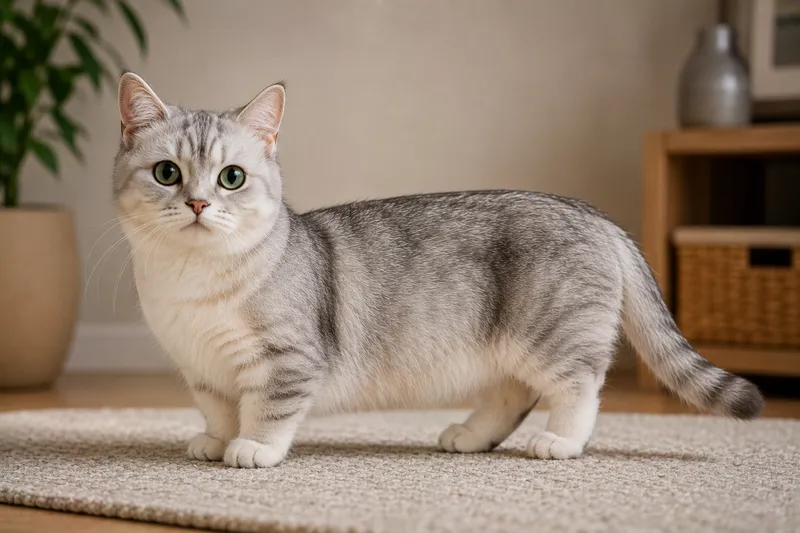
Minuet Shorthair
The Minuet Shorthair is the short-coated, short-legged form of the Minuet, a modern breed developed from Persian Breed Group and Munchkin ancestry. Joe Smith began the breeding programme in 1995 with the goal of…
Recognized by: TICA
Size
Medium
Weight
2.5–4.5 kg
Life span
12–15 years
Breed Traits
Energy Level
Moderate energy
Energy Level: 3 of 5
Low energyHigh energyChild / Family Compatibility
High compatibility
Child / Family Compatibility: 4 of 5
Low compatibilityHigh compatibilityGrooming Need
Light grooming need
Grooming Need: 2 of 5
Low maintenanceHigh maintenanceTrainability
Easy to train
Trainability: 4 of 5
Hard to trainEasy to trainApartment / Home Suitability
Excellent apartment fit
Apartment / Home Suitability: 5 of 5
Needs space / yardExcellent for apartmentsAlone-Time Tolerance
Half-day is hard
Alone-Time Tolerance: 2 of 5
Needs frequent companyHandles long alone timeFirst-Time Owner Suitability
Suitable for many first-timers
First-Time Owner Suitability: 4 of 5
Needs experienced ownerGreat for first-time ownersCompatibility with Other Pets
Generally gets along well with other pets
Compatibility with Other Pets: 4 of 5
Single-pet homes are a better fitHighly compatible with other animals
The Minuet Shorthair is the short-coated, short-legged form of the Minuet, a modern breed developed from Persian Breed Group and Munchkin ancestry. Joe Smith began the breeding programme in 1995 with the goal of producing a sturdy, rounded companion cat that would remain distinctive in both short-legged and long-legged offspring.
The breed was originally known as the Napoleon. After several years of discussion, TICA approved changing the official breed name to Minuet in 2015, and the breed subsequently advanced to full Championship status in 2016. The historical Napoleon name remains relevant to the breed's development, but Minuet is the current official name used by BondPals Atlas.
The Minuet Shorthair is medium-sized, substantial, and well muscled rather than delicate or miniature. The head emphasizes roundness, with large round eyes, a broad face, a short muzzle, and small-to-medium ears with rounded tips. The body is sturdy and carried on shortened legs in the standard Minuet form.
The Shorthair has a dense, plush coat with undercoat and a soft texture. It lacks the flowing furnishings and plumed tail of the Minuet Longhair but retains the same rounded breed type. BondPals maintains Minuet Longhair, Minuet Talls, and Minuet Talls Longhair as separate Atlas records.
Minuet Shorthairs are generally affectionate, gentle, curious, playful, and strongly interested in people. Many enjoy lap time and close companionship while still showing a lively interest in toys, household activity, and exploration.
Short legs do not eliminate the desire to run or play. Healthy individuals can move quickly and often enjoy wand toys, rolling toys, food puzzles, short training sessions, and accessible climbing routes. Their activity level is generally moderate rather than extreme.
Well-socialized Minuet Shorthairs may live successfully with respectful children, compatible cats, and cat-friendly dogs. They usually value regular companionship and may be less suited to homes where they would routinely spend very long periods without interaction.
The short plush coat is easier to maintain than the longhaired form but still benefits from regular grooming. Brushing or combing once or twice a week is sufficient for many cats, with additional care during seasonal shedding.
Facial care should be adapted to the individual. Persian-derived facial structure can contribute to tear staining or ocular discharge in some cats, so the eye area should be kept clean and persistent tearing, redness, squinting, or irritation should receive veterinary assessment.
Provide daily interactive exercise while respecting the cat's short-legged conformation. Stable low-to-moderate climbing furniture, intermediate steps, non-slip surfaces, and easily accessible resting places can help maintain activity without requiring repeated high-impact jumps. Routine care should also include dental hygiene, nail trimming, clean litter facilities, body-condition monitoring, and a complete life-stage-appropriate diet.
Minuet-specific clinical research remains limited, so health evaluation should consider the breed's Persian-group and Munchkin ancestry without assuming that every disorder reported in either ancestral population occurs at the same frequency in Minuets.
Polycystic kidney disease associated with the PKD1 variant is an important consideration because of the breed's Persian background. TICA recommends that Minuets come from parents that have been checked and cleared for PKD. A negative PKD1 result excludes the tested variant but does not rule out every possible kidney disorder.
The shortened limbs also warrant lifelong attention to comfortable mobility and body condition. Owners should monitor gait, willingness to run and climb, joint comfort, spinal comfort, and litter-box access. Persistent stiffness, limping, abnormal posture, reluctance to move, or reduced activity should receive veterinary assessment rather than being dismissed as normal for a short-legged breed.
Prospective owners should request documented PKD information, veterinary records, and family history covering mobility, eye health, breathing, kidney and cardiac health, longevity, and causes of death. DNA testing should be interpreted only for the specific variants examined and should never be treated as complete health clearance. This information is for general educational purposes and is not a substitute for diagnosis or treatment by a veterinarian.
Recognizing organizations
Independent registries that list this breed. Tap a badge to learn more.
These statuses reflect each registry’s recording and show systems. They are not a health, quality, or superiority score.
Frequently asked questions
Was the Minuet Shorthair previously called the Napoleon?
Yes. The breed was originally developed under the Napoleon name. TICA approved changing the official name to Minuet in 2015, and Minuet is the name used by the registry and BondPals Atlas today.
Are Minuet Shorthairs good family cats?
Minuet Shorthairs are generally affectionate, playful, gentle, and interested in household life. They can suit many families that provide regular companionship, interactive play, and respectful handling.
Are Minuet Shorthairs good with children?
Many well-socialized individuals can live successfully with respectful children. Adults should supervise younger children and discourage rough handling or forcing the cat to jump from high surfaces.
Do Minuet Shorthairs get along with other pets?
Many can live successfully with compatible cats and cat-friendly dogs after gradual introductions. Separate food, litter, resting, and hiding resources help reduce competition while animals become familiar with one another.
Can a Minuet Shorthair live in an apartment?
Yes. Their moderate activity level and social temperament can suit apartment living when daily play, scratching surfaces, accessible climbing opportunities, comfortable resting areas, and secure windows or balconies are provided.
How much grooming does a Minuet Shorthair need?
Brushing or combing once or twice a week is sufficient for many individuals. Grooming may need to increase during seasonal shedding, while the eyes, nails, teeth, skin, and body condition should also be checked routinely.
What is the difference between a Minuet Shorthair and a Minuet Longhair?
Both are short-legged members of the same Minuet breed family and share the same fundamental body type and temperament tendencies. The Shorthair has a dense plush short coat, while the Longhair has a longer silky coat with more pronounced furnishings and a plumed tail.
What health screening should a Minuet Shorthair breeder provide?
Ask for documented PKD screening because of Persian ancestry, together with veterinary and family information covering mobility, eyes, breathing, kidney and cardiac health, longevity, and causes of death. No single DNA panel guarantees complete Minuet health.
More about Minuet Shorthair
Pet profiles are coming soon. For now, keep exploring trusted breed knowledge in the Breed Guide.
Back to Breed Guide