

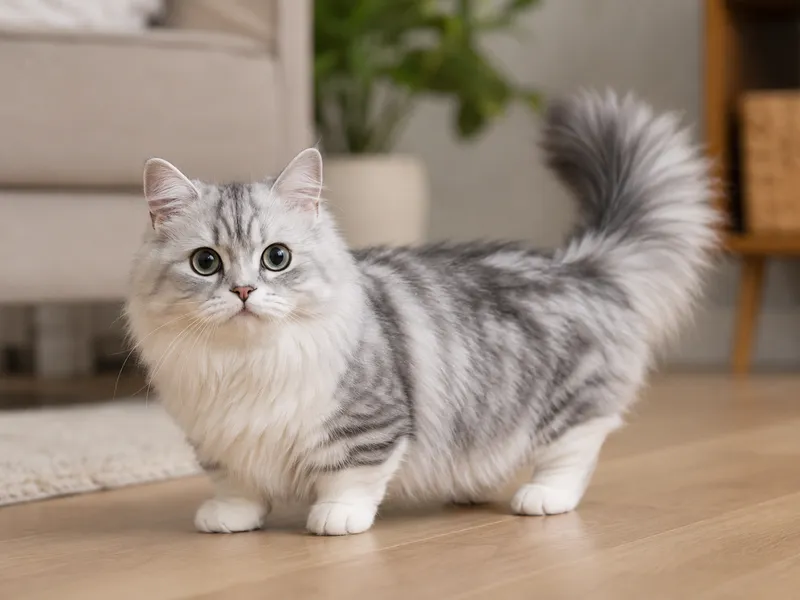
Minuet
The Minuet is a modern domestic breed developed from the Persian Breed Group and the Munchkin. Founder Joe Smith began the project in the mid-1990s after becoming interested in short-legged cats and sought a sturdy,…
Recognized by: TICA
Size
Medium
Weight
2.7–4.5 kg
Life span
12–16 years
Breed Traits
Energy Level
Moderate energy
Energy Level: 3 of 5
Low energyHigh energyChild / Family Compatibility
High compatibility
Child / Family Compatibility: 4 of 5
Low compatibilityHigh compatibilityGrooming Need
Moderate grooming need
Grooming Need: 3 of 5
Low maintenanceHigh maintenanceTrainability
Easy to train
Trainability: 4 of 5
Hard to trainEasy to trainApartment / Home Suitability
Fits apartments well
Apartment / Home Suitability: 4 of 5
Needs space / yardExcellent for apartmentsAlone-Time Tolerance
Half-day is hard
Alone-Time Tolerance: 2 of 5
Needs frequent companyHandles long alone timeFirst-Time Owner Suitability
Challenging for beginners
First-Time Owner Suitability: 2 of 5
Needs experienced ownerGreat for first-time ownersCompatibility with Other Pets
Generally gets along well with other pets
Compatibility with Other Pets: 4 of 5
Single-pet homes are a better fitHighly compatible with other animals
The Minuet is a modern domestic breed developed from the Persian Breed Group and the Munchkin. Founder Joe Smith began the project in the mid-1990s after becoming interested in short-legged cats and sought a sturdy, rounded cat that would remain distinctive in both short-legged and long-legged offspring. Early breeding used Munchkins with doll-faced Persians and Exotics, and the first planned litters arrived in the late 1990s.
The breed was originally registered as the Napoleon. That name never achieved universal acceptance within the developing breed community, and TICA voted in 2015 to change it to Minuet. TICA promoted the short-legged Minuet to Championship status in January 2016, while long-legged cats are now commonly described as Minuet Talls and tracked separately by some registries.
A typical Minuet is medium-sized, sturdy, and well muscled, with substantial boning, a rounded head, large round eyes, small-to-medium ears with rounded tips, and a short muzzle with a gentle profile. Short-legged individuals display disproportionate dwarfism, while Talls have ordinary leg length. Both longhaired and shorthaired coats occur in many colours and patterns; BondPals maintains separate Atlas records for several coat and leg-length entries.
Minuets are generally described as affectionate, people-oriented, gentle, and curious. Many enjoy staying close to familiar people, resting on a lap, following household activity, and greeting family members without being persistently vocal.
They combine a relatively calm companion style with regular bursts of play. Rolling toys, wand games, food puzzles, short training sessions, and accessible climbing routes can provide useful enrichment. Short legs do not remove the desire to run or explore, but individual jumping and climbing ability varies.
Well-socialized Minuets may live successfully with respectful children, compatible cats, and calm cat-friendly dogs. Their sturdy appearance should not invite rough handling, and children should never force a short-legged cat to jump or treat it as a novelty. Regular companionship is important because many individuals do not enjoy repeated long periods without social contact.
Grooming depends on coat length and density. Shorthaired Minuets usually benefit from brushing once or twice a week, while longhaired cats may need combing several times a week or daily attention around the chest, belly, armpits, hindquarters, and tail. The coat contains undercoat, so small tangles should be removed before they develop into painful mats.
A short-legged Minuet benefits from an accessible environment with non-slip flooring, low-entry litter trays, stable steps, ramps, and closely spaced platforms. Play and climbing should still be encouraged, but furniture should offer safe routes that do not require repeated high-impact jumps. Long-legged Minuet Talls generally need fewer mobility adaptations, although individual comfort should always guide the setup.
Routine care should also include dental hygiene, nail trimming, visible eye and nose checks, clean litter facilities, measured portions of a complete life-stage-appropriate diet, and regular veterinary examinations. Maintain a lean body condition because excess weight adds load to shortened or misaligned limbs and can make subtle mobility changes harder to recognize.
Short-legged Minuets inherit the disproportionate dwarfism phenotype introduced through Munchkin ancestry. A structural variant in UGDH is strongly associated with the short-legged phenotype and appears to act dominantly; the absence of cats with two variant copies and reduced litter sizes support concern that the homozygous state may be embryonically lethal. Long-legged Minuet Talls do not display the defining short-legged phenotype.
Research on cats with UGDH-associated disproportionate dwarfism has documented complex angular limb and joint alignment changes, but available imaging studies are small and do not establish the frequency or lifetime severity of pain, arthritis, or mobility impairment specifically in Minuets. Owners should monitor for stiffness, altered gait, reluctance to jump, reduced play, difficulty grooming, sensitivity when handled, or changes in litter-box use.
Persian-derived ancestry also makes documented PKD1 and Persian PRA testing relevant. More extreme Persian-type facial shortening has been associated with greater eye exposure, reduced dimensions at part of the nasal airway, and dental displacement; these findings should be applied according to the individual Minuet's conformation rather than assumed to affect every cat. Prospective owners should request parental DNA results, family health history, veterinary records, and evidence of comfortable breathing, clear eyes, normal mobility, and appropriate genetic diversity. This information is for general educational purposes and is not a substitute for diagnosis or treatment by a veterinarian.
Recognizing organizations
Independent registries that list this breed. Tap a badge to learn more.
These statuses reflect each registry’s recording and show systems. They are not a health, quality, or superiority score.
Frequently asked questions
Are Minuet cats good family pets?
Minuets are generally affectionate, gentle, and interested in family life. Well-socialized individuals may suit homes with respectful children, but adults should supervise handling and prevent children from forcing a short-legged cat to jump or climb.
Do Minuet cats get along with other pets?
Many Minuets can live successfully with compatible cats and calm cat-friendly dogs after gradual introductions. A larger or highly physical companion should not be allowed to overwhelm an individual with reduced reach or mobility.
Can a Minuet live in an apartment?
A Minuet can adapt well to apartment living when provided with daily play, scratching areas, hiding places, and accessible vertical territory. Short-legged cats may benefit from ramps, stable steps, low platforms, non-slip floors, and secure windows or balconies.
Can Minuet cats be left alone during the day?
Many adults can manage ordinary short absences, but frequent prolonged isolation is not ideal for this people-oriented breed. A predictable routine, puzzle activities, comfortable observation points, and dependable daily interaction help reduce boredom.
How much grooming does a Minuet need?
Shorthaired Minuets usually need brushing once or twice a week, while longhaired individuals may need combing several times a week or daily. Grooming needs increase with coat density and seasonal shedding, especially around the belly, armpits, hindquarters, and tail.
Why was the Napoleon cat renamed Minuet?
The breed was originally known as the Napoleon, but TICA states that the name never achieved complete acceptance. TICA voted in 2015 to rename the breed Minuet, which is now the official registry name used by BondPals.
What is the difference between a Minuet, a Minuet Tall, and a Munchkin?
A standard Minuet combines Persian-group type with the short-legged phenotype inherited from Munchkin ancestry. Minuet Talls share the rounded breed type but have ordinary-length legs, while the Munchkin has its own separate standard and is not simply another name for a Minuet.
What health screening should a Minuet breeder provide?
Ask for documented PKD1 and Persian PRA results, family health history, and veterinary information covering mobility, limb alignment, breathing, eyes, teeth, heart, and kidneys. Short-legged breeding cats should also be assessed with an understanding of UGDH inheritance, while remembering that no single DNA result guarantees overall health.
More about Minuet
Pet profiles are coming soon. For now, keep exploring trusted breed knowledge in the Breed Guide.
Back to Breed Guide