

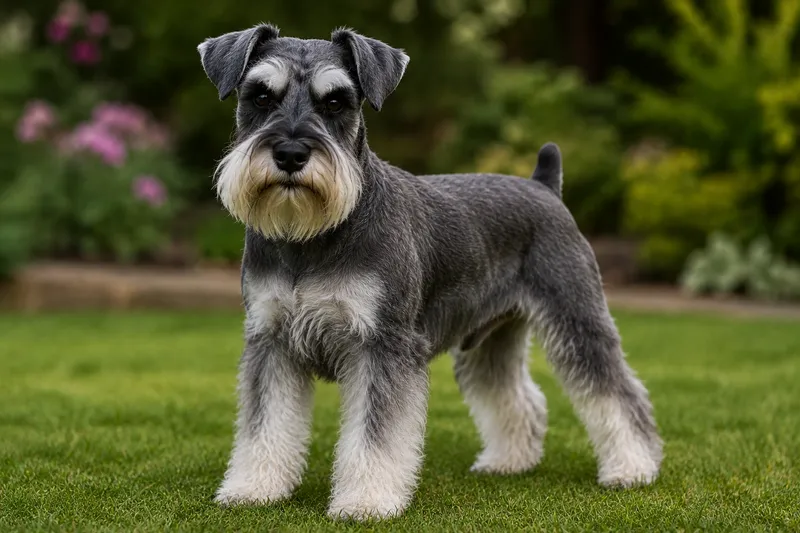
Miniature Schnauzer
The Miniature Schnauzer is a sturdy, nearly square small dog with a harsh, wiry outer coat, dense undercoat, prominent eyebrows, and a characteristic beard. Natural ears are small and V-shaped, folding forward close to…
Recognized by: AKC · ANKC · +5
Size
Small
Weight
5–9.1 kg
Life span
12–15 years
Breed Traits
Energy Level
High energy
Energy Level: 4 of 5
Low energyHigh energyChild / Family Compatibility
High compatibility
Child / Family Compatibility: 4 of 5
Low compatibilityHigh compatibilityGrooming Need
High grooming need
Grooming Need: 4 of 5
Low maintenanceHigh maintenanceTrainability
Easy to train
Trainability: 4 of 5
Hard to trainEasy to trainApartment / Home Suitability
Fits apartments well
Apartment / Home Suitability: 4 of 5
Needs space / yardExcellent for apartmentsAlone-Time Tolerance
Half-day is hard
Alone-Time Tolerance: 2 of 5
Needs frequent companyHandles long alone timeFirst-Time Owner Suitability
Suitable for many first-timers
First-Time Owner Suitability: 4 of 5
Needs experienced ownerGreat for first-time ownersCompatibility with Other Pets
Can adapt with proper socialization
Compatibility with Other Pets: 3 of 5
Single-pet homes are a better fitHighly compatible with other animals
The Miniature Schnauzer is a sturdy, nearly square small dog with a harsh, wiry outer coat, dense undercoat, prominent eyebrows, and a characteristic beard. Natural ears are small and V-shaped, folding forward close to the head, while the natural tail is carried alertly and should not be presented as requiring docking.
Developed in Germany during the late nineteenth century, the breed was created from smaller Schnauzer-type dogs with contributions commonly attributed to breeds such as the Affenpinscher or Miniature Pinscher. Its traditional work included controlling rats and other vermin around farms and stables.
The German name Zwergschnauzer refers to the same breed. Despite the shared family name, the Miniature Schnauzer, Standard Schnauzer, and Giant Schnauzer are maintained as three distinct breeds rather than simple size varieties of one registry entry.
Miniature Schnauzers are commonly alert, lively, intelligent, and strongly engaged with their households. Many are confident watchdogs that readily announce visitors or unfamiliar sounds, so calm barking habits should be taught rather than expecting silence naturally.
They generally learn quickly and enjoy training, scent work, games, and other activities that involve problem-solving. Short reward-based sessions, consistent boundaries, early socialization, and practice settling after excitement usually produce better results than harsh correction.
Many live successfully with considerate children and compatible dogs or cats. Their vermin-hunting background can influence interest in rodents and other small animals, so prey drive and individual behavior should guide introductions and household management.
A healthy Miniature Schnauzer needs daily physical activity and mental engagement through walks, play, training, scent games, and opportunities to explore. Secure fencing and reliable leash skills are important because an interesting scent or small moving animal may trigger pursuit.
The double coat needs regular combing, especially through the beard and leg furnishings, plus professional trimming or clipping every several weeks for many companion dogs. Hand stripping preserves the traditional harsh outer-coat texture for show presentation, while clipping is more practical for many homes but can soften or lighten the coat over time.
Keep the beard clean and dry, and maintain the nails, ears, teeth, and skin as part of routine care. The breed may be predisposed to abnormal blood lipid levels, but diet changes or fat restriction should be based on the individual dog's condition and veterinary guidance rather than applied as an unsupervised universal rule.
Important health concerns in Miniature Schnauzers include inherited eye disorders such as cataracts and progressive retinal atrophy, hyperlipidemia or hypertriglyceridemia, pancreatitis, urinary stones, and portosystemic vascular anomalies. Myotonia congenita and susceptibility to disseminated Mycobacterium avium complex infection occur in relevant genetic lines, while cardiac disease and other conditions can also affect individuals.
The American Miniature Schnauzer Club recommends an annual ophthalmologist examination and a cardiac evaluation for breeding dogs. The club additionally recommends DNA testing for Schnauzer-type myotonia congenita, Mycobacterium avium complex susceptibility, and PRA Type B associated with HIVEP3; the Royal Kennel Club also lists MAC testing and eye screening, including litter eye examination, as best practice.
Owners should discuss fasting lipid testing when clinically appropriate and seek veterinary attention for recurrent vomiting, abdominal pain, reduced appetite, weakness, difficulty urinating, blood in the urine, vision changes, unusual muscle stiffness, or unexplained recurrent illness. Screening supports informed breeding and early investigation but cannot guarantee that an individual dog will remain free of disease.
This information is for general educational purposes and is not a substitute for diagnosis or treatment by a veterinarian.
Recognizing organizations
Independent registries that list this breed. Tap a badge to learn more.
These statuses reflect each registry’s recording and show systems. They are not a health, quality, or superiority score.
AKCFull recognitionhttps://www.akc.org/dog-breeds/miniature-schnauzer/ ANKCFull recognitionhttps://www.dogsaustralia.org.au/members/breeds/breed-standards/Schnauzer-%28Miniature%29 CKCRecognized breedhttps://www.ckc.ca/en/Choosing-a-Dog/Choosing-a-Breed/Terriers/Schnauzer-Miniature FCIDefinitive recognitionhttps://www.fci.be/en/nomenclature/MINIATURE-SCHNAUZER-183.html NZKCRecognised breedhttps://www.dogsnz.org.nz/breeds/info/schnauzer-miniature/692 RKCBreed Registerhttps://www.royalkennelclub.com/search/breeds-a-to-z/breeds/utility/miniature-schnauzer/ UKCFull recognitionhttps://www.ukcdogs.com/miniature-schnauzer
Frequently asked questions
Is a Miniature Schnauzer suitable for apartment living?
A Miniature Schnauzer can adapt well to an apartment when daily exercise, mental engagement, and social contact are provided. Alert barking can disturb neighbors, so owners should teach calm responses to hallway sounds, visitors, and activity outside rather than relying on size alone.
How much exercise does a Miniature Schnauzer need?
Most healthy adults benefit from daily walks, active play, training, and scent-based activities. Exercise should match the dog's age and health, and mental work is important because physical activity alone may not satisfy this alert, problem-solving breed.
Are Miniature Schnauzers good with children?
Many well-socialized Miniature Schnauzers are playful and affectionate with considerate children. Adults should supervise interactions, prevent rough handling or chasing, and give the dog a quiet resting place where children will not disturb it.
Can Miniature Schnauzers live with other pets?
Many can live successfully with compatible dogs and cats after gradual introductions. Their background as vermin controllers means rodents, birds, and other small animals may trigger predatory interest, so safety should be based on the individual dog's behavior rather than assumed from social friendliness.
Are Miniature Schnauzers easy to train?
They are intelligent and often enthusiastic learners, although alertness and excitement can make them vocal or distractible. Brief reward-based sessions, consistent rules, early socialization, recall practice, and reinforcement of calm behavior usually work well.
Do Miniature Schnauzers shed, and are they hypoallergenic?
The wiry double coat generally releases relatively little loose hair but still requires regular combing and scheduled trimming or clipping. No dog is guaranteed to be hypoallergenic because allergens also come from skin flakes and saliva, so people with allergies should spend time around adult dogs before making a commitment.
What health screening should a Miniature Schnauzer breeder provide?
Ask for current ophthalmologist and cardiac evaluations for both parents. Relevant DNA results for myotonia congenita, Mycobacterium avium complex susceptibility, and PRA Type B associated with HIVEP3 provide additional information, and litter eye screening is also recommended under Royal Kennel Club guidance.
Is the Miniature Schnauzer a smaller variety of the Standard Schnauzer?
Major registries maintain the Miniature, Standard, and Giant Schnauzer as distinct breeds with separate standards and records. They share recognizable family traits, but a Miniature Schnauzer should not be registered as merely a small Standard Schnauzer.
More about Miniature Schnauzer
Pet profiles are coming soon. For now, keep exploring trusted breed knowledge in the Breed Guide.
Back to Breed Guide