

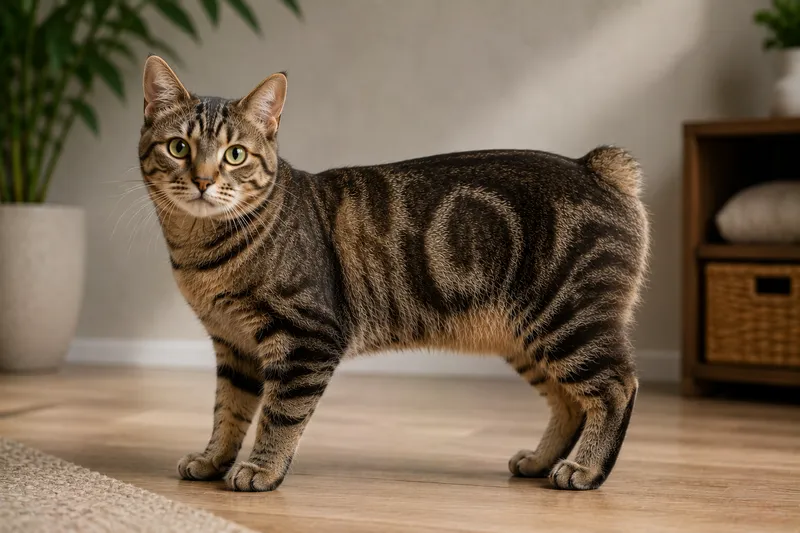
Manx Tailed
The Manx Tailed is the tailed shorthaired form within the historic Manx breed group associated with the Isle of Man. Although the Manx is famous for taillessness, kittens within Manx breeding populations can naturally…
Recognized by: FIFe · GCCF · +1
Size
Medium
Weight
3.5–5.5 kg
Life span
12–16 years
Breed Traits
Energy Level
High energy
Energy Level: 4 of 5
Low energyHigh energyChild / Family Compatibility
High compatibility
Child / Family Compatibility: 4 of 5
Low compatibilityHigh compatibilityGrooming Need
Light grooming need
Grooming Need: 2 of 5
Low maintenanceHigh maintenanceTrainability
Easy to train
Trainability: 4 of 5
Hard to trainEasy to trainApartment / Home Suitability
Fits apartments well
Apartment / Home Suitability: 4 of 5
Needs space / yardExcellent for apartmentsAlone-Time Tolerance
Handles a typical workday
Alone-Time Tolerance: 3 of 5
Needs frequent companyHandles long alone timeFirst-Time Owner Suitability
Suitable for many first-timers
First-Time Owner Suitability: 4 of 5
Needs experienced ownerGreat for first-time ownersCompatibility with Other Pets
Generally gets along well with other pets
Compatibility with Other Pets: 4 of 5
Single-pet homes are a better fitHighly compatible with other animals
The Manx Tailed is the tailed shorthaired form within the historic Manx breed group associated with the Isle of Man. Although the Manx is famous for taillessness, kittens within Manx breeding populations can naturally be born with a range of tail lengths. Tailed individuals have long played an important role in maintaining the breed and its genetic diversity.
This is a medium-sized, compact, muscular, and heavily boned cat with the rounded contours characteristic of Manx type. The head is round with prominent cheeks, the chest is broad, the flanks are deep, and the hind legs are longer and more powerful than the forelegs, producing the characteristic rise toward the rump. The short coat is dense and double, giving the body a well-padded appearance.
Registry treatment of tailed Manx cats varies. TICA introduced Manx Tailed as a separate Championship breed in 2026. FIFe recognises Manx tail-length varieties including Stumpy and Longie within the Manx breed, while GCCF includes stumpy and fully tailed Manx cats as an important part of its breeding programme even though only the tailless shorthair form is eligible under its Manx show Standard of Points.
Manx Tailed cats generally share the affectionate, intelligent, playful, and people-oriented temperament associated with the Manx breed group. Many form strong relationships with familiar people, follow household activity closely, and communicate with relatively quiet trills and other soft vocalizations.
Their powerful hindquarters make healthy individuals capable runners and jumpers. Retrieving games, wand toys, food puzzles, climbing furniture, and reward-based training can provide useful physical and mental stimulation. Normal Manx movement should be strong and functional rather than impaired or persistently rabbit-like.
Well-socialized Manx Tailed cats commonly live successfully with respectful children, compatible cats, and cat-friendly dogs. Many can cope with an ordinary working-day absence when their environment and routine are predictable, although regular companionship remains important.
The dense short double coat is relatively easy to maintain. Brushing or combing several times a month is sufficient for many adults, with more frequent grooming during seasonal shedding when loose undercoat can accumulate.
A substantial or full tail should be handled like any other cat's tail: never pull, twist, bend, or use it to restrain the cat. Become familiar with the individual's normal tail movement, gait, jumping ability, and hind-limb strength so that pain, stiffness, swelling, or mobility changes can be recognised promptly.
Routine care should include daily interactive play, sturdy climbing and scratching furniture, dental hygiene, nail trimming, clean litter facilities, and measured portions of a complete life-stage-appropriate diet. Persistent constipation, urinary changes, abnormal gait, hind-limb weakness, spinal discomfort, or changes in tail function deserve veterinary assessment.
Manx Tailed cats belong to the same breeding population as tailless and short-tailed Manx cats, but a substantial or full tail should not by itself be interpreted as evidence of Manx syndrome. Research has identified several loss-of-function variants in TBXT, historically called T or Brachyury, associated with shortened tails in Manx cats. Most short-tailed Manx cats in the principal genetic study were heterozygous for a TBXT variant, and different Manx lineages carried different variants.
Manx syndrome, or sacrocaudal dysgenesis, is associated primarily with abnormal development of the caudal spine, spinal cord, and related nerves in severely tail-reduced individuals. Clinical consequences can include abnormal gait, hind-limb weakness, constipation, and impaired urinary or fecal control. These findings should not be transferred automatically to every tailed Manx simply because it belongs to the same breed population.
Tailed Manx cats are valuable in responsible breeding programmes because breeders can use different tail phenotypes while managing the risks associated with extreme taillessness and maintaining genetic diversity. Prospective owners should nevertheless request family health records covering spinal abnormalities, gait, continence, reproductive outcomes, neonatal losses, longevity, and causes of death. Any TBXT DNA result should be interpreted for the specific variant tested rather than treated as complete spinal or neurological health clearance. This information is for general educational purposes and is not a substitute for diagnosis or treatment by a veterinarian.
Recognizing organizations
Independent registries that list this breed. Tap a badge to learn more.
These statuses reflect each registry’s recording and show systems. They are not a health, quality, or superiority score.
Frequently asked questions
What is a Manx Tailed cat?
A Manx Tailed is a shorthaired Manx with a substantial or full tail. Tailed kittens occur naturally within Manx breeding populations and share the breed's rounded body, powerful hindquarters, dense double coat, and general temperament.
Is a Manx Tailed a recognized cat breed?
Recognition depends on the registry. TICA recognizes Manx Tailed as a separate Championship breed, while FIFe recognizes multiple Manx tail-length varieties within the Manx breed. GCCF accepts tailed Manx cats as an important part of the breeding programme but limits its Manx show standard to the tailless shorthair form.
Are Manx Tailed cats good family pets?
They are generally affectionate, playful, intelligent, and socially involved cats that can suit many families. Respectful handling, regular interactive play, and opportunities to climb and explore are important.
Do Manx Tailed cats get along with children and other pets?
Many well-socialized individuals live successfully with respectful children, compatible cats, and cat-friendly dogs. Introductions should be gradual, and children should be taught never to pull or twist the cat's tail.
Can a Manx Tailed live in an apartment?
Yes. A healthy Manx Tailed can adapt well to apartment life when provided with daily interactive play, sturdy climbing furniture, scratching surfaces, puzzle activities, comfortable resting areas, and secure windows or balconies.
How much grooming does a Manx Tailed need?
The dense short double coat generally requires brushing or combing several times a month, with more frequent grooming during seasonal shedding. Routine nail, dental, skin, and body-condition care should also be maintained.
Does a Manx Tailed have the same risk of Manx syndrome as a tailless Manx?
A substantial or full tail should not automatically be interpreted as evidence of Manx syndrome. The most serious congenital problems are associated with abnormal development accompanying severe tail reduction, although family health history and normal gait, spinal comfort, urinary function, and bowel function remain important considerations in every breeding line.
Why are tailed Manx cats important in breeding programmes?
Tailed Manx cats provide breeders with additional mating options when managing the dominant tail-reduction trait and maintaining genetic diversity. Responsible programmes use pedigree, phenotype, family health information, and appropriate genetic evidence rather than selecting only for extreme taillessness.
More about Manx Tailed
Pet profiles are coming soon. For now, keep exploring trusted breed knowledge in the Breed Guide.
Back to Breed Guide