

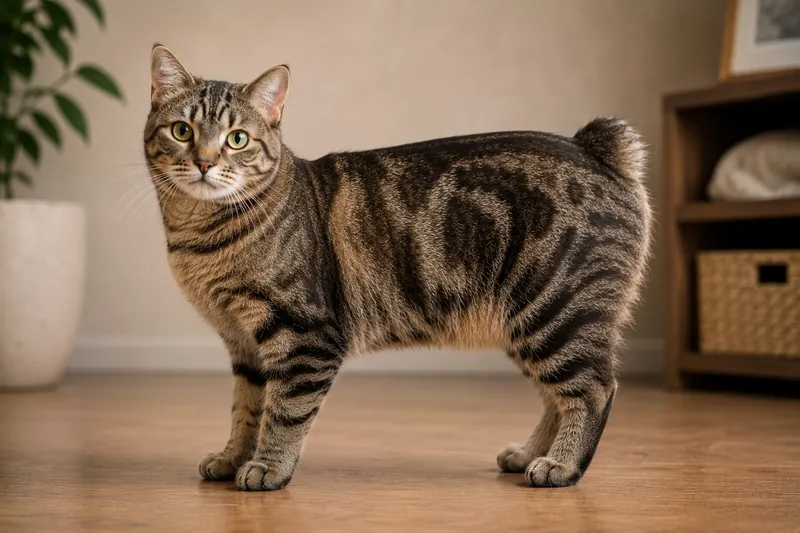
Manx Shorthair
The Manx Shorthair is the short-coated form of the historic Manx breed associated with the Isle of Man in the Irish Sea. Tailless and short-tailed cats became established in the island population through a naturally…
Recognized by: CFA · FIFe · +2
Size
Medium
Weight
3.5–5.5 kg
Life span
12–16 years
Breed Traits
Energy Level
High energy
Energy Level: 4 of 5
Low energyHigh energyChild / Family Compatibility
High compatibility
Child / Family Compatibility: 4 of 5
Low compatibilityHigh compatibilityGrooming Need
Light grooming need
Grooming Need: 2 of 5
Low maintenanceHigh maintenanceTrainability
Easy to train
Trainability: 4 of 5
Hard to trainEasy to trainApartment / Home Suitability
Fits apartments well
Apartment / Home Suitability: 4 of 5
Needs space / yardExcellent for apartmentsAlone-Time Tolerance
Handles a typical workday
Alone-Time Tolerance: 3 of 5
Needs frequent companyHandles long alone timeFirst-Time Owner Suitability
Challenging for beginners
First-Time Owner Suitability: 2 of 5
Needs experienced ownerGreat for first-time ownersCompatibility with Other Pets
Generally gets along well with other pets
Compatibility with Other Pets: 4 of 5
Single-pet homes are a better fitHighly compatible with other animals
The Manx Shorthair is the short-coated form of the historic Manx breed associated with the Isle of Man in the Irish Sea. Tailless and short-tailed cats became established in the island population through a naturally occurring dominant mutation, and Manx cats were among the earliest breeds represented in organized cat shows. CFA has registered Manx since its foundation in 1906.
This is a medium-sized, compact, muscular, and heavily boned cat with a very rounded overall appearance. The head is round with prominent cheeks, the body is short and deep through the flanks, and the hind legs are longer than the forelegs, producing a characteristic rise toward the rounded rump. Healthy individuals should move powerfully and comfortably rather than relying on an abnormal hopping gait.
The Shorthair has a dense, plush double coat with a well-padded feel. Many colours and patterns occur according to registry rules. Tail length within the wider Manx population ranges from completely tailless through small rises and partial tails to full tails, but this Atlas record focuses on the shorthaired Manx show phenotype; BondPals maintains Manx Tailed as a separate registry entry.
Manx Shorthairs are generally affectionate, intelligent, playful, and strongly connected to their households. Many form particularly close relationships with one or more family members and communicate through chirps, trills, purrs, and relatively quiet vocalizations.
Their powerful hindquarters make healthy individuals capable runners and jumpers. Retrieving games, wand toys, food puzzles, climbing furniture, and short reward-based training sessions provide useful physical and mental stimulation. A sudden reluctance to jump, run, or play should not be dismissed as a normal feature of the breed.
Well-socialized Manx Shorthairs commonly live successfully with respectful children, compatible cats, and cat-friendly dogs. Many can manage an ordinary working-day absence when their routine is predictable, but they generally prefer regular companionship and involvement in family life.
The dense short double coat is relatively easy to maintain. Brushing or combing several times a month is sufficient for many cats, with more frequent grooming during seasonal shedding when loose undercoat can accumulate.
The rump and any tail remnant should be handled gently. Never poke repeatedly at a tailless rump or pull, bend, or straighten a partial tail. Support the hindquarters when lifting the cat and become familiar with its normal gait, posture, and comfort level.
Provide daily interactive play, sturdy climbing and scratching furniture, non-slip surfaces, dental hygiene, nail care, clean litter facilities, and measured portions of a complete life-stage-appropriate diet. Difficulty jumping, hind-limb weakness, pain around the lower spine, persistent constipation, urinary problems, or loss of bowel or bladder control warrants prompt veterinary assessment.
The characteristic Manx tail phenotype is strongly associated with loss-of-function variants in TBXT, historically called the T or Brachyury gene. Genetic research has identified several different Manx-associated TBXT alleles, with most short-tailed Manx cats in the studied population carrying one mutant copy. The absence of cats carrying two mutant copies supports the concern that the homozygous state is incompatible with normal embryonic development.
Manx syndrome, also called sacrocaudal dysgenesis, describes congenital abnormalities involving the lower vertebral column, spinal cord, and associated nerves that can occur in some Manx cats. Reported clinical consequences include malformed or absent sacral vertebrae, hind-limb weakness or abnormal gait, reduced anal tone, constipation, and impaired urinary or fecal control. Not every tailless Manx develops clinically significant disease, and severity cannot be predicted reliably from external tail appearance alone.
Prospective owners should ask how kittens are assessed for normal gait, hind-limb strength, spinal and rump comfort, urination, defecation, and neurologic development before placement. Breeders should maintain family records covering congenital spinal abnormalities, continence problems, neonatal losses, reproductive outcomes, longevity, and causes of death. A TBXT result identifies a specific tail-associated variant but does not predict exact clinical severity or guarantee overall health. This information is for general educational purposes and is not a substitute for diagnosis or treatment by a veterinarian.
Recognizing organizations
Independent registries that list this breed. Tap a badge to learn more.
These statuses reflect each registry’s recording and show systems. They are not a health, quality, or superiority score.
Frequently asked questions
Are Manx Shorthairs good family cats?
Manx Shorthairs are generally affectionate, playful, and strongly involved with their households. Families should provide gentle handling, regular activity, and careful observation for mobility or elimination problems associated with severe tail reduction.
Are Manx Shorthairs good with children?
Many well-socialized Manx Shorthairs live successfully with respectful children. Children should support the cat properly and must never poke the rump or pull, bend, or repeatedly manipulate a tail remnant.
Do Manx Shorthairs get along with other pets?
Many adapt well to compatible cats and cat-friendly dogs after gradual introductions. Their hunting instincts may make birds, rodents, and other small animals unsuitable companions without secure separation.
Can a Manx Shorthair live in an apartment?
Yes. A healthy Manx Shorthair can adapt well to apartment living when provided with daily play, sturdy climbing furniture, scratching areas, puzzle activities, and regular companionship. Non-slip surfaces and accessible litter trays can be useful for cats with mobility limitations.
Can Manx Shorthairs be left alone during the day?
Many adults can manage an ordinary working-day absence when their routine and environment are predictable. Frequent prolonged isolation is less suitable for a breed that commonly forms strong social bonds with its household.
How much grooming does a Manx Shorthair need?
The dense short coat generally needs brushing or combing several times a month, with additional grooming during seasonal shedding. Nail care, dental hygiene, skin checks, and body-condition monitoring should remain part of the regular routine.
What is the difference between a Manx Shorthair and a Manx Tailed?
They belong to the same Manx breed family and share the same basic body type and temperament tendencies. The Manx Shorthair page focuses on the traditional short-coated tailless or strongly tail-reduced phenotype, while the Manx Tailed has a substantial or full tail and is maintained as a separate BondPals Atlas record.
Does every tailless Manx Shorthair develop Manx syndrome?
No. Some tailless Manx cats remain clinically comfortable throughout life, while others develop congenital spinal, neurologic, urinary, or bowel problems. Tail appearance alone cannot reliably predict severity, so normal gait, elimination, neurologic function, and family health history are important.
More about Manx Shorthair
Pet profiles are coming soon. For now, keep exploring trusted breed knowledge in the Breed Guide.
Back to Breed Guide