

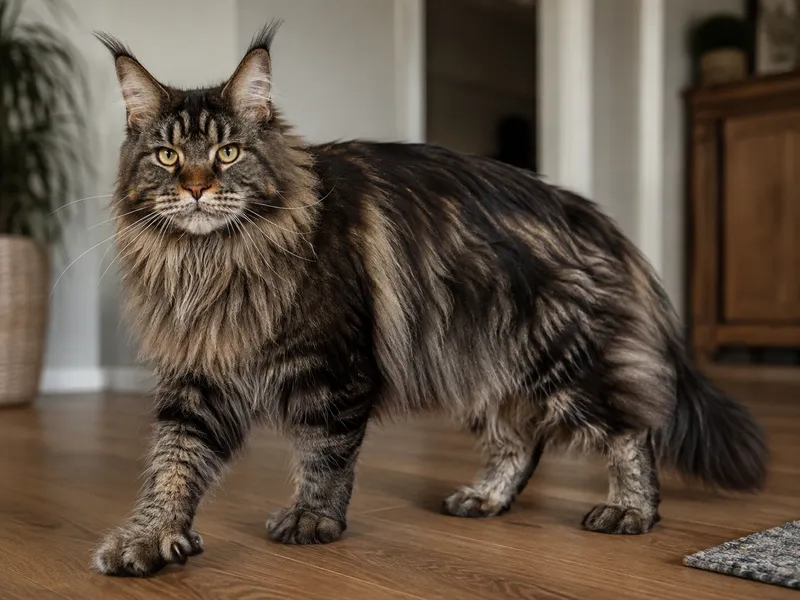
Maine Coon Polydactyl
The Maine Coon Polydactyl is the polydactyl form of the Maine Coon, one of North America's oldest natural pedigree breeds. Maine Coons developed in the northeastern United States, particularly Maine, where a substantial…
Recognized by: TICA
Size
Large
Weight
4.5–9.1 kg
Life span
9–15 years
Breed Traits
Energy Level
Moderate energy
Energy Level: 3 of 5
Low energyHigh energyChild / Family Compatibility
Very high compatibility
Child / Family Compatibility: 5 of 5
Low compatibilityHigh compatibilityGrooming Need
Moderate grooming need
Grooming Need: 3 of 5
Low maintenanceHigh maintenanceTrainability
Easy to train
Trainability: 4 of 5
Hard to trainEasy to trainApartment / Home Suitability
Fits apartments well
Apartment / Home Suitability: 4 of 5
Needs space / yardExcellent for apartmentsAlone-Time Tolerance
Handles a typical workday
Alone-Time Tolerance: 3 of 5
Needs frequent companyHandles long alone timeFirst-Time Owner Suitability
Suitable for many first-timers
First-Time Owner Suitability: 4 of 5
Needs experienced ownerGreat for first-time ownersCompatibility with Other Pets
Shows very high compatibility
Compatibility with Other Pets: 5 of 5
Single-pet homes are a better fitHighly compatible with other animals
The Maine Coon Polydactyl is the polydactyl form of the Maine Coon, one of North America's oldest natural pedigree breeds. Maine Coons developed in the northeastern United States, particularly Maine, where a substantial longhaired body, weather-resistant coat, large paws, and adaptable temperament suited the regional climate and working-cat lifestyle.
Polydactyly means that the cat is born with more than the usual number of toes on one or more paws. The trait was historically present in Maine Coon populations and can produce a broad range of paw shapes, from one additional digit to markedly enlarged mitten-like feet. TICA maintains Maine Coon Polydactyl as a distinct Championship registry entry within the Maine Coon breed group.
Apart from the extra digits, the breed should retain standard Maine Coon type: a large rectangular body, substantial boning and musculature, a broad chest, a squared muzzle, large high-set ears, expressive oval eyes, and a long flowing tail. The semi-long shaggy coat is shorter over the shoulders and longer along the belly, britches, and tail, with an undercoat that varies with season.
Maine Coon Polydactyl cats generally share the affectionate, confident, playful, and people-oriented temperament associated with the wider Maine Coon breed. Many enjoy following household activity, greeting family members, and remaining socially involved without demanding continuous physical contact.
They are intelligent and moderately active cats that often enjoy retrieving, food puzzles, climbing, interactive wand play, and reward-based training. Their large body means climbing furniture and shelves should be sturdy enough to support an adult safely.
Well-socialized individuals commonly live successfully with respectful children, compatible cats, and cat-friendly dogs. Their size and strength should still be considered during introductions, particularly with elderly, very small, or timid companion animals.
The shaggy semi-long coat generally benefits from thorough combing once or twice a week, with additional grooming during seasonal shedding. Pay particular attention to the belly, armpits, britches, ruff, and tail where loose undercoat and friction can create tangles.
Polydactyl paws require extra attention because additional digits can carry claws that do not contact scratching surfaces normally. Every toe should be identified and each claw checked regularly for overgrowth, curling, splitting, pressure against neighbouring digits, debris, or skin irritation. Hidden or closely spaced claws may require more frequent trimming than the cat's other nails.
Daily care should also include interactive exercise, sturdy climbing and scratching furniture, dental hygiene, clean litter facilities, and measured portions of a complete life-stage-appropriate diet. Limping, swelling, persistent paw licking, abnormal nail growth, pressure sores, or reluctance to bear weight should receive veterinary assessment.
Polydactyly in Maine Coon cats is generally described as a non-syndromic preaxial limb trait and is inherited dominantly in studied lines, with variable expression in the number and position of extra digits. Genetic research has identified the Hw variant in the ZRS regulatory region in some polydactyl Maine Coons, while other affected cats lack that known variant, demonstrating that the genetic basis is heterogeneous rather than explained by one universal test.
Clinical research has documented considerable variation in digit, carpal, and tarsal conformation among polydactyl Maine Coons. The available evidence does not establish that every polydactyl cat develops pain or disability, but individual paw structure should be assessed for functional problems, abnormal claw placement, altered weight bearing, or secondary skin and nail complications.
The wider Maine Coon breed also has established inherited health concerns, including the MYBPC3 A31P variant associated with hypertrophic cardiomyopathy, spinal muscular atrophy, and pyruvate kinase deficiency. These targeted DNA tests can provide useful breeding information, but negative results do not rule out every cause of cardiac, neurological, hematologic, or other disease. Prospective owners should request documented testing, family health history, cardiac screening information, and veterinary records. This information is for general educational purposes and is not a substitute for diagnosis or treatment by a veterinarian.
Recognizing organizations
Independent registries that list this breed. Tap a badge to learn more.
These statuses reflect each registry’s recording and show systems. They are not a health, quality, or superiority score.
Frequently asked questions
What makes a Maine Coon Polydactyl different from a regular Maine Coon?
The defining difference is the presence of extra toes on one or more paws. Otherwise, the Maine Coon Polydactyl should share the same large rectangular body, shaggy coat, temperament tendencies, and general breed type as the standard Maine Coon.
Are Maine Coon Polydactyl cats good family pets?
They are generally affectionate, playful, and socially involved cats that can suit many families. Their large adult size means children should learn respectful handling and the cat should have sturdy furniture and enough space to move comfortably.
Do Maine Coon Polydactyl cats get along with other pets?
Many live successfully with compatible cats and cat-friendly dogs after gradual introductions. Their size and confidence can overwhelm a timid companion, so separate resources and supervised introductions remain important.
Can a Maine Coon Polydactyl live in an apartment?
Yes, if the home provides enough usable space, sturdy vertical territory, daily interactive play, large scratching surfaces, and appropriately sized litter trays and resting areas. Secure windows and balconies are essential.
Do extra toes cause health problems in Maine Coon Polydactyl cats?
Not every polydactyl Maine Coon develops a medical problem, and many function normally. However, paw anatomy varies considerably, so extra claws, altered digit alignment, abnormal weight bearing, or pressure between toes should be checked regularly.
How should the paws of a Maine Coon Polydactyl be cared for?
Identify every toe and claw and inspect them regularly. Some extra claws do not wear naturally and may need more frequent trimming; redness, swelling, overgrown claws, persistent licking, or lameness should be assessed by a veterinarian.
Is Maine Coon polydactyly caused by one genetic mutation?
No single known variant explains every polydactyl Maine Coon. The Hw variant in the ZRS regulatory region has been identified in some lines, while other polydactyl cats lack that variant, showing that the trait is genetically heterogeneous.
What health screening should a Maine Coon Polydactyl breeder provide?
Ask for Maine Coon-specific health information including MYBPC3 A31P HCM, spinal muscular atrophy, and pyruvate kinase deficiency results where appropriate, together with cardiac screening, family health history, and careful assessment of paw structure and function. No DNA panel guarantees complete health.
More about Maine Coon Polydactyl
Pet profiles are coming soon. For now, keep exploring trusted breed knowledge in the Breed Guide.
Back to Breed Guide