

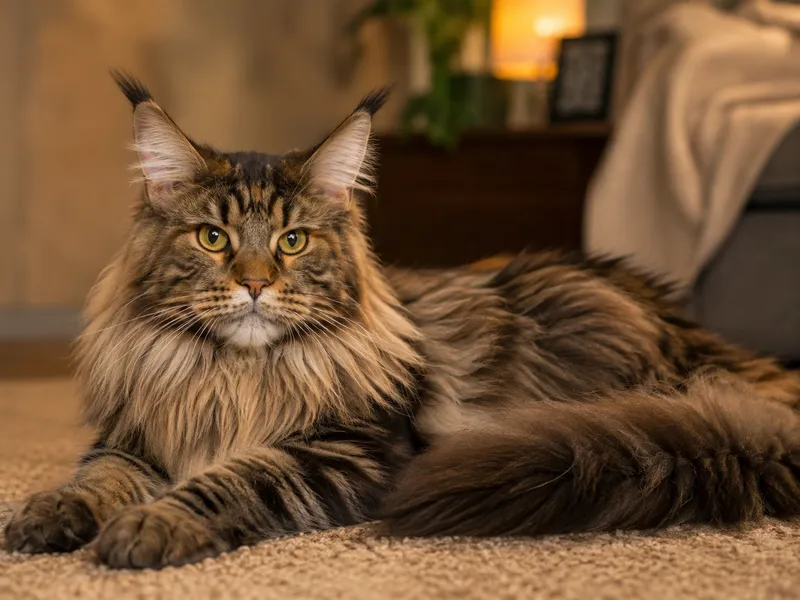
Maine Coon
The Maine Coon is a large, powerfully built cat with a broad chest, substantial bone, a long rectangular body, tufted paws, and a full flowing tail. Its uneven semi-long coat is shorter over the shoulders and longer…
Recognized by: CFA · FIFe · +2
Size
Large
Weight
5.4–10 kg
Life span
10–15 years
Breed Traits
Energy Level
Moderate energy
Energy Level: 3 of 5
Low energyHigh energyChild / Family Compatibility
High compatibility
Child / Family Compatibility: 4 of 5
Low compatibilityHigh compatibilityGrooming Need
High grooming need
Grooming Need: 4 of 5
Low maintenanceHigh maintenanceTrainability
Easy to train
Trainability: 4 of 5
Hard to trainEasy to trainApartment / Home Suitability
Moderate — depends on setup
Apartment / Home Suitability: 3 of 5
Needs space / yardExcellent for apartmentsAlone-Time Tolerance
Handles a typical workday
Alone-Time Tolerance: 3 of 5
Needs frequent companyHandles long alone timeFirst-Time Owner Suitability
Suitable for many first-timers
First-Time Owner Suitability: 4 of 5
Needs experienced ownerGreat for first-time ownersCompatibility with Other Pets
Shows very high compatibility
Compatibility with Other Pets: 5 of 5
Single-pet homes are a better fitHighly compatible with other animals
The Maine Coon is a large, powerfully built cat with a broad chest, substantial bone, a long rectangular body, tufted paws, and a full flowing tail. Its uneven semi-long coat is shorter over the shoulders and longer around the ruff, belly, and hindquarters, creating the rugged appearance associated with the breed.
The breed developed in the northeastern United States and is closely associated with the state of Maine. Its precise ancestry is not documented, and stories involving raccoons, royal cats, or Viking ships remain legends rather than established history; the modern breed is generally understood to have developed from domestic cats adapted to the region.
Maine Coons mature slowly and may take three to four years to reach their full size, musculature, and adult coat. Their substantial build is paired with an adaptable, sociable temperament that can suit active families as well as quieter homes able to provide regular interaction and appropriately sized equipment.
Maine Coons are generally friendly, steady, and strongly interested in family life. Many follow familiar people from room to room, observe household activity, and stay nearby without constantly demanding to be held or carried.
They commonly retain a playful disposition into adulthood and may enjoy retrieving toys, learning routines, exploring puzzle feeders, or investigating running water. Their intelligence and food motivation can make positive, reward-based training practical, although enthusiasm varies between individuals.
Well-socialized Maine Coons can live successfully with respectful children, compatible cats, and cat-friendly dogs. Their large size makes gentle handling and gradual introductions especially important, and every cat should have quiet areas where it can rest without interruption.
The Maine Coon's semi-long coat requires regular combing to remove loose hair and prevent tangles, especially around the ruff, armpits, belly, and hindquarters. Several grooming sessions each week suit many cats, while denser or more cottony coats may need more frequent attention during seasonal shedding.
Daily life should include interactive play, sturdy climbing furniture, wide resting platforms, strong scratching posts, and opportunities for exploration. Carriers, litter boxes, beds, and cat trees should be stable and large enough to support a fully grown Maine Coon comfortably.
Routine care should include dental hygiene, nail trimming, ear checks, body-condition monitoring, and regular veterinary examinations. Food portions should reflect the individual cat's age, activity, health, and body condition rather than the assumption that a large breed always needs unrestricted feeding.
Hypertrophic cardiomyopathy is an important inherited health concern in Maine Coons. A breed-associated MYBPC3 A31P variant can be identified through DNA testing, but the test detects only that specific risk variant and a negative result does not exclude every possible cause of HCM; responsible breeding programs may therefore combine genetic information with veterinary cardiac screening.
Spinal muscular atrophy and pyruvate kinase deficiency are additional inherited conditions for which DNA tests are available. Hip dysplasia has also been documented in the breed, so prospective owners should ask about family health history, relevant genetic results, cardiac evaluations, and orthopedic screening rather than relying on appearance or size alone.
Regular veterinary care can help monitor heart health, mobility, dental condition, body weight, and changes in breathing, activity, or coordination. This information is for general educational purposes and is not a substitute for diagnosis or treatment by a veterinarian.
Recognizing organizations
Independent registries that list this breed. Tap a badge to learn more.
These statuses reflect each registry’s recording and show systems. They are not a health, quality, or superiority score.
Frequently asked questions
Are Maine Coons good family cats?
Maine Coons are often friendly, patient companions in households that provide respectful handling and regular interaction. Children should be taught not to chase, restrain, or lift the cat without properly supporting its large body.
How large do Maine Coons become?
Adult females are commonly smaller than males, while healthy males may approach the upper end of the breed's typical weight range. Body condition matters more than pursuing an unusually high number on the scale, and the breed may continue developing for several years.
Do Maine Coons need a lot of grooming?
Their coats require more maintenance than a typical shorthaired cat, but the workload varies with coat texture and season. Thorough combing several times a week helps remove loose undercoat and catches tangles before they become mats.
Can a Maine Coon live in an apartment?
A Maine Coon can live comfortably in an apartment when there is enough usable space, vertical territory, daily play, and appropriately sized equipment. Secure enrichment and owner involvement matter more than access to a garden.
Can Maine Coons be left alone during the day?
Many adults can manage ordinary working-day absences when they have a predictable routine and an enriched environment. They remain social cats and should receive dependable companionship, play, and observation before and after periods alone.
Are Maine Coons easy to train?
Many Maine Coons respond well to short, reward-based sessions and can learn carrier routines, recall cues, retrieving games, simple tricks, or harness skills. Training should remain voluntary and should use food, play, or praise rather than punishment.
Are Maine Coons hypoallergenic?
No cat breed is guaranteed to be hypoallergenic, and Maine Coons produce common feline allergens like other cats. Their large coat can also distribute shed hair and dander, so people with allergies should spend time around individual cats before making a commitment.
What health screening should a Maine Coon breeder discuss?
A responsible breeder should discuss testing for the Maine Coon-associated HCM variant, spinal muscular atrophy, and pyruvate kinase deficiency. Buyers should also ask about repeated cardiac evaluation, family health history, and orthopedic assessment because one DNA result cannot evaluate every possible risk.
More about Maine Coon
Pet profiles are coming soon. For now, keep exploring trusted breed knowledge in the Breed Guide.
Back to Breed Guide