

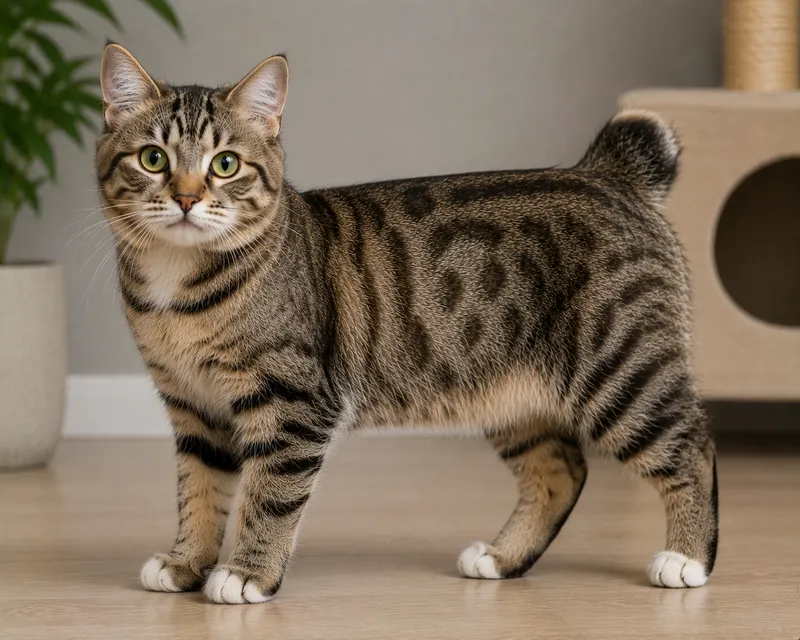
Kurilian Bobtail Shorthair
The Kurilian Bobtail Shorthair is the short-coated form of the Kurilian Bobtail, a naturally developed cat associated with the Kuril Islands, Sakhalin Island, and Russia's Kamchatka region. Accounts of bobtailed island…
Recognized by: FIFe · GCCF · +1
Size
Large
Weight
3.6–6.8 kg
Life span
15–20 years
Breed Traits
Energy Level
High energy
Energy Level: 4 of 5
Low energyHigh energyChild / Family Compatibility
High compatibility
Child / Family Compatibility: 4 of 5
Low compatibilityHigh compatibilityGrooming Need
Light grooming need
Grooming Need: 2 of 5
Low maintenanceHigh maintenanceTrainability
Easy to train
Trainability: 4 of 5
Hard to trainEasy to trainApartment / Home Suitability
Moderate — depends on setup
Apartment / Home Suitability: 3 of 5
Needs space / yardExcellent for apartmentsAlone-Time Tolerance
Handles a typical workday
Alone-Time Tolerance: 3 of 5
Needs frequent companyHandles long alone timeFirst-Time Owner Suitability
Suitable for many first-timers
First-Time Owner Suitability: 4 of 5
Needs experienced ownerGreat for first-time ownersCompatibility with Other Pets
Generally gets along well with other pets
Compatibility with Other Pets: 4 of 5
Single-pet homes are a better fitHighly compatible with other animals
The Kurilian Bobtail Shorthair is the short-coated form of the Kurilian Bobtail, a naturally developed cat associated with the Kuril Islands, Sakhalin Island, and Russia's Kamchatka region. Accounts of bobtailed island cats extend back for generations, but the precise ancestry of the modern pedigree population remains uncertain and competing origin explanations should not be presented as proven fact.
This is a medium-to-large, substantial cat with strong boning, firm musculature, a broad chest, and a compact semi-cobby body. The hind legs are longer than the forelegs, creating a gently rising back line toward the rump. The head has broad, rounded contours, the eyes are walnut-shaped, and the overall impression is powerful rather than slender or refined.
The defining tail contains kinks, curves, or both and may form a snag, spiral, whisk, or pom-pom shape. No two tails are exactly alike. In the Shorthair form, the soft, silky coat is short, lies relatively close to the body, and has a moderate undercoat; the tail hair helps create the breed's characteristic rounded or brush-like outline.
Kurilian Bobtail Shorthairs are generally described as intelligent, confident, affectionate, and observant. Many form close relationships with their families while retaining some independence, and they often follow household activity or supervise it from an elevated resting place.
They are capable jumpers and enthusiastic players that benefit from climbing furniture, retrieving games, food puzzles, and regular interactive exercise. Historical descriptions emphasize hunting and fishing ability, and some individuals are interested in running water, although comfort with water varies and should never be assumed.
Well-socialized individuals may live successfully with respectful children, compatible cats, and cat-friendly dogs. Their hunting instincts can make unsupervised access to birds, rodents, aquarium fish, or other small animals unsafe. Gradual introductions and individual temperament remain more important than breed reputation alone.
The short, silky coat is generally straightforward to maintain. Weekly brushing can remove loose hair and distribute natural skin oils, with additional grooming during seasonal shedding. The moderate undercoat should be checked for excessive shedding, dandruff, parasites, or skin changes even when tangles are uncommon.
The bobbed tail should be handled gently and never pulled, straightened, or repeatedly manipulated. It may contain rigid sections, flexible sections, or both. Pain, swelling, skin irritation, reduced movement, sudden sensitivity, or difficulty keeping the tail area clean warrants veterinary assessment.
Daily care should also include interactive play, secure climbing and scratching structures, dental hygiene, nail trimming, clean litter facilities, and measured portions of a complete life-stage-appropriate diet. The breed can adapt to apartment living when given sufficient vertical territory, exercise, companionship, and secure windows or balconies.
Published health data focused specifically on the Kurilian Bobtail Shorthair remain limited, and no coat-length-associated disorder is established as a defining problem of this variety. Limited reporting should not be interpreted as proof that every individual or family line is free from inherited or acquired disease.
The genetic basis of the Kurilian bobtail is not fully resolved. A small study found none of the Manx-associated causal T variants in the Kurilian Bobtails examined, while a later large genetic survey found the HES7 short-tail variant to be prevalent in sampled Kurilian Bobtails. These findings indicate that the Kurilian tail should not automatically be treated as the Manx condition, but they do not establish that every tail configuration is clinically harmless or that a tail-related DNA result provides complete health clearance.
Prospective owners should ask about family longevity, mobility, spinal and tail comfort, urinary and bowel function, heart and kidney health, known illnesses, and causes of death among related cats. Breeding decisions should combine veterinary examination, pedigree information, family history, genetic diversity, and any line-appropriate testing. This information is for general educational purposes and is not a substitute for diagnosis or treatment by a veterinarian.
Recognizing organizations
Independent registries that list this breed. Tap a badge to learn more.
These statuses reflect each registry’s recording and show systems. They are not a health, quality, or superiority score.
Frequently asked questions
Are Kurilian Bobtail Shorthairs good family cats?
Kurilian Bobtail Shorthairs are generally affectionate, playful, and involved companions. Well-socialized individuals often live successfully with respectful children, but interactions should be supervised and the tail must never be pulled or forced into a different position.
Do Kurilian Bobtail Shorthairs get along with other pets?
Many can live successfully with compatible cats and cat-friendly dogs after gradual introductions. Their hunting instincts may make birds, rodents, aquarium fish, and other small animals unsafe housemates unless secure separation is maintained.
Can a Kurilian Bobtail Shorthair live in an apartment?
This variety can adapt to apartment living when provided with sturdy climbing furniture, daily interactive play, scratching areas, puzzle activities, and regular companionship. Its size and activity level make generous vertical space and secure windows or balconies especially important.
Can Kurilian Bobtail Shorthairs be left alone during the day?
Many adults can manage ordinary short absences and may show some independence. Frequent prolonged isolation is still unsuitable for a social and intelligent cat, so predictable routines, enrichment, and dependable interaction are important.
How much grooming does a Kurilian Bobtail Shorthair need?
Weekly brushing is usually sufficient for the short, silky coat. Additional grooming may be helpful during seasonal shedding, while nail care, visible ear checks, and dental hygiene should remain part of the regular routine.
What is the difference between a Kurilian Bobtail Shorthair and a Kurilian Bobtail Longhair?
Both share the same substantial body type, naturally kinked tail, and general temperament tendencies. The Shorthair has a shorter, closer coat that usually needs less grooming, while the Longhair has a semi-long coat with a plumed tail and possible ruff, britches, and toe tufts.
Is the Kurilian Bobtail Shorthair a separate breed or a coat variety?
Classification depends on the registry. BondPals gives it a separate Atlas page, TICA lists Kurilian Bobtail and Kurilian Bobtail Longhair separately within the same breed group, and FIFe fully recognises Kurilean Bobtail Shorthair under the KBS code.
Is the Kurilian Bobtail tail associated with Manx syndrome?
The Kurilian tail has not been established as the same genetic condition as the Manx phenotype. Research remains limited, so pain, weakness, an abnormal gait, urinary or bowel difficulty, or unusual tail sensitivity still requires veterinary assessment.
More about Kurilian Bobtail Shorthair
Pet profiles are coming soon. For now, keep exploring trusted breed knowledge in the Breed Guide.
Back to Breed Guide