

Japanese Bobtail
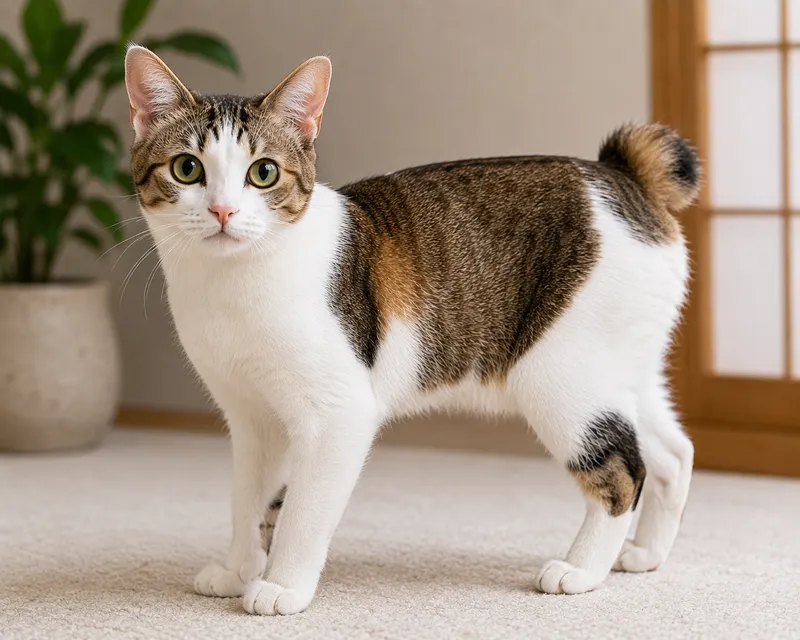
The Japanese Bobtail is a medium-sized, elegant and athletic cat with long clean lines, firm musculature, high cheekbones, large expressive eyes, and hind legs that are slightly longer than the forelegs. Its defining…
Recognized by: CFA · FIFe · +1
Size
Medium
Weight
2.3–4.5 kg
Life span
9–13 years
Breed Traits
Energy Level
Very energetic
Energy Level: 5 of 5
Low energyHigh energyChild / Family Compatibility
Very high compatibility
Child / Family Compatibility: 5 of 5
Low compatibilityHigh compatibilityGrooming Need
Light grooming need
Grooming Need: 2 of 5
Low maintenanceHigh maintenanceTrainability
Very easy to train
Trainability: 5 of 5
Hard to trainEasy to trainApartment / Home Suitability
Fits apartments well
Apartment / Home Suitability: 4 of 5
Needs space / yardExcellent for apartmentsAlone-Time Tolerance
Half-day is hard
Alone-Time Tolerance: 2 of 5
Needs frequent companyHandles long alone timeFirst-Time Owner Suitability
Suitable for many first-timers
First-Time Owner Suitability: 4 of 5
Needs experienced ownerGreat for first-time ownersCompatibility with Other Pets
Shows very high compatibility
Compatibility with Other Pets: 5 of 5
Single-pet homes are a better fitHighly compatible with other animals
The Japanese Bobtail is a medium-sized, elegant and athletic cat with long clean lines, firm musculature, high cheekbones, large expressive eyes, and hind legs that are slightly longer than the forelegs. Its defining feature is a naturally shortened tail composed of curves, angles, kinks, or combinations of these structures, with longer hair creating a characteristic pom-pom appearance.
No two tails are exactly alike. The underlying tail may be flexible, partly rigid, or sharply curved, but it should be clearly present rather than completely absent. Japanese Bobtails occur in both shorthaired and longhaired forms, generally with soft, silky coats and little noticeable undercoat. Many colours and patterns occur, while the red, black, and white tricolour known as mi-ke is especially associated with the breed.
Short-tailed cats have appeared in Japanese art and tradition for centuries. The modern pedigree breed was established internationally from cats imported from Japan to North America beginning in 1968. Although the breed is commonly linked with the maneki-neko good-luck figure, the Japanese Bobtail should be understood as a natural domestic breed rather than a miniature wild cat or a tailless Manx-type breed.
Japanese Bobtails are generally outgoing, affectionate, curious, and highly intelligent. Many form close relationships with their families, follow household activity, greet visitors confidently, and communicate through a varied range of soft chirps, trills, and songlike meows.
They are active cats that often enjoy retrieving toys, learning tricks, climbing, exploring cupboards, using puzzle feeders, and playing with water. Their powerful hind legs make them capable jumpers, so secure vertical territory and structured interactive play are important parts of daily life.
Well-socialized Japanese Bobtails commonly live successfully with respectful children, compatible cats, and cat-friendly dogs. They usually want regular involvement and companionship and may become bored when repeatedly left without enough social contact or mental stimulation.
The shorthaired coat usually needs only gentle weekly brushing to remove loose hair. Longhaired Japanese Bobtails may benefit from brushing once or twice a week, with additional attention to the tail plume, hindquarter furnishings, and seasonal shedding. The limited undercoat generally makes both coat varieties easier to maintain than dense-coated longhaired breeds.
The tail should be handled carefully and never pulled, straightened, or repeatedly manipulated. Some tails contain fused or sharply angled vertebrae, and the cat should be allowed to choose how the area is touched. Pain, swelling, skin irritation, reduced tail movement, or sudden sensitivity warrants veterinary assessment.
Daily care should also include energetic interactive play, stable climbing furniture, scratching areas, puzzle activities, dental hygiene, nail trimming, body-condition monitoring, and regular veterinary examinations. Japanese Bobtails can adapt well to apartment living when their need for exercise, vertical space, training, and companionship is consistently met.
The Japanese Bobtail is generally regarded as a healthy natural breed, and no single inherited disease is currently established as a defining breed-wide disorder. Published breed-specific health data remain limited, so the health of an individual cat should still be assessed through veterinary records, family history, physical examination, and any line-specific screening used by the breeder.
The shortened and kinked tail is strongly associated with a variant in the HES7 gene and is inherited differently from the TBXT variants responsible for the Manx phenotype. A radiographic study found variations in caudal and other vertebrae among Japanese Bobtails, including hemivertebrae within tail kinks, but the observed vertebral patterns were not associated with morbidity or mortality in the cats examined. This evidence is reassuring but does not guarantee that every individual will be free from spinal, neurological, urinary, bowel, or tail-related problems.
HES7 testing identifies a breed-defining tail variant rather than serving as a complete health clearance. Prospective owners should ask about family longevity, mobility, spinal and tail comfort, urinary and bowel function, heart and kidney health, known illnesses, causes of death, and genetic diversity within the breeding programme. This information is for general educational purposes and is not a substitute for diagnosis or treatment by a veterinarian.
Recognizing organizations
Independent registries that list this breed. Tap a badge to learn more.
These statuses reflect each registry’s recording and show systems. They are not a health, quality, or superiority score.
Frequently asked questions
Are Japanese Bobtails good family cats?
Japanese Bobtails are generally affectionate, playful, and involved family companions. Well-socialized individuals commonly live successfully with respectful children who understand gentle handling and do not pull or manipulate the cat's tail.
Do Japanese Bobtails get along with other pets?
Well-socialized Japanese Bobtails usually have a high potential to live successfully with compatible cats and cat-friendly dogs. Introductions should still be gradual because confidence, play intensity, age, and previous experience vary between individuals.
Can a Japanese Bobtail live in an apartment?
A Japanese Bobtail can adapt well to apartment living when provided with stable climbing furniture, energetic daily play, puzzle activities, scratching areas, training opportunities, and regular companionship.
Can Japanese Bobtails be left alone during the day?
Many adults can manage ordinary short absences, but frequent prolonged isolation is not ideal for this active and people-oriented breed. A predictable routine, extensive enrichment, and dependable human or animal companionship are important.
How much grooming does a Japanese Bobtail need?
Shorthaired Japanese Bobtails usually need light weekly brushing. Longhaired individuals may benefit from brushing once or twice a week, particularly around the tail plume and hindquarters, but both varieties generally have little undercoat.
Are Japanese Bobtail Longhair and Japanese Bobtail Shorthair separate breeds?
They are best understood as two coat varieties within the same Japanese Bobtail breed concept, although registries classify them differently. CFA recognises both within Japanese Bobtail, TICA uses separate JB and JBL championship codes, and FIFe recognises only the shorthaired JBS variety.
Does the Japanese Bobtail's short tail cause the same health problems as the Manx trait?
No. The Japanese Bobtail tail is associated with HES7, while the Manx phenotype is linked to different TBXT variants. Research has not established the same Manx-type syndrome as a defining Japanese Bobtail problem, but any pain, weakness, abnormal gait, urinary difficulty, constipation, or tail sensitivity still requires veterinary assessment.
What is the difference between a Japanese Bobtail and a Kurilian Bobtail?
The Japanese Bobtail is generally more slender and refined, with long clean lines and a pom-pom tail carried close to the body. The Kurilian Bobtail is usually more substantial and powerful, with a broader build and a bobbed tail that may form hook, spiral, or whisk-like shapes.
More about Japanese Bobtail
Pet profiles are coming soon. For now, keep exploring trusted breed knowledge in the Breed Guide.
Back to Breed Guide