

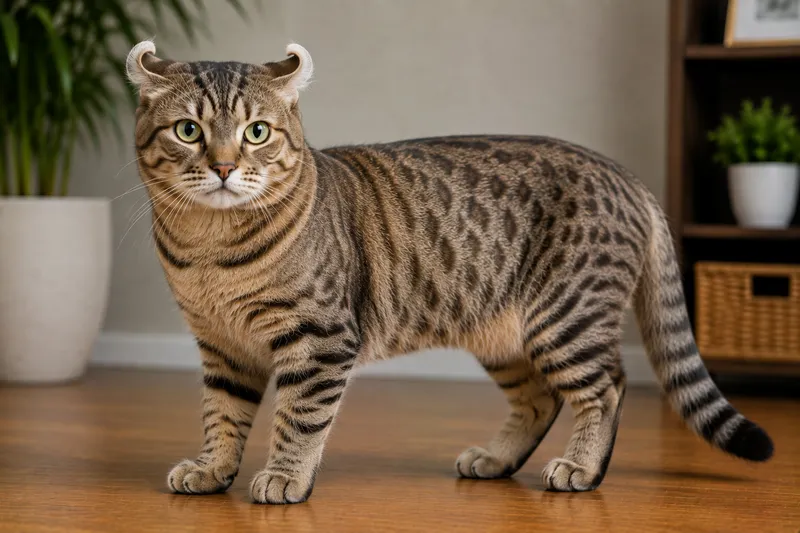
Highlander Shorthair
The Highlander Shorthair is the short-coated form of the Highlander, a modern North American breed developed to create a powerful domestic cat with a distinctive big-cat appearance. Organized development began in 2004,…
Recognized by: TICA
Size
Large
Weight
4.5–9.1 kg
Life span
10–15 years
Breed Traits
Energy Level
Very energetic
Energy Level: 5 of 5
Low energyHigh energyChild / Family Compatibility
High compatibility
Child / Family Compatibility: 4 of 5
Low compatibilityHigh compatibilityGrooming Need
Light grooming need
Grooming Need: 2 of 5
Low maintenanceHigh maintenanceTrainability
Easy to train
Trainability: 4 of 5
Hard to trainEasy to trainApartment / Home Suitability
Moderate — depends on setup
Apartment / Home Suitability: 3 of 5
Needs space / yardExcellent for apartmentsAlone-Time Tolerance
Half-day is hard
Alone-Time Tolerance: 2 of 5
Needs frequent companyHandles long alone timeFirst-Time Owner Suitability
Manageable with guidance
First-Time Owner Suitability: 3 of 5
Needs experienced ownerGreat for first-time ownersCompatibility with Other Pets
Generally gets along well with other pets
Compatibility with Other Pets: 4 of 5
Single-pet homes are a better fitHighly compatible with other animals
The Highlander Shorthair is the short-coated form of the Highlander, a modern North American breed developed to create a powerful domestic cat with a distinctive big-cat appearance. Organized development began in 2004, the Highlander name was adopted in 2005, and the breed later progressed through TICA's new-breed programme to Championship status.
This is a medium-to-large, muscular, athletic cat with substantial boning, a rectangular body, and hind legs that are slightly longer than the forelegs. The head is broad with a long sloping forehead, a wide nose, strong chin, prominent whisker pads, and medium-to-large expressive eyes.
The ears are wide at the base and remain erect while the upper portion forms a loose backward curl. The naturally short tail is thick, articulated, and may include kinks or curves. The Shorthair has a dense, resilient short coat that lies closer to the body than the longhaired Highlander and requires less grooming.
Highlander Shorthairs are generally playful, energetic, confident, and strongly interested in people. Many enjoy greeting family members, following household activity, and becoming involved in games or new objects while remaining relatively quiet vocally.
Their substantial muscular build is matched by an active temperament. Chasing games, retrieving, food puzzles, tall climbing furniture, interactive toys, and reward-based training can provide useful outlets for energy and curiosity.
Well-socialized individuals may live successfully with respectful children, compatible cats, and cat-friendly dogs. Their size and energetic play style should still be considered when introducing them to very small, elderly, or timid companion animals.
The short dense coat is generally easy to maintain. Weekly brushing or combing is sufficient for many cats and helps remove loose hair while allowing routine checks for skin irritation, parasites, lumps, or changes in coat condition. More frequent grooming may be useful during seasonal shedding.
The curled ears should be handled gently and never deliberately bent farther backward or repeatedly manipulated. Owners should inspect the visible ear for redness, discharge, odor, swelling, or discomfort and seek veterinary assessment when abnormalities persist.
The short tail should likewise never be pulled, twisted, or straightened. Daily care should also include vigorous interactive play, sturdy climbing and scratching furniture, dental hygiene, nail trimming, clean litter facilities, and measured portions of a complete life-stage-appropriate diet.
Published Highlander Shorthair-specific clinical health research remains limited, and no single inherited disease has been established through large studies as a breed-wide disorder. The breed combines two conspicuous structural traits, loosely curled ears and a naturally shortened tail, but the precise genetic basis and long-term clinical implications of those traits have not been adequately characterized in Highlander populations.
Short tails in domestic cats can arise through several different genetic mechanisms, some of which have different implications for vertebral development. The Highlander Shorthair bobtail should therefore not be assumed to be genetically identical to the Manx, Japanese Bobtail, American Bobtail, or another bobtailed breed without direct evidence. Comfortable movement, normal hind-limb strength, spinal and tail comfort, urinary function, and bowel function are useful practical observations in breeding cats and kittens.
Prospective owners should request veterinary records and family information covering gait, spinal or tail abnormalities, urinary and bowel function, chronic ear problems, reproductive outcomes, neonatal losses, longevity, and causes of death. Breeders should combine clinical examination, pedigree management, genetic diversity, and any evidence-based line-specific testing rather than treating appearance or a broad commercial DNA panel as complete health clearance. This information is for general educational purposes and is not a substitute for diagnosis or treatment by a veterinarian.
Recognizing organizations
Independent registries that list this breed. Tap a badge to learn more.
These statuses reflect each registry’s recording and show systems. They are not a health, quality, or superiority score.
Frequently asked questions
Are Highlander Shorthairs good family cats?
Highlander Shorthairs are generally playful, affectionate, and strongly interested in household activity. They can suit active families that provide regular interaction, vigorous play, climbing opportunities, and respectful handling.
Are Highlander Shorthairs good with children?
Many well-socialized individuals can live successfully with respectful children. Adults should supervise younger children and prevent pulling or bending of the curled ears or short tail.
Do Highlander Shorthairs get along with other pets?
They commonly have good potential to live with compatible cats and cat-friendly dogs after gradual introductions. Their size and energetic play style may overwhelm a very timid or fragile companion, so interactions should be monitored.
Can a Highlander Shorthair live in an apartment?
Apartment living is possible when the home provides substantial vertical territory, vigorous daily play, sturdy climbing furniture, scratching areas, puzzle activities, and secure windows or balconies.
Can Highlander Shorthairs be left alone during the day?
Many adults can manage ordinary short absences, but frequent prolonged isolation is not ideal for this playful and people-oriented cat. A predictable routine and varied enrichment can help, although they do not replace dependable social interaction.
How much grooming does a Highlander Shorthair need?
Weekly brushing is sufficient for many cats because the short coat is dense but relatively easy to maintain. Grooming may need to increase during seasonal shedding.
What is the difference between a Highlander Shorthair and a Highlander?
They belong to the same breed group and share the muscular body, loosely curled ears, bobtail, and general temperament. The Highlander Shorthair has the shorter dense coat, while the Highlander has the longer shaggy coat and somewhat greater grooming needs.
What health information should a Highlander Shorthair breeder provide?
Ask for veterinary and family records covering normal gait, spinal and tail comfort, urinary and bowel function, chronic ear problems, reproductive outcomes, kitten losses, longevity, and causes of death. Highlander-specific genetic health evidence remains limited, so no single DNA test currently provides complete breed-wide clearance.
More about Highlander Shorthair
Pet profiles are coming soon. For now, keep exploring trusted breed knowledge in the Breed Guide.
Back to Breed Guide