

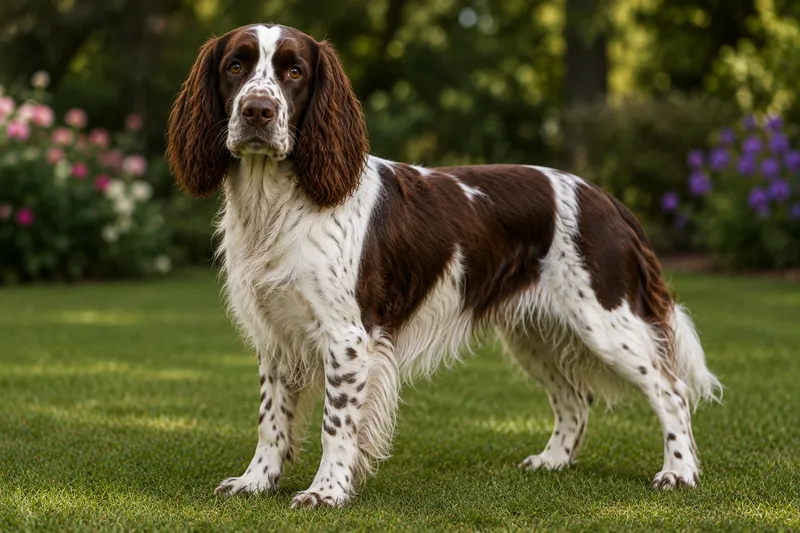
English Springer Spaniel
The English Springer Spaniel is a medium-sized, athletic gundog with a balanced body, long naturally hanging ears, and a weather-resistant coat with moderate feathering. Common colors are liver and white or black and…
Recognized by: AKC · ANKC · +5
Size
Medium
Weight
18.1–22.7 kg
Life span
12–14 years
Breed Traits
Energy Level
Very energetic
Energy Level: 5 of 5
Low energyHigh energyChild / Family Compatibility
High compatibility
Child / Family Compatibility: 4 of 5
Low compatibilityHigh compatibilityGrooming Need
High grooming need
Grooming Need: 4 of 5
Low maintenanceHigh maintenanceTrainability
Very easy to train
Trainability: 5 of 5
Hard to trainEasy to trainApartment / Home Suitability
Struggles in small spaces
Apartment / Home Suitability: 2 of 5
Needs space / yardExcellent for apartmentsAlone-Time Tolerance
Half-day is hard
Alone-Time Tolerance: 2 of 5
Needs frequent companyHandles long alone timeFirst-Time Owner Suitability
Manageable with guidance
First-Time Owner Suitability: 3 of 5
Needs experienced ownerGreat for first-time ownersCompatibility with Other Pets
Generally gets along well with other pets
Compatibility with Other Pets: 4 of 5
Single-pet homes are a better fitHighly compatible with other animals
The English Springer Spaniel is a medium-sized, athletic gundog with a balanced body, long naturally hanging ears, and a weather-resistant coat with moderate feathering. Common colors are liver and white or black and white, sometimes with tan markings.
The breed developed in Britain to locate and flush game from cover and retrieve it after the shot. Its name refers to the action of springing game into the open, and the English Springer was formally recognized as distinct from the smaller Cocker Spaniel in the early twentieth century.
Working and show-bred English Springers can differ noticeably in build, coat, and intensity, but they remain one breed rather than separate varieties. Whichever line a dog comes from, sound movement, stable temperament, functional structure, and the ability to breathe, see, and work comfortably should take priority over exaggeration.
English Springer Spaniels are commonly friendly, affectionate, enthusiastic, and eager to cooperate with people. They often form close household bonds and may become restless or distressed when regularly left without companionship, activity, or a predictable routine.
Their intelligence and working drive generally make them highly trainable, but excitement, scent interest, and adolescent impulsiveness can challenge consistency. Early socialization and short reward-based sessions should emphasize recall, loose-leash walking, calm greetings, settling, handling, and reliable responses around wildlife and other distractions.
Many well-socialized Springers live successfully with considerate children, compatible dogs, and other household pets. Their exuberance can overwhelm small children or delicate animals, and individual prey drive and resource-related behavior should guide introductions and supervision.
A healthy adult English Springer Spaniel needs substantial daily physical exercise together with mental work. Brisk walks, safe off-leash running where permitted, retrieving, scent games, swimming, hiking, and structured training can help meet these needs; working-line dogs may require especially demanding outlets.
The coat should be brushed several times each week, with extra attention to feathering that can collect tangles, seeds, mud, and debris. Regular trimming may be useful for hygiene and coat management, while the naturally hanging ears need frequent checks and careful drying after swimming because poor ventilation can contribute to irritation or infection.
Maintain routine nail, dental, skin, and paw care, and inspect the dog after outdoor activity for grass awns, ticks, cuts, or foreign material. Feed a complete diet appropriate to age and workload, monitor body condition, and adjust food rather than allowing frequent training rewards to produce excess weight.
Important health concerns in English Springer Spaniels include hip and elbow dysplasia, inherited eye disorders such as progressive retinal atrophy, and recurrent ear disease. Phosphofructokinase deficiency, fucosidosis, acral mutilation syndrome, and dyserythropoietic anemia and myopathy syndrome are inherited disorders for which DNA testing may be relevant in particular breeding populations.
Current official screening programs recommend hip and elbow evaluations, specialist eye examination, and DNA testing for PRA(cord1). Depending on country, ancestry, and breeding program, DNA results for PFK deficiency, fucosidosis, AMS, and DAMS may also be appropriate. Genetic results must be interpreted according to inheritance and should not replace clinical examinations, pedigree review, or attention to genetic diversity.
Owners should seek veterinary assessment for persistent ear pain or discharge, impaired vision, unusual exercise intolerance, weakness, unexplained anemia, repeated seizures, significant mobility changes, or other concerning symptoms. Prospective owners should request independently verifiable results for both parents rather than relying on a breeder's general assurance that a line is healthy.
This information is for general educational purposes and is not a substitute for diagnosis or treatment by a veterinarian.
Recognizing organizations
Independent registries that list this breed. Tap a badge to learn more.
These statuses reflect each registry’s recording and show systems. They are not a health, quality, or superiority score.
AKCFull recognitionhttps://www.akc.org/dog-breeds/english-springer-spaniel/ ANKCFull recognitionhttps://dogsaustralia.org.au/members/breeds/breed-standards/English-Springer-Spaniel CKCRecognized breedhttps://www.ckc.ca/en/Choosing-a-Dog/Choosing-a-Breed/Sporting-Dogs/Spaniel-English-Springer FCIDefinitive recognitionhttps://www.fci.be/en/nomenclature/ENGLISH-SPRINGER-SPANIEL-125.html NZKCRecognised breedhttps://www.dogsnz.org.nz/breeds/info/english-springer-spaniel/360 RKCBreed Registerhttps://www.royalkennelclub.com/search/breeds-a-to-z/breeds/gundog/spaniel-english-springer/ UKCFull recognitionhttps://www.ukcdogs.com/english-springer-spaniel
Frequently asked questions
Can an English Springer Spaniel live in an apartment?
Apartment living is possible when the dog receives substantial outdoor exercise, training, and mental engagement every day. Its energy, sociability, shedding, and potential vocal or restless behavior make a home with convenient access to safe outdoor space more practical for many owners.
How much exercise does an English Springer Spaniel need?
A healthy adult usually needs vigorous daily activity divided among walks, running or play in secure areas, training, and scent-based tasks. Needs vary between individuals and lines, and growing puppies should avoid excessive forced or repetitive high-impact exercise.
Are English Springer Spaniels good with children?
Many well-socialized Springers are affectionate and playful with considerate children. Their enthusiasm can accidentally knock over a small child, so adults should supervise interactions and teach both dog and child calm greetings, respectful handling, and appropriate boundaries.
Can English Springer Spaniels live with other pets?
Many can live successfully with compatible dogs and cats after gradual introductions. Because the breed was developed to locate and flush game, interest in birds or small animals may be strong in some individuals and should be assessed rather than assumed away.
Are English Springer Spaniels easy to train?
They are generally intelligent, responsive, and eager to work with people. Consistent reward-based training is most effective, with particular attention to recall, impulse control, calm behavior, and focus around scents, wildlife, water, and other exciting distractions.
How much grooming does an English Springer Spaniel need?
Brush the coat several times each week and check the feathering for tangles and outdoor debris. Periodic trimming may help keep the coat manageable, while nails, teeth, paws, skin, and the long hanging ears require routine care throughout the year.
What is the difference between working and show English Springer Spaniels?
Working-bred Springers are often lighter in build, less heavily coated, and selected for intense field performance, while show-bred dogs may carry more coat and substance. They are not separate breeds, and energy, temperament, appearance, and suitability still vary among individual dogs.
What health screening should an English Springer Spaniel breeder provide?
Ask for independently verifiable hip, elbow, specialist eye, and PRA(cord1) results for both parents. Relevant PFK deficiency, fucosidosis, AMS, and DAMS DNA results may also be appropriate, depending on the dogs' ancestry and the recommendations followed by the breeder.
More about English Springer Spaniel
Pet profiles are coming soon. For now, keep exploring trusted breed knowledge in the Breed Guide.
Back to Breed Guide