

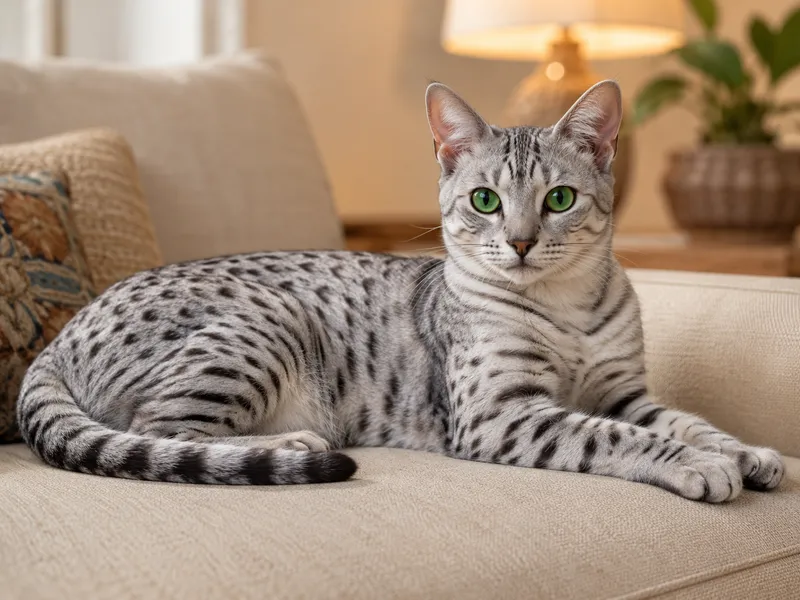
Egyptian Mau
The Egyptian Mau is a medium-sized, elegant but muscular cat with proportionally longer hind legs, a loose skin fold extending toward the hindquarters, and large almond-shaped eyes in the breed's characteristic…
Recognized by: CFA · FIFe · +2
Size
Medium
Weight
3.2–4.1 kg
Life span
12–15 years
Breed Traits
Energy Level
Very energetic
Energy Level: 5 of 5
Low energyHigh energyChild / Family Compatibility
High compatibility
Child / Family Compatibility: 4 of 5
Low compatibilityHigh compatibilityGrooming Need
Light grooming need
Grooming Need: 2 of 5
Low maintenanceHigh maintenanceTrainability
Very easy to train
Trainability: 5 of 5
Hard to trainEasy to trainApartment / Home Suitability
Fits apartments well
Apartment / Home Suitability: 4 of 5
Needs space / yardExcellent for apartmentsAlone-Time Tolerance
Half-day is hard
Alone-Time Tolerance: 2 of 5
Needs frequent companyHandles long alone timeFirst-Time Owner Suitability
Manageable with guidance
First-Time Owner Suitability: 3 of 5
Needs experienced ownerGreat for first-time ownersCompatibility with Other Pets
Generally gets along well with other pets
Compatibility with Other Pets: 4 of 5
Single-pet homes are a better fitHighly compatible with other animals
The Egyptian Mau is a medium-sized, elegant but muscular cat with proportionally longer hind legs, a loose skin fold extending toward the hindquarters, and large almond-shaped eyes in the breed's characteristic gooseberry-green color. Its short-to-medium coat carries randomly distributed spots that occur on the individual hairs rather than being created only by surface patterning.
Silver, bronze, and smoke are the principal championship colors accepted by several major registries. The forehead commonly carries an M-shaped marking, while dark lines extending from the eyes contribute to the breed's distinctive alert or concerned expression.
Spotted cats appear frequently in ancient Egyptian art, but a continuous documented pedigree between those cats and the modern breed cannot be proven. The modern Egyptian Mau population was established internationally during the twentieth century, particularly after Nathalie Troubetskoy brought foundation cats to the United States in 1956.
Egyptian Maus are generally intelligent, athletic, devoted, and highly aware of their surroundings. Many form particularly strong bonds with familiar people, follow household routines closely, and communicate through chirps, trills, kneading, tail movements, and soft vocalizations.
They are often reserved with unfamiliar visitors and can be sensitive to sudden noises, uncontrolled handling, or unexpected environmental changes. Early, positive socialization and access to secure hiding or elevated resting places help them manage new people and situations confidently.
Their speed, jumping ability, and curiosity create a strong need for interactive play, climbing, retrieving games, puzzle feeders, and opportunities to observe the household. Well-socialized individuals often live successfully with respectful children, compatible cats, and cat-friendly dogs that can tolerate their active play style.
The short-to-medium coat is relatively easy to maintain and normally benefits from gentle weekly brushing to remove loose hair and preserve its natural shine. The denser silver and bronze coats may feel more resilient, while smoke coats can have a finer, silkier texture.
Daily life should include tall and stable climbing furniture, scratching surfaces, energetic interactive play, puzzle activities, and safe observation points. Egyptian Maus can adapt to apartment living, but a small or poorly enriched environment may not satisfy their athletic and mental needs.
Routine care should include dental hygiene, nail trimming, ear checks, body-condition monitoring, and regular veterinary examinations. Food intake should be matched to the individual cat's activity and condition because a muscular appearance does not prevent gradual excess weight gain.
Erythrocyte pyruvate kinase deficiency is an autosomal recessive inherited condition documented in Egyptian Maus. It can cause intermittent hemolytic anemia with variable age of onset and severity, and a DNA test is available to identify cats that are clear, carriers, or genetically affected.
Urolithiasis, involving mineral stones within the urinary tract, has also been reported as a concern in the breed. Leukodystrophy is a rare neurological disorder described in some Egyptian Mau kittens and may produce early progressive problems with coordination or movement, although no widely established routine breed-specific DNA screening test is currently available for every reported form.
Prospective owners should request documented PK deficiency results and ask about family neurological, urinary, and general health, longevity, known illnesses, and veterinary records. The presence of an available genetic test does not mean that every Egyptian Mau is affected, and no test panel can guarantee lifelong health. This information is for general educational purposes and is not a substitute for diagnosis or treatment by a veterinarian.
Recognizing organizations
Independent registries that list this breed. Tap a badge to learn more.
These statuses reflect each registry’s recording and show systems. They are not a health, quality, or superiority score.
Frequently asked questions
Are Egyptian Maus good family cats?
Egyptian Maus can be affectionate and devoted family companions when household interactions are calm and respectful. They often live well with older or considerate children but may be unsettled by loud, unpredictable handling.
Do Egyptian Maus get along with other pets?
Well-socialized Egyptian Maus often live successfully with compatible cats and cat-friendly dogs. Introductions should be gradual, and very small animals must remain securely protected because the breed retains a strong hunting instinct.
Can an Egyptian Mau live in an apartment?
An Egyptian Mau can adapt to apartment living when provided with substantial vertical space, energetic daily play, scratching areas, and mental challenges. A small home without enrichment may not meet the needs of this highly athletic breed.
Can Egyptian Maus be left alone during the day?
Many adults can manage ordinary short absences when their routine is predictable and the home is enriched. They form strong social bonds and are not well suited to frequent prolonged isolation.
How much grooming does an Egyptian Mau need?
The coat normally needs gentle brushing about once a week. Dental care, nail trimming, ear checks, and body-condition monitoring generally require more attention than coat maintenance.
Are Egyptian Maus naturally spotted?
Yes. The breed's random spots occur as part of its natural coat pattern and are visible on the individual hairs. A spotted coat alone does not identify a cat as an Egyptian Mau, because pedigree and complete physical type are also required.
Are Egyptian Maus related directly to cats from ancient Egypt?
Ancient Egyptian artwork includes spotted cats that resemble the modern breed. However, a continuous documented pedigree linking those historical cats directly to every modern Egyptian Mau cannot be proven.
What health testing should an Egyptian Mau breeder discuss?
A responsible breeder should provide documented pyruvate kinase deficiency results and discuss family neurological, urinary, and general health. Buyers should also ask about longevity, known illnesses, and veterinary records in related cats.
More about Egyptian Mau
Pet profiles are coming soon. For now, keep exploring trusted breed knowledge in the Breed Guide.
Back to Breed Guide