

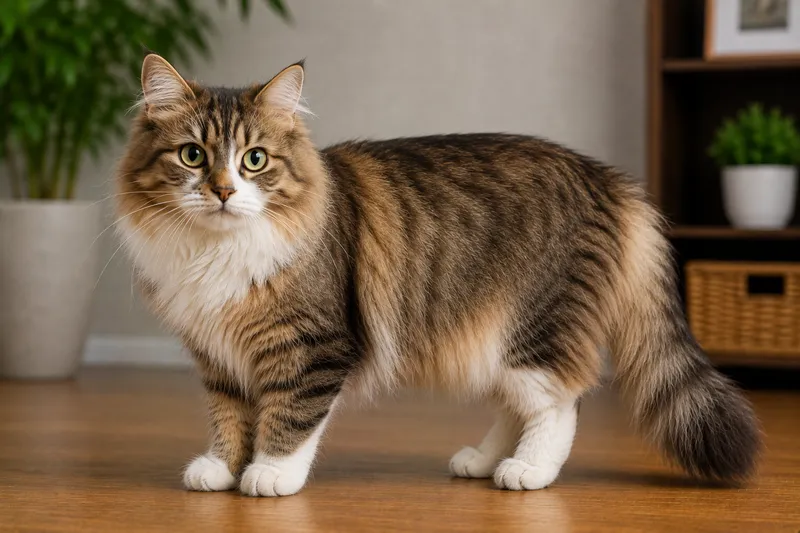
Domestic Medium Hair
Domestic Medium Hair describes non-pedigree or mixed-ancestry domestic cats whose coats fall between the typical short and long coat categories. It is a practical descriptive label used by shelters, veterinary…
Size
Medium
Weight
3–6.5 kg
Life span
12–18 years
Breed Traits
Energy Level
Moderate energy
Energy Level: 3 of 5
Low energyHigh energyChild / Family Compatibility
Moderate compatibility
Child / Family Compatibility: 3 of 5
Low compatibilityHigh compatibilityGrooming Need
Moderate grooming need
Grooming Need: 3 of 5
Low maintenanceHigh maintenanceTrainability
Moderately trainable
Trainability: 3 of 5
Hard to trainEasy to trainApartment / Home Suitability
Fits apartments well
Apartment / Home Suitability: 4 of 5
Needs space / yardExcellent for apartmentsAlone-Time Tolerance
Handles a typical workday
Alone-Time Tolerance: 3 of 5
Needs frequent companyHandles long alone timeFirst-Time Owner Suitability
Suitable for many first-timers
First-Time Owner Suitability: 4 of 5
Needs experienced ownerGreat for first-time ownersCompatibility with Other Pets
Can adapt with proper socialization
Compatibility with Other Pets: 3 of 5
Single-pet homes are a better fitHighly compatible with other animals
Domestic Medium Hair describes non-pedigree or mixed-ancestry domestic cats whose coats fall between the typical short and long coat categories. It is a practical descriptive label used by shelters, veterinary practices, databases, and pet owners rather than a standardized pedigree breed with one ancestry, written breed standard, or predictable appearance.
Individuals vary enormously in size, body shape, head type, eye colour, coat colour, and pattern. Their coats may be slightly longer over the body than those of a Domestic Shorthair and may develop a fuller tail, modest neck furnishings, longer belly hair, or light hindquarter feathering without reaching the flowing length usually associated with a Domestic Longhair.
Coat length alone does not make a cat a Maine Coon, Norwegian Forest Cat, Siberian, British Longhair, or another pedigree breed. Unless reliable pedigree documentation establishes a recognized ancestry, resemblance to a particular breed should be treated only as a visual similarity.
There is no single Domestic Medium Hair temperament. These cats may be outgoing, cautious, calm, energetic, independent, vocal, highly affectionate, or any combination of these traits because the category includes genetically diverse individuals rather than a controlled breed population.
Behaviour is shaped by ancestry, early socialization, previous experiences, health, age, and the current environment. Daily interactive play, scratching surfaces, climbing and hiding opportunities, food puzzles, and predictable social contact can be adjusted to the individual cat's activity level and preferences.
Many well-socialized Domestic Medium Hairs live successfully with respectful children, compatible cats, or cat-friendly dogs. Others may prefer a quieter or single-pet home. Gradual introductions and observation of the individual cat's body language are more useful than assumptions based on coat length.
The intermediate-length coat generally needs more grooming than a typical short coat but less intensive maintenance than many dense long coats. Brushing or combing once or twice a week is sufficient for many cats, while softer, denser, or more heavily furnished coats may need additional attention during seasonal shedding.
Check behind the ears, beneath the front legs, along the belly, around the hindquarters, and through any fuller tail furnishings for developing tangles. Frequent brushing also reduces the amount of loose hair swallowed during self-grooming; repeated vomiting or frequent apparent hairballs should not automatically be considered normal and deserve veterinary assessment.
Routine care should also include daily play, scratching and climbing opportunities, dental hygiene, nail care, clean litter facilities, body-condition monitoring, and measured portions of a complete life-stage-appropriate diet. Sudden matting, reduced self-grooming, a greasy coat, bald areas, itching, or a major change in coat quality can indicate pain, obesity, skin disease, dental problems, or another health change.
Domestic Medium Hairs are genetically diverse and therefore do not have one breed-specific inherited disease profile. Health risks depend on the individual cat's ancestry, age, sex, reproductive status, body condition, lifestyle, infectious-disease exposure, and family history rather than on the Domestic Medium Hair label itself.
Preventive healthcare should be tailored to the individual. Current feline veterinary guidance emphasizes life stage, environment, lifestyle, and other risk factors when planning vaccination, parasite control, oral healthcare, and screening. Visual resemblance to a pedigree breed is not sufficient reason to assume that breed's genetic diseases or select a breed-specific DNA panel without additional ancestry information.
Owners should monitor appetite, thirst, weight, activity, breathing, mobility, coat condition, and litter-box habits and seek veterinary assessment when persistent changes occur. Known veterinary records, previous outdoor exposure, reproductive status, retrovirus history, and age-appropriate screening should be discussed with the cat's veterinarian. This information is for general educational purposes and is not a substitute for diagnosis or treatment by a veterinarian.
Frequently asked questions
Is a Domestic Medium Hair a recognized cat breed?
No. Domestic Medium Hair is generally a descriptive category for non-pedigree or mixed-ancestry cats with an intermediate-length coat rather than a standardized breed with a documented ancestry and breed standard.
How is a Domestic Medium Hair different from a Domestic Shorthair or Domestic Longhair?
The distinction is primarily practical coat length rather than ancestry. A Domestic Medium Hair has more coat length or furnishings than a typical shorthair but usually lacks the consistently long, flowing coat expected of a Domestic Longhair.
Can a Domestic Medium Hair be part Maine Coon or another pedigree breed?
Mixed ancestry is possible, but appearance alone cannot establish it. Without reliable pedigree records or other strong ancestry evidence, Domestic Medium Hair is more accurate than assigning a pedigree breed based on coat, size, or facial features.
Are Domestic Medium Hairs good family cats?
Many are excellent family companions, but there is no breed-wide temperament because the category includes genetically diverse cats. The individual cat's socialization, confidence, activity level, handling preferences, and health are the best guides to suitability.
Do Domestic Medium Hairs get along with children and other pets?
Some live very successfully with respectful children, compatible cats, and cat-friendly dogs, while others prefer a quieter home. Gradual introductions, supervision, separate resources, and careful observation of feline body language are important.
Can a Domestic Medium Hair live in an apartment?
Most can adapt well to apartment living when provided with daily play, climbing and scratching opportunities, hiding places, clean litter facilities, and secure windows or balconies. Enrichment should be matched to the individual cat's energy level.
How often should a Domestic Medium Hair be groomed?
Brushing or combing once or twice a week is sufficient for many cats, although denser coats may need more attention during shedding. Areas behind the ears, beneath the legs, along the belly, and around the hindquarters should be checked regularly for tangles.
What health screening does a Domestic Medium Hair need?
There is no universal breed-specific DNA panel because ancestry varies widely. Screening should be based on age, lifestyle, physical examination, family or pedigree information when available, previous outdoor exposure, and any clinical findings identified by a veterinarian.
More about Domestic Medium Hair
Pet profiles are coming soon. For now, keep exploring trusted breed knowledge in the Breed Guide.
Back to Breed Guide