

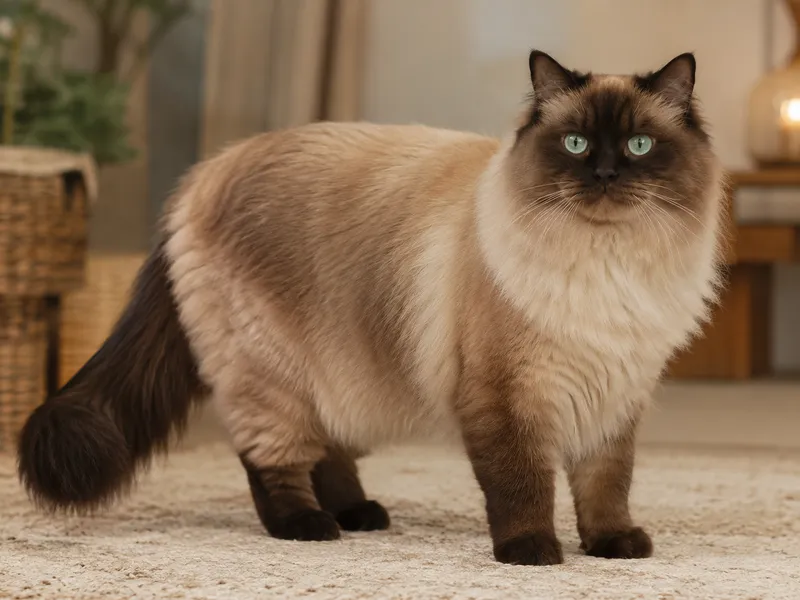
Cherubim
The Cherubim is a large semi-longhaired cat formally established by TICA as a Championship breed within the Ragdoll Breed Group effective May 1, 2025. It developed from cats previously handled as Ragdoll New Traits,…
Recognized by: TICA
Size
Large
Weight
4.5–9.1 kg
Life span
10–17 years
Breed Traits
Energy Level
Moderate energy
Energy Level: 3 of 5
Low energyHigh energyChild / Family Compatibility
Very high compatibility
Child / Family Compatibility: 5 of 5
Low compatibilityHigh compatibilityGrooming Need
Moderate grooming need
Grooming Need: 3 of 5
Low maintenanceHigh maintenanceTrainability
Easy to train
Trainability: 4 of 5
Hard to trainEasy to trainApartment / Home Suitability
Excellent apartment fit
Apartment / Home Suitability: 5 of 5
Needs space / yardExcellent for apartmentsAlone-Time Tolerance
Half-day is hard
Alone-Time Tolerance: 2 of 5
Needs frequent companyHandles long alone timeFirst-Time Owner Suitability
Suitable for many first-timers
First-Time Owner Suitability: 4 of 5
Needs experienced ownerGreat for first-time ownersCompatibility with Other Pets
Shows very high compatibility
Compatibility with Other Pets: 5 of 5
Single-pet homes are a better fitHighly compatible with other animals
The Cherubim is a large semi-longhaired cat formally established by TICA as a Championship breed within the Ragdoll Breed Group effective May 1, 2025. It developed from cats previously handled as Ragdoll New Traits, particularly mink, sepia, and non-blue-eyed traditional-colored lines. The name itself has older connections with Ragdoll founder Ann Baker, whose historical registration material used the term Cherubim.
Under the current TICA standard, the Cherubim and Ragdoll share the same fundamental head, body, coat, and temperament type. The ideal Cherubim is substantial, muscular, broad-chested, and slow to mature, with a broad modified-wedge head, large oval eyes, substantial legs and feet, and a long tapering tail. Full physical development may take three to four years.
The distinction from the modern TICA Ragdoll lies primarily in color genetics and eye color. Cherubims are accepted in mink, sepia, and traditional color categories rather than being restricted to the blue-eyed pointed phenotype required of Ragdolls. Their semi-long coat is silky and soft with minimal undercoat, falling smoothly rather than forming a woolly or cottony texture.
Cherubims are generally calm, affectionate, sociable, and easy-going cats that retain a playful side. Many enjoy staying close to family members and participating in household routines without the relentless activity level of more demanding athletic breeds.
Interactive wand play, balls, retrieving games, food puzzles, scratching furniture, and climbing areas provide useful exercise and mental stimulation. Their relaxed appearance should not be mistaken for a lack of need for activity, particularly because regular play helps maintain healthy muscle and body condition in this large breed.
Well-socialized Cherubims commonly have good potential to live with respectful children, compatible cats, and cat-friendly dogs. They tend to value dependable companionship and may be less suited to homes where they would routinely spend very long periods without social contact.
The silky semi-long coat has relatively little undercoat and is usually easier to maintain than a dense woolly long coat. Thorough combing once or twice a week is appropriate for many adults, with additional grooming during seasonal shedding or whenever tangles begin to develop.
Pay particular attention behind the ears, beneath the front legs, along the belly, around the hindquarters, and through the tail furnishings. Routine grooming also provides an opportunity to check the skin, claws, ears, teeth, and body condition while keeping handling familiar and positive.
Cherubims are large, slow-maturing cats, so maintaining appropriate body condition is important. Provide measured portions of a complete life-stage-appropriate diet, daily interactive exercise, sturdy climbing and scratching furniture, dental hygiene, nail care, clean litter facilities, and regular veterinary examinations rather than assuming a very heavy body is automatically normal for the breed.
Cherubim-specific clinical health research is currently limited, and no inherited disorder has yet been established through large studies as uniquely prevalent across the breed. Because the modern Cherubim was developed directly from Ragdoll New Trait lines and remains in the closed Ragdoll Breed Group, health information from Ragdoll ancestry can be relevant, but ancestry alone should not be presented as proof that every Ragdoll-associated disorder has the same frequency in Cherubims.
The Ragdoll-associated MYBPC3 R820W variant is an established genetic risk factor for hypertrophic cardiomyopathy in Ragdolls. Testing is therefore a reasonable ancestry-based screening consideration for Cherubim breeding lines. A negative result excludes the tested R820W variant but does not rule out every genetic cause of HCM or guarantee that a cat will never develop cardiac disease, so veterinary cardiac assessment and family history remain important.
Prospective owners should ask for documented MYBPC3 R820W results where applicable, information about cardiac examinations used by the breeder, and family records covering HCM, sudden cardiac death, longevity, kidney health, mobility, and causes of death. Until larger Cherubim-specific studies become available, health claims should remain conservative and DNA panels should be treated as targeted tools rather than complete health clearance. This information is for general educational purposes and is not a substitute for diagnosis or treatment by a veterinarian.
Recognizing organizations
Independent registries that list this breed. Tap a badge to learn more.
These statuses reflect each registry’s recording and show systems. They are not a health, quality, or superiority score.
Frequently asked questions
Are Cherubim cats good family pets?
Cherubims are generally affectionate, calm, and interested in being part of household life. They suit families that can provide regular companionship, interactive play, gentle handling, and enough space and furniture for a large adult cat.
Are Cherubim cats good with children?
Many well-socialized Cherubims have excellent potential to live with respectful children. Adults should supervise younger children, discourage rough carrying or restraint, and make sure the cat can leave whenever it wants quiet.
Do Cherubim cats get along with other pets?
Cherubims commonly have good potential to live with compatible cats and cat-friendly dogs after gradual introductions. Separate feeding, litter, resting, and hiding resources help prevent competition and allow each animal to control social contact.
Can a Cherubim live in an apartment?
Yes, provided the apartment can accommodate a large cat and offers daily play, sturdy climbing furniture, scratching areas, comfortable resting places, and secure windows or balconies. Their moderate energy level does not eliminate the need for regular exercise and enrichment.
Can Cherubim cats be left alone during the day?
Many adults can cope with ordinary periods alone when their routine is predictable. Frequent prolonged isolation is less suitable for this sociable breed, and toys or puzzle feeders do not completely replace dependable human or compatible animal companionship.
How much grooming does a Cherubim need?
Combing once or twice a week is sufficient for many adults because the semi-long coat has minimal undercoat and should fall smoothly. Grooming may need to increase during seasonal shedding, particularly behind the ears, under the legs, along the belly, and around the hindquarters.
What is the difference between a Cherubim, a Ragdoll, and a RagaMuffin?
TICA places the Cherubim and Ragdoll in the same breed group and gives them the same fundamental body and head type. Ragdolls are blue-eyed pointed cats, while Cherubims are accepted in mink, sepia, and traditional color categories with category-appropriate eye colors; the RagaMuffin is a separately developed and separately standardized breed.
What health screening should a Cherubim breeder provide?
Ask about the Ragdoll-associated MYBPC3 R820W HCM test, cardiac examinations used in the breeding programme, and documented family health history. A negative R820W result rules out that specific variant but does not exclude every form of hypertrophic cardiomyopathy or guarantee overall health.
More about Cherubim
Pet profiles are coming soon. For now, keep exploring trusted breed knowledge in the Breed Guide.
Back to Breed Guide