

Chausie
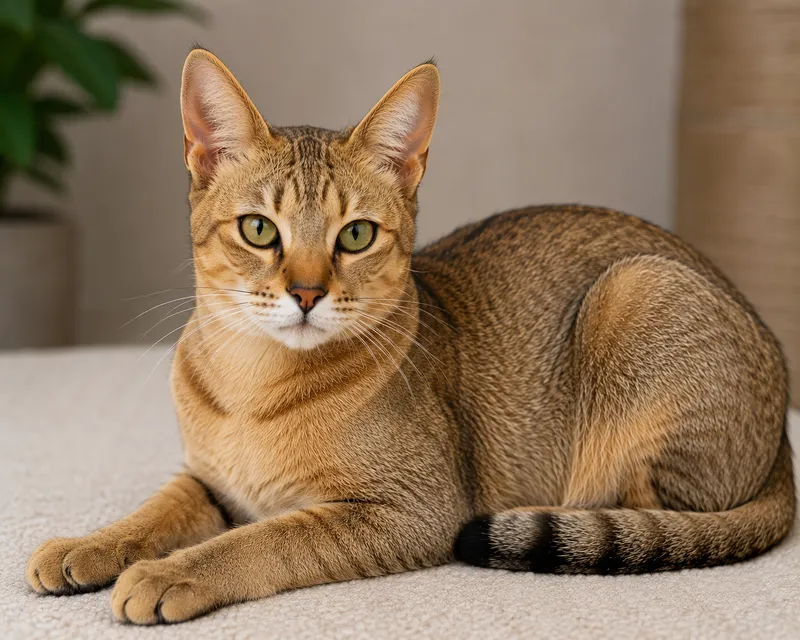
The Chausie is a medium-to-large, tall and long-bodied cat with a deep chest, flat sides, long legs, lean musculature, and a slightly shorter-than-average tail. Its large upright ears, long sloping forehead, high…
Recognized by: TICA
Size
Large
Weight
4.5–6.8 kg
Life span
12–18 years
Breed Traits
Energy Level
Very energetic
Energy Level: 5 of 5
Low energyHigh energyChild / Family Compatibility
Moderate compatibility
Child / Family Compatibility: 3 of 5
Low compatibilityHigh compatibilityGrooming Need
Low grooming need
Grooming Need: 1 of 5
Low maintenanceHigh maintenanceTrainability
Very easy to train
Trainability: 5 of 5
Hard to trainEasy to trainApartment / Home Suitability
Struggles in small spaces
Apartment / Home Suitability: 2 of 5
Needs space / yardExcellent for apartmentsAlone-Time Tolerance
Very short alone time (a few hours)
Alone-Time Tolerance: 1 of 5
Needs frequent companyHandles long alone timeFirst-Time Owner Suitability
Challenging for beginners
First-Time Owner Suitability: 2 of 5
Needs experienced ownerGreat for first-time ownersCompatibility with Other Pets
Generally gets along well with other pets
Compatibility with Other Pets: 4 of 5
Single-pet homes are a better fitHighly compatible with other animals
The Chausie is a medium-to-large, tall and long-bodied cat with a deep chest, flat sides, long legs, lean musculature, and a slightly shorter-than-average tail. Its large upright ears, long sloping forehead, high angular cheekbones, and elongated muzzle contribute to the breed's distinctive wild-inspired appearance.
The short-to-medium coat has a dense undercoat and a slightly resilient outer coat. TICA accepts three color-patterns: solid black, brown ticked tabby, and black grizzled ticked tabby. The grizzled pattern, inherited through the breed's Jungle Cat ancestry, creates alternating light and dark bands along the hair shaft.
The breed was developed from crosses between the domestic cat and the Jungle Cat, Felis chaus. Organised development began in the late twentieth century, TICA granted foundation registration in 1995, and the breed entered championship competition in 2013. Modern pedigree Chausies are selected for a predominantly domestic temperament while retaining the tall, athletic outline associated with their non-domestic ancestor.
Chausies are generally affectionate, intensely active, confident, curious, vocal, and strongly bonded to their people. Many want to participate in nearly every household activity and may investigate cupboards, doors, shelves, and objects that a calmer cat would ignore.
They are highly trainable and commonly enjoy retrieving, food puzzles, target training, harness walking, and other positive-reinforcement activities. Their intelligence and athletic ability require structured daily outlets rather than occasional play alone.
Chausies often benefit from a compatible feline companion and usually dislike prolonged isolation. They can live successfully with respectful older children and well-matched pets, but their size, speed, persistence, and energetic play can be overwhelming for very young children or timid animals.
The short coat is easy to maintain and normally needs only occasional gentle combing or weekly brushing to remove loose hair. Routine bathing is generally unnecessary unless recommended for an individual medical or hygiene reason.
The more demanding part of Chausie care is environmental management. A suitable home should provide tall and stable climbing structures, long running routes, strong scratching surfaces, puzzle feeders, daily interactive play, and regular training. Cabinets, breakable objects, windows, and escape routes may need additional securing because the breed is unusually curious and capable.
A Chausie may live in a spacious apartment, but only when the household can provide substantial vertical territory, intensive enrichment, and dependable companionship. Routine care should also include dental hygiene, nail trimming, ear checks, body-condition monitoring, parasite prevention appropriate to the cat's environment, and regular veterinary examinations.
TICA describes the Chausie as generally healthy, and no single inherited disease is currently established as a defining breed-wide disorder. Published health data remain limited, however, so responsible assessment should rely on the individual cat's pedigree, family history, veterinary records, and any line-specific screening used by the breeder.
Hybrid male infertility is a documented reproductive issue in Chausie breeding. Research has shown that early-generation males are typically sterile and that fertility may remain variable in some later backcross generations. This finding concerns reproduction and breeding management rather than a disease expected in every companion Chausie.
No universal Chausie-specific DNA panel can guarantee health. Prospective owners should ask about family longevity, heart and kidney health, mobility, digestive history, fertility where breeding is relevant, known illnesses, and causes of death. Claims that every Chausie requires a grain-free or gluten-free diet are not supported by an established breed-wide diagnosis; persistent digestive signs should be investigated by a veterinarian. This information is for general educational purposes and is not a substitute for diagnosis or treatment by a veterinarian.
Recognizing organizations
Independent registries that list this breed. Tap a badge to learn more.
These statuses reflect each registry’s recording and show systems. They are not a health, quality, or superiority score.
Frequently asked questions
Is the Chausie a domestic cat or a wild cat?
The Chausie is a recognised pedigree cat breed developed from historical crosses between domestic cats and the Jungle Cat, Felis chaus. Modern breeding aims for a predominantly domestic temperament while preserving a tall, athletic, wild-inspired appearance.
Are Chausies good family cats?
Chausies can be affectionate and deeply bonded family companions in active, experienced households. Their size, speed, persistence, and energetic play generally make them a better match for adults and respectful older children than for homes with very young children.
Do Chausies get along with other pets?
Many Chausies benefit from a compatible feline companion and can live successfully with confident, cat-friendly dogs. Introductions should be gradual and supervised because individual confidence, play intensity, and previous experience vary.
Can a Chausie live in an apartment?
A Chausie can live in a sufficiently spacious and enriched apartment, but the breed is not naturally easy to accommodate in a small or minimally equipped home. Tall climbing structures, running space, intensive daily play, training, and secure windows and doors are essential.
Can Chausies be left alone during the day?
Chausies generally tolerate isolation poorly and should not be left without stimulation or companionship for prolonged periods. A predictable routine, extensive enrichment, and a compatible human or feline companion can help meet their social needs.
How much grooming does a Chausie need?
The short-to-medium coat is low maintenance and normally needs only occasional combing or light weekly brushing. Dental care, nail trimming, ear checks, exercise, training, and environmental enrichment require more attention than coat care.
Does every Chausie need a grain-free or gluten-free diet?
No breed-wide gluten intolerance has been established for the Chausie. The cat should receive a complete and balanced diet appropriate to its age and health, while vomiting, diarrhoea, weight loss, or other persistent digestive signs should be assessed by a veterinarian.
What should a responsible Chausie breeder disclose?
A responsible breeder should explain the cat's documented generation and pedigree, registration status, family longevity, known illnesses, causes of death, temperament, socialisation, veterinary care, and any line-specific health screening. Fertility history is also relevant when a cat is intended for breeding.
More about Chausie
Pet profiles are coming soon. For now, keep exploring trusted breed knowledge in the Breed Guide.
Back to Breed Guide