

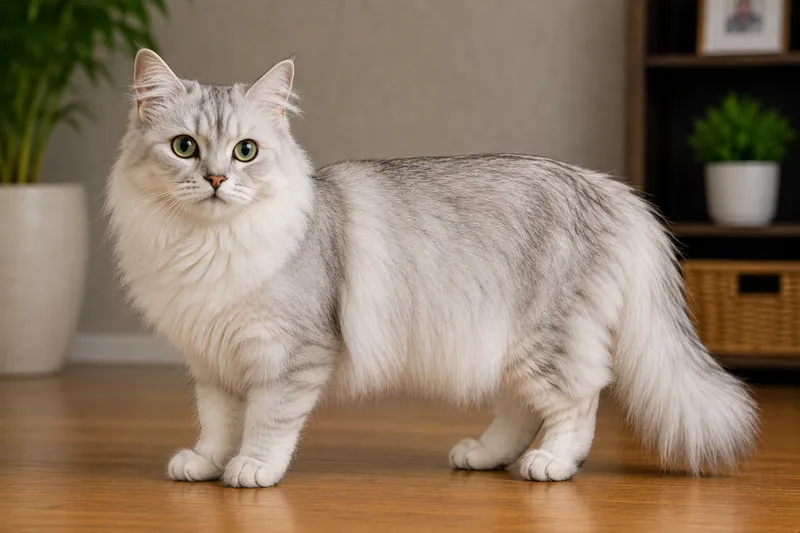
Burmilla Longhair
The Burmilla Longhair is the semi-longhaired form of the Burmilla, a breed that began in Britain after an accidental 1981 mating between a Chinchilla Persian male and a lilac Burmese female. Their four shorthaired…
Recognized by: CFA · GCCF · +1
Size
Medium
Weight
3.6–5.4 kg
Life span
15–18 years
Breed Traits
Energy Level
Moderate energy
Energy Level: 3 of 5
Low energyHigh energyChild / Family Compatibility
High compatibility
Child / Family Compatibility: 4 of 5
Low compatibilityHigh compatibilityGrooming Need
Moderate grooming need
Grooming Need: 3 of 5
Low maintenanceHigh maintenanceTrainability
Easy to train
Trainability: 4 of 5
Hard to trainEasy to trainApartment / Home Suitability
Excellent apartment fit
Apartment / Home Suitability: 5 of 5
Needs space / yardExcellent for apartmentsAlone-Time Tolerance
Half-day is hard
Alone-Time Tolerance: 2 of 5
Needs frequent companyHandles long alone timeFirst-Time Owner Suitability
Suitable for many first-timers
First-Time Owner Suitability: 4 of 5
Needs experienced ownerGreat for first-time ownersCompatibility with Other Pets
Shows very high compatibility
Compatibility with Other Pets: 5 of 5
Single-pet homes are a better fitHighly compatible with other animals
The Burmilla Longhair is the semi-longhaired form of the Burmilla, a breed that began in Britain after an accidental 1981 mating between a Chinchilla Persian male and a lilac Burmese female. Their four shorthaired daughters became the foundation of an organised breeding programme, while the Persian ancestry also allowed longhaired kittens to appear in later generations.
This is a medium-sized, elegant but muscular cat with a gently rounded head, a balanced blunt wedge to the face, medium-to-large ears, expressive green eyes, and a body that is neither cobby nor extremely slender. The characteristic facial effect includes dark outlining around the eyes, nose, and lips, complementing the shaded or tipped coat.
The Longhair has a fine, silky semi-long coat rather than the very dense, full coat of a Persian. Longer hair forms a bib, feathering along the underside, britches, and a full tail plume. Registry terminology differs: CFA includes longhair and shorthair within Burmilla, TICA lists Burmilla Longhair separately, while GCCF classifies the semi-longhaired member of the related Asian group as the Tiffanie.
Burmilla Longhairs are generally sociable, affectionate, inquisitive, and playful while being less intense than many highly demanding breeds. They often enjoy staying close to their people, investigating household activity, and retaining kitten-like playfulness well into adulthood.
Interactive toys, food puzzles, climbing furniture, retrieving games, and short reward-based training sessions provide useful mental and physical activity. Many individuals are capable jumpers and climbers despite their relaxed and gentle reputation.
Well-socialized Burmilla Longhairs commonly have good potential to live with respectful children, compatible cats, and cat-friendly dogs. They usually appreciate dependable companionship and involvement in family routines, although individual confidence and social preferences still vary.
The fine semi-long coat is generally easier to maintain than a heavy Persian coat because it should not have a dense woolly undercoat. Thorough combing once or twice a week is sufficient for many cats, although grooming may need to increase during seasonal shedding or whenever tangles begin to develop.
Pay particular attention to the bib, belly, armpits, hindquarters, britches, areas behind the ears, and tail plume. Gentle grooming helps preserve the silky texture while also allowing routine checks for skin irritation, lumps, parasites, or changes in coat condition.
Regular care should also include dental hygiene, nail trimming, clean litter facilities, measured portions of a complete life-stage-appropriate diet, interactive play, and stable climbing and scratching furniture. Maintaining a healthy body condition is important because the soft coat and rounded contours can make gradual weight gain less obvious.
Published health data specific to the Burmilla Longhair remain limited, but an inherited form of hypokalaemic polymyopathy associated with a recessive WNK4 variant is relevant to the Burmilla family. The variant has been documented in tested Burmillas and in Tiffanies, and veterinary genetics laboratories list both among breeds appropriate for testing. Affected cats can develop episodes of low blood potassium and skeletal muscle weakness, including difficulty holding the head normally or walking comfortably.
Polycystic kidney disease caused by the dominant PKD1 variant is also considered appropriate for testing in Burmillas because of their Persian ancestry. A positive result predicts inheritance of this specific form of PKD, while a negative result excludes the tested PKD1 variant rather than every possible kidney disease. The availability of the test should not be interpreted as evidence that PKD1 is common in every Burmilla Longhair population.
Prospective owners should request documented WNK4 hypokalemia and PKD1 results where relevant, together with veterinary records and family information covering kidney health, episodes of weakness, longevity, and causes of death. Breeders should use genetic results alongside pedigree management, clinical examination, and attention to genetic diversity rather than treating any DNA panel as complete health clearance. This information is for general educational purposes and is not a substitute for diagnosis or treatment by a veterinarian.
Recognizing organizations
Independent registries that list this breed. Tap a badge to learn more.
These statuses reflect each registry’s recording and show systems. They are not a health, quality, or superiority score.
Frequently asked questions
Are Burmilla Longhairs good family cats?
Burmilla Longhairs are generally affectionate, playful, and interested in family life without being constantly demanding. They tend to suit households that can provide regular companionship, interactive play, and a predictable routine.
Are Burmilla Longhairs good with children?
Many well-socialized Burmilla Longhairs live successfully with respectful children. Adults should supervise younger children, teach gentle handling, and make sure the cat can leave an interaction whenever it chooses.
Do Burmilla Longhairs get along with other pets?
They generally have high potential to live with compatible cats and cat-friendly dogs after gradual introductions. Separate litter, feeding, resting, and hiding resources help each animal settle without unnecessary competition.
Can a Burmilla Longhair live in an apartment?
Yes. The breed can adapt very well to apartment living when provided with daily play, scratching surfaces, climbing furniture, puzzle activities, and secure windows or balconies.
Can Burmilla Longhairs be left alone during the day?
Many adults can manage ordinary periods alone, but frequent prolonged isolation is not ideal for this sociable breed. A predictable routine and enrichment help, but they do not completely replace dependable human or compatible animal companionship.
How much grooming does a Burmilla Longhair need?
Combing once or twice a week is sufficient for many individuals because the semi-long coat should be fine and silky without a heavy woolly undercoat. The bib, belly, armpits, hindquarters, britches, areas behind the ears, and tail plume may require additional attention.
What is the difference between a Burmilla Longhair and a Burmilla Shorthair?
They belong to the same Burmilla breed family and share the same general body type, shaded appearance, temperament tendencies, and health-screening considerations. The Longhair has a silky semi-long coat with a bib, britches, feathering, and tail plume, while the Shorthair has a short smooth coat with lower grooming needs.
What health screening should a Burmilla Longhair breeder provide?
Ask for documented WNK4 hypokalemia and PKD1 results where those variants are relevant to the breeding line, together with veterinary and family health records. Genetic tests address specific inherited variants only, so information about kidney health, episodes of muscle weakness, longevity, and causes of death remains important.
More about Burmilla Longhair
Pet profiles are coming soon. For now, keep exploring trusted breed knowledge in the Breed Guide.
Back to Breed Guide