Recognizing organizations
Independent registries that list this breed. Tap a badge to learn more.
These statuses reflect each registry’s recording and show systems. They are not a health, quality, or superiority score.
Breed Traits
High energy
Very high compatibility
Low grooming need
Very easy to train
Excellent apartment fit
Very short alone time (a few hours)
Suitable for many first-timers
Shows very high compatibility
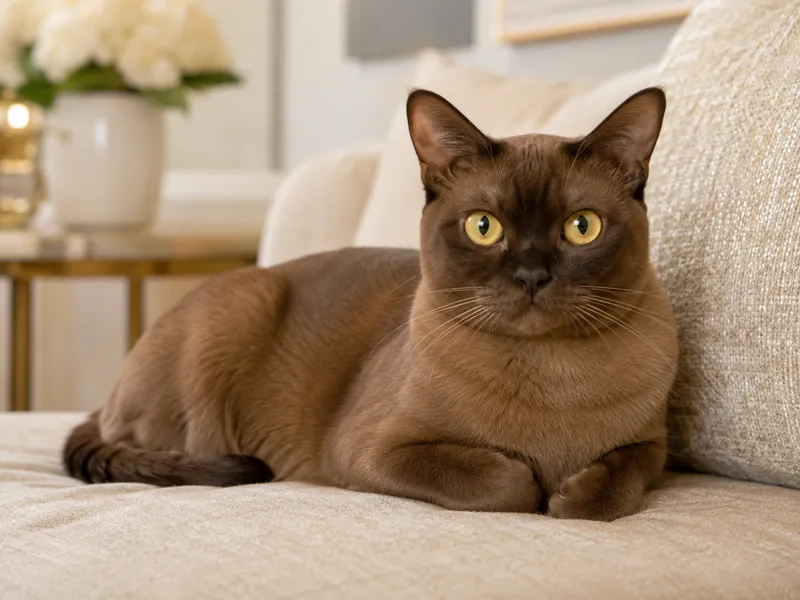
The Burmese is a medium-sized, compact cat with substantial muscle, a rounded head, expressive gold-to-yellow eyes, and a surprisingly heavy body for its apparent size. Its short, fine, satin-like coat lies close to the body and requires very little grooming.
This entry describes the compact, round-headed Burmese type that some registries distinguish from the more moderately built European Burmese. Accepted colors differ between organizations, with sable or rich brown remaining the color most strongly associated with the breed.
The modern pedigree breed was developed in the United States from Wong Mau, a brown cat brought to San Francisco in 1930. Her exact ancestry was initially uncertain, but planned matings demonstrated the inheritance pattern that established the modern Burmese breeding population.
Are Burmese cats good family pets?
Burmese cats are often affectionate, playful, and highly involved family companions. They commonly live well with respectful children, although handling should remain gentle and voluntary.
Do Burmese cats get along with other pets?
Well-socialized Burmese cats generally have a high potential to live successfully with compatible cats and cat-friendly dogs. Introductions should still be gradual because age, previous experience, and individual temperament influence every relationship.
Can a Burmese cat live in an apartment?
Burmese cats usually adapt very well to apartment living when they receive daily play, climbing opportunities, mental stimulation, and frequent social contact. Their need for companionship is generally more important than the size of the home.
Can Burmese cats be left alone during the day?
Most adults can manage ordinary short absences, but Burmese cats generally dislike frequent prolonged isolation. A predictable routine, extensive enrichment, and a compatible human or animal companion are particularly valuable.
How much grooming does a Burmese cat need?
The short satin-like coat normally needs only light weekly grooming. Dental care, nail trimming, ear checks, and body-condition monitoring usually require more attention than coat maintenance.
What is the difference between a Burmese and a European Burmese?
The breeds share common ancestry but are treated separately by some registries. Burmese cats are generally more compact and rounded, while European Burmese cats have a more moderate body and head shape and may be accepted in a broader color range.
Are Burmese cats very vocal?
Many Burmese communicate regularly with soft, expressive voices and enjoy responding to their owners. They are usually less piercing than some closely related breeds, but individual vocal behavior varies.
What health testing should a Burmese breeder discuss?
A responsible breeder should discuss documented Burmese head defect and hypokalaemic polymyopathy test results where relevant. Buyers should also ask about family heart health, longevity, known illnesses, and veterinary screening practices.
- Species
- Cat
More about Burmese
Pet profiles and public accounts open soon. For now, explore verified breed guides in the atlas.