

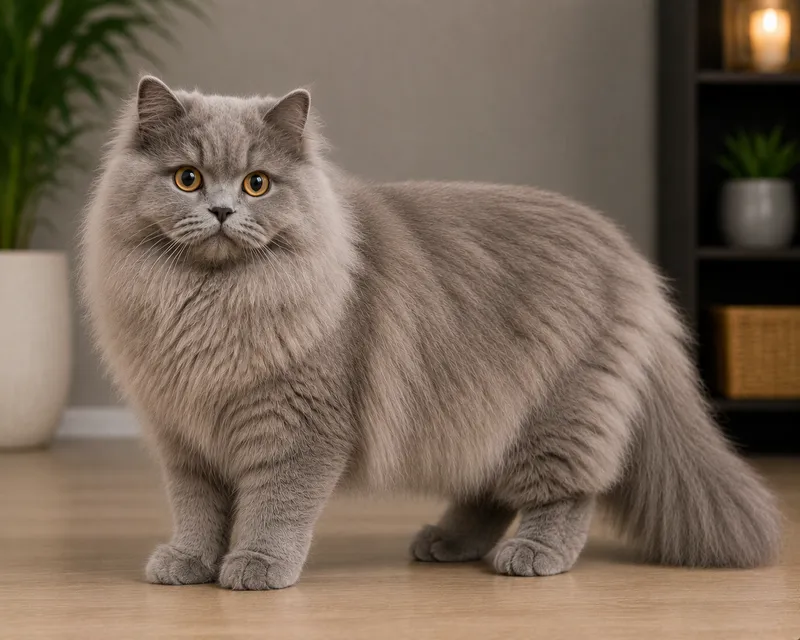
British Longhair
The British Longhair is the semi-longhaired member of the British breed family. Its development is closely connected with the British Shorthair: Persian cats were used during periods of breed rebuilding in the twentieth…
Recognized by: FIFe · GCCF · +1
Size
Large
Weight
3.2–7.7 kg
Life span
12–20 years
Breed Traits
Energy Level
Low energy
Energy Level: 2 of 5
Low energyHigh energyChild / Family Compatibility
High compatibility
Child / Family Compatibility: 4 of 5
Low compatibilityHigh compatibilityGrooming Need
High grooming need
Grooming Need: 4 of 5
Low maintenanceHigh maintenanceTrainability
Moderately trainable
Trainability: 3 of 5
Hard to trainEasy to trainApartment / Home Suitability
Excellent apartment fit
Apartment / Home Suitability: 5 of 5
Needs space / yardExcellent for apartmentsAlone-Time Tolerance
Handles a typical workday
Alone-Time Tolerance: 3 of 5
Needs frequent companyHandles long alone timeFirst-Time Owner Suitability
Manageable with guidance
First-Time Owner Suitability: 3 of 5
Needs experienced ownerGreat for first-time ownersCompatibility with Other Pets
Generally gets along well with other pets
Compatibility with Other Pets: 4 of 5
Single-pet homes are a better fitHighly compatible with other animals
The British Longhair is the semi-longhaired member of the British breed family. Its development is closely connected with the British Shorthair: Persian cats were used during periods of breed rebuilding in the twentieth century, introducing recessive longhair genes that could later produce longhaired kittens from apparently shorthaired parents. Dedicated breeding programmes eventually established the longhaired form as a consistent registry entry in its own right.
This is a medium-to-large, compact, and powerful cat with strong boning, a broad chest, short sturdy legs, rounded paws, and a thick tail with a rounded tip. The head is large and round, with full cheeks, a broad muzzle, widely spaced round eyes, and small-to-medium ears. Males are usually noticeably larger and develop more prominent jowls than females.
The coat is dense, straight, and semi-long, standing away from the body rather than flowing flat like a fine single coat. A full ruff, substantial britches, and a well-furnished tail contribute to the mature appearance. Blue is widely associated with the British family, but British Longhairs occur in many solid, tabby, tortoiseshell, silver, golden, bicolour, and colourpointed combinations, subject to registry-specific rules.
British Longhairs are generally calm, patient, affectionate, and somewhat reserved with unfamiliar people. Many form strong bonds with their households and prefer to remain near family members without demanding constant attention or spending long periods on a lap.
They tend to be moderately playful rather than intensely athletic. Short interactive sessions with wand toys, rolling toys, food puzzles, and sturdy low-to-medium climbing furniture help maintain muscle and prevent boredom. Adults often prefer keeping all four paws on a stable surface and may dislike being carried for long periods.
Well-socialized individuals commonly live successfully with respectful children, compatible cats, and calm cat-friendly dogs. Their quiet confidence can suit a predictable home, but individual tolerance varies. They should always have private resting places where they can withdraw from noise, handling, or persistent companions.
The dense semi-long coat requires regular, thorough combing. Daily grooming is ideal for many cats, while some may remain comfortable with several careful sessions each week. Particular attention should be given to the ruff, belly, armpits, hindquarters, and tail, with more frequent grooming during seasonal shedding or whenever small tangles begin to form.
Use a comb that reaches through the coat without pulling, and introduce grooming gradually from kittenhood. Mats should not be cut close to the skin with scissors because folded skin can be injured easily. Cats that cannot remain comfortable or mat-free with home care may need help from a veterinarian or an experienced feline groomer.
British Longhairs can gain excess weight when their calm activity level is combined with unrestricted feeding. Provide measured portions of a complete life-stage-appropriate diet, daily play, sturdy scratching and climbing surfaces, dental hygiene, nail care, clean litter facilities, and regular veterinary examinations. Body condition should be assessed by touch because the full coat can hide gradual weight change.
Health data focused specifically on the British Longhair remain limited, so findings from the closely related British Shorthair population must be applied cautiously rather than assumed to represent an identical prevalence. Hypertrophic cardiomyopathy has been documented in British Shorthairs, including a screening cohort that found a marked male predisposition. No validated British-specific HCM DNA test is currently established, making veterinarian-guided echocardiographic screening and family history particularly important for breeding cats.
The autosomal dominant PKD1 variant that causes polycystic kidney disease is relevant to British Longhairs because of Persian-derived ancestry, and the UC Davis Veterinary Genetics Laboratory lists the breed as appropriate for testing. A negative result excludes the tested PKD1 variant but does not rule out every kidney disorder, while a positive result has important health and breeding implications.
Prospective owners should request documented PKD1 results, cardiac screening information, and family records covering longevity, kidney disease, heart disease, sudden death, and mobility. Maintaining a lean body condition is also important because excess weight can add strain and make early changes in activity or breathing harder to recognize. This information is for general educational purposes and is not a substitute for diagnosis or treatment by a veterinarian.
Recognizing organizations
Independent registries that list this breed. Tap a badge to learn more.
These statuses reflect each registry’s recording and show systems. They are not a health, quality, or superiority score.
Frequently asked questions
Are British Longhairs good family cats?
British Longhairs are generally calm, affectionate, and comfortable in predictable households. They often enjoy staying near their family without demanding constant handling, making them suitable for people who appreciate a quieter companion.
Are British Longhairs good with children?
Many well-socialized British Longhairs live successfully with respectful children. Children should support the cat's body properly, avoid carrying it against its wishes, and allow it to retreat to a quiet resting place.
Do British Longhairs get along with other pets?
They often adapt to compatible cats and calm, cat-friendly dogs after gradual introductions. Separate food, water, litter, resting, and hiding resources help prevent conflict, especially when another animal is more active or intrusive.
Can a British Longhair live in an apartment?
The breed is generally well suited to apartment living because of its moderate activity level and calm nature. The home should still provide daily play, sturdy scratching surfaces, comfortable observation points, and secure windows or balconies.
Can British Longhairs be left alone during the day?
Many adults can manage an ordinary workday absence when their routine and environment are stable. Frequent prolonged isolation is not ideal, and daily grooming, appetite, breathing, activity, and litter-box habits still require dependable observation.
How much grooming does a British Longhair need?
The dense semi-long coat usually needs combing several times a week, and daily grooming is often the safest routine for preventing mats. The ruff, belly, armpits, hindquarters, and tail require particular attention during seasonal shedding.
Is the British Longhair a separate breed or a longhaired British Shorthair?
The two forms belong to the same British breed family and share the same basic body type and temperament tendencies. TICA, FIFe, and GCCF recognise British Longhair as a showable registry entry, while CFA currently lists British Shorthair but not British Longhair as a recognised breed.
What health screening should a British Longhair breeder provide?
Documented PKD1 testing is appropriate for the breed, and cardiac screening by echocardiography is valuable because HCM is established in the closely related British Shorthair population. Family history, veterinary examination, and repeated age-appropriate assessment remain important because a DNA result does not guarantee overall health.
More about British Longhair
Pet profiles are coming soon. For now, keep exploring trusted breed knowledge in the Breed Guide.
Back to Breed Guide