

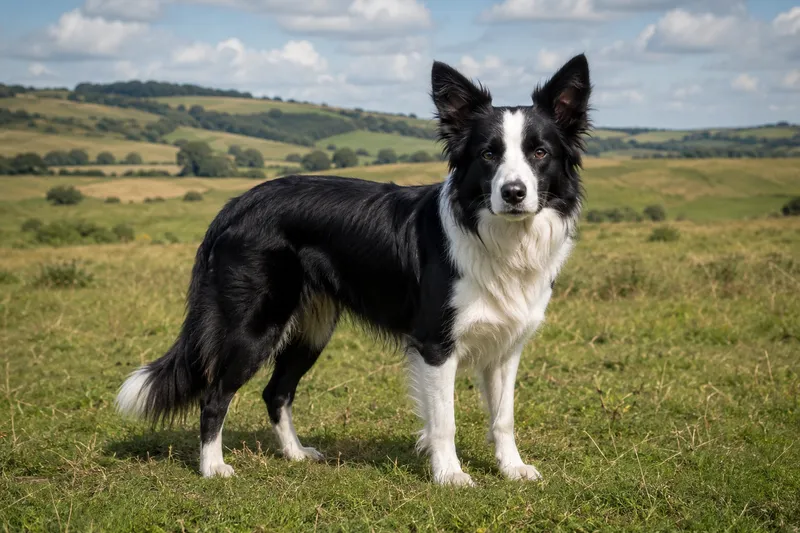
Border Collie
The Border Collie is a medium-sized, athletic sheepdog whose balance, agility, stamina, and efficient movement are more important than exaggerated substance or a uniform appearance. Both smooth and moderately long rough…
Recognized by: AKC · ANKC · +5
Size
Medium
Weight
13.6–24.9 kg
Life span
12–15 years
Breed Traits
Energy Level
Very energetic
Energy Level: 5 of 5
Low energyHigh energyChild / Family Compatibility
High compatibility
Child / Family Compatibility: 4 of 5
Low compatibilityHigh compatibilityGrooming Need
Moderate grooming need
Grooming Need: 3 of 5
Low maintenanceHigh maintenanceTrainability
Very easy to train
Trainability: 5 of 5
Hard to trainEasy to trainApartment / Home Suitability
Struggles in small spaces
Apartment / Home Suitability: 2 of 5
Needs space / yardExcellent for apartmentsAlone-Time Tolerance
Half-day is hard
Alone-Time Tolerance: 2 of 5
Needs frequent companyHandles long alone timeFirst-Time Owner Suitability
Challenging for beginners
First-Time Owner Suitability: 2 of 5
Needs experienced ownerGreat for first-time ownersCompatibility with Other Pets
Can adapt with proper socialization
Compatibility with Other Pets: 3 of 5
Single-pet homes are a better fitHighly compatible with other animals
The Border Collie is a medium-sized, athletic sheepdog whose balance, agility, stamina, and efficient movement are more important than exaggerated substance or a uniform appearance. Both smooth and moderately long rough coats occur, supported by a weather-resistant double coat, and the breed appears in numerous colors and patterns rather than only the familiar black and white.
The breed developed in the border country of England and Scotland, where shepherds selected dogs primarily for practical livestock ability. Generations of work on difficult ground refined the characteristic crouching approach, intense control of stock often called eye, rapid responses to a handler's signals, and the judgment to move sheep at distance.
Border Collies still work livestock around the world and also excel in obedience, agility, flyball, tracking, detection, search work, disc sports, and other demanding activities. Exceptional intelligence does not make the breed effortless to own; it increases the need for purposeful education, suitable outlets, emotional stability, and an owner who can teach both active skills and genuine relaxation.
A sound Border Collie is typically alert, eager, highly responsive, and intensely aware of movement and changes in the environment. Many form close working relationships with their handlers and are affectionate with familiar people, while some remain reserved with strangers without being fearful or aggressive.
Herding behavior can appear as staring, stalking, circling, blocking, or attempting to control running children, bicycles, vehicles, or other animals. Early socialization, interruption of unsafe chasing, supervised interaction, and appropriate outlets are necessary because instinctive behavior cannot be managed by obedience cues alone.
The breed often notices subtle body language and may be sensitive to pressure, sound, conflict, or repetitive arousal. Clear reward-based training, predictable routines, gradual exposure, and planned rest generally produce better results than harsh correction or an endless cycle of high-intensity ball chasing that creates fitness without teaching an off switch.
Healthy adult Border Collies need substantial daily physical activity together with mentally demanding work. Herding, agility, obedience, tracking, scent searches, hiking, controlled running, problem-solving, and carefully structured play can be combined, but quality and variety matter more than simply exhausting the dog for hours.
Smooth and rough coats are both relatively practical, although the double coat sheds and can collect mud, burrs, and loose undercoat. Thorough brushing once or twice weekly and more often during seasonal shedding, plus nail trimming, dental care, and checks of the ears, skin, feet, and feathering, usually maintain the coat without routine clipping.
A Border Collie can live in town when exercise, enrichment, quiet recovery, and safe outdoor access are consistently provided, but a garden by itself does not meet the breed's needs. Owners should also protect developing joints from repetitive impact, manage work in hot weather, use secure containment, and prevent uncontrolled pursuit of traffic, wildlife, livestock, or fast-moving recreational equipment.
Hip dysplasia and inherited eye disease are central screening priorities for Border Collies in the American parent-club program. Other national programs may also recommend elbow evaluation, repeated specialist eye examinations, gonioscopy for primary lens angle assessment, and hearing tests according to the breeding population and local guidance.
DNA-screenable conditions relevant to some Border Collie lines include Collie eye anomaly or choroidal hypoplasia, neuronal ceroid lipofuscinosis, trapped neutrophil syndrome, Imerslund-Gräsbeck syndrome, sensory neuropathy, multidrug sensitivity, severe goniodysgenesis and glaucoma risk, and dental hypomineralization or Raine's syndrome. Test selection should follow the breeder's country, ancestry, and registry requirements rather than treating every available panel result as equally important for every dog.
A responsible breeder should provide verifiable hip and current ophthalmologist results for both parents and explain which DNA, elbow, hearing, and gonioscopy records apply to the planned litter. Buyers should review the actual certificates, ask about epilepsy, vision, hearing, mobility, longevity, and temperament among close relatives, and avoid merle-to-merle matings because of the increased risk of serious hearing and vision impairment. This information is for general educational purposes and is not a substitute for diagnosis or treatment by a veterinarian.
Recognizing organizations
Independent registries that list this breed. Tap a badge to learn more.
These statuses reflect each registry’s recording and show systems. They are not a health, quality, or superiority score.
AKCFull recognitionhttps://www.akc.org/dog-breeds/border-collie/ ANKCFull recognitionhttps://dogsaustralia.org.au/members/breeds/breed-standards/Border-Collie CKCRecognized breedhttps://www.ckc.ca/en/Choosing-a-Dog/Choosing-a-Breed/Herding-Dogs/Border-Collie-England FCIDefinitive recognitionhttps://www.fci.be/en/nomenclature/BORDER-COLLIE-297.html NZKCRecognised breedhttps://www.dogsnz.org.nz/breeds/info/border-collie/516 RKCBreed Registerhttps://www.royalkennelclub.com/search/breeds-a-to-z/breeds/pastoral/border-collie/ UKCFull recognitionhttps://www.ukcdogs.com/border-collie
Frequently asked questions
Are Border Collies good family dogs?
A well-matched Border Collie can be affectionate, loyal, and deeply involved with an active family that provides training, exercise, and calm recovery time. Adults should supervise children because fast movement may trigger stalking or herding behavior and the dog's intensity can overwhelm very young family members.
How much exercise does a Border Collie need?
Most healthy adults need substantial daily physical activity combined with problem-solving, training, scent work, herding, or another purposeful task. Exercise should suit the dog's age and health and include opportunities to settle, because endlessly increasing high-arousal running can create a fitter dog without meeting emotional needs.
Is a Border Collie suitable for a first-time owner?
A dedicated beginner can succeed with expert guidance, but the breed's intensity, sensitivity, speed, and need for structured engagement create a steep learning curve. Prospective owners should realistically assess their daily schedule and access to appropriate training rather than choosing the breed only for intelligence or appearance.
Can a Border Collie live in an apartment?
Apartment living is possible when the household reliably provides extensive outdoor activity, mental work, toilet access, quiet rest, and management of barking or movement sensitivity. Limited indoor space and shared walls make this arrangement demanding, while access to a garden does not replace active participation by the owner.
Why do Border Collies try to herd children or vehicles?
The breed was selected to notice, approach, and control movement, so staring, stalking, circling, blocking, or chasing may be redirected toward everyday targets. Owners should prevent access to traffic, supervise play with children, interrupt unsafe patterns early, and provide appropriate trained outlets instead of allowing the behavior to become rehearsed.
Can Border Collies live with cats and other pets?
Many live successfully with familiar dogs or cats, but compatibility depends on individual temperament, social experience, and the strength of herding or chase behavior. Slow introductions, escape spaces for smaller animals, supervision, and prevention of staring or pursuit are more dependable than assuming intelligence guarantees self-control.
Do Border Collies shed and need much grooming?
Both smooth and rough Border Collies have a double coat that sheds throughout the year and usually more heavily during seasonal changes. Regular thorough brushing, occasional bathing, nail and dental care, and inspection for burrs, mats, or skin irritation are normally sufficient without routine coat clipping.
What health screening should a Border Collie breeder provide?
At minimum, buyers should verify recognized hip and current specialist eye results for both parents under the applicable breeding program. They should also ask which DNA, elbow, hearing, and gonioscopy tests are relevant to the country and bloodlines and confirm that no merle-to-merle mating was used.
More about Border Collie
Pet profiles are coming soon. For now, keep exploring trusted breed knowledge in the Breed Guide.
Back to Breed Guide